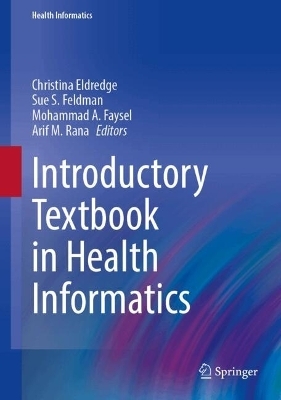
Introductory Textbook in Health Informatics
Springer International Publishing (Verlag)
978-3-032-16656-2 (ISBN)
- Noch nicht erschienen - erscheint am 09.03.2026
- Versandkostenfrei
- Auch auf Rechnung
- Artikel merken
This textbook provides an educational foundation for undergraduate students interested in the field of health informatics and serves as a resource for further study, including future classes and certification exams. The majority of textbooks currently available in this field are targeted toward graduate level students and/or specific subfields of health informatics. This textbook fills a critical gap by offering a comprehensive, accessible resource tailored to baccalaureate students. It also provides instructors with guidance and resources for administering undergraduate level classes that meet foundational domains (and their corresponding knowledge, skills and attitudes) used in the assessment of programs for health informatics undergraduate program accreditation.
Introductory Textbook in Health Informatics has been written by subject matter experts and edited by members of the AMIA Baccalaureate Educational Committee, who have national representation and experience in curriculum development at this level. Additionally, faculty with experience in accreditation and site visits have contributed to the textbook making this a critical addition to the literature for use by undergraduate trainees and program directors within health informatics. It also represents a key foundational text for those taking their Clinical Informatics sub-specialty boards.
Christina Eldredge is the Director of Health Informatics Programs at the University of South Florida (USF) School of Information and holds an adjunct faculty position at USF Health Morsani School of Medicine. Dr. Eldredge received her medical degree at the University of Miami School of Medicine and completed residency training in Family Medicine at the Medical College of Wisconsin (MCW). She began her medical career in the U.S. Navy, serving as a Family Physician, where she utilized early forms of electronic health records (EHRs). During her time in the Navy, Dr. Eldredge developed an interest in the use of EHRs and health information technology to improve quality of care, support clinical research, and enhance population health. After active duty, she returned to MCW to complete a Fellowship in Academic Primary Care Research with an emphasis on Health Informatics and earned a master s degree in Medical Informatics at the Milwaukee School of Engineering and a doctoral degree in Biomedical and Health Informatics at the University of Wisconsin-Milwaukee. Dr. Eldredge is a member of the American Medical Informatics Association and serves as Chair-Elect of the Academic Forum and past Chair of the Academic Forum s Baccalaureate Education Community (BEC). She has also served on the AMIA Education Committee, the CAHIIM BHI Standards Workgroup, and as the Faculty Advisor for the USF Student Health Informatics Club. Dr. Eldredge has presented on Health Informatics nationally at numerous conferences, in addition to authoring journal articles, book chapters, and co-authoring accreditation guidelines. Her research interests include data-driven approaches to improving the management of chronic and life-threatening conditions in community settings, the use of controlled terminology to study adverse events, examining vaccine hesitancy, and addressing health misinformation. Dr. Eldredge also reviews for several journals, conferences, and has served on grant review panels.
Arif M. Rana was faculty of Health Informatics and Information Management SUNY Polytechnic Institute (SUNY Poly). Early in the writing of this book, he passed away very suddenly, and he retains authorship, posthumously.
Sue Feldman, RN, MEd, PhD, FACMI is a professor in the School of Health Professions at the University of Alabama at Birmingham (UAB) with a dual appointment in the Heersink School of Medicine in the Department of Biomedical Informatics and Data Science. She also holds a leadership position in the Center for Addiction and Pain Prevention and Intervention, a University-wide Research Center at UAB. Her research focuses on best practices for health information systems for social good and social protections. During COVID, she led several statewide initiatives resulting in her being awarded the HIMSS 2021 Changemaker in Health Award. Her teaching and research resulted in a recent Mentor of the Year award. Her international and domestic research in health, wellness and social-benefit initiatives has been funded by the World Bank, the Asian Development Bank, the Centers for Disease Control and Prevention, the Centers for Medicare & Medicaid Services, the Department of Labor, and other federal and state agencies, industry partners, and private foundations. Her work in healthcare informatics transcends many domains, contexts, and user types. Dr. Feldman is a Fellow in the American College of Medical Informatics and holds a PhD in Education and a PhD in Information Systems and Technology from Claremont Graduate University in Claremont, CA.
Unit 1: Introduction to the field of Health Informatics.- 1. History of the field (include ONC development), HI vs. HIM.- 2. Careers and professional organizations: Includes how informatics relates to daily lives of health professionals (may be individual health professions).- 3. Foundational domains (brief overview of minimal knowledge areas and multi-disciplinary nature of the field for students with supplemental resources for faculty).- Unit 2: Foundational concepts.- 4. Information science basics (Data, information, knowledge, indexing, information retrieval, mesh terms, etc.).- 5. Computer science basics/review (bits, bytes, hardware, software, networking, ).- 6. Basics of data science.- 7. Decision science.- Unit 3: Clinical and Research Informatics.- 8. EHRs, PHRs, and patient portals.- 9. Imaging informatics (to include radiology and pathology).- 10. Clinical decision support, CDSS, and AI.- 11. Telehealth/digital health.- Unit 4: Public Health Informatics and Population Health.- 12. Public health information systems.- 13. Clinical research informatics.- Unit 5: Biomedical Informatics and Translational Informatics:.- 14. Genomics.- 15. Precision Medicine.- 16. Translational Informatics.- Unit 6: Patient-centered care and patient engagement.- 17. Consumer health applications (mobile health, wearables, etc.).- 18. Human factors/systems thinking.- 19. Patient safety.- Unit 7: Interoperability, standards, and terminologies.- 20. Standards.- 21. Health informatics standard development organizations and standards development.- 22. Interoperability.- 23. Controlled vocabularies/codes/terminologies/UMLS.- Unit 8: Health Information Privacy and security.- 24. Health information Privacy.- 25. Health Information security and threat prevention.- Unit 9: Health Information Administration and Policy.- 26. Project management.- 27. Data governance/legal/ethical aspects.- 28. Data management.- Unit 10: Future directions.- 29. AI/Blockchain- OpenAI (ChatGPT).- 30. Robotics.- 31.Virtual care.
| Erscheint lt. Verlag | 9.3.2026 |
|---|---|
| Reihe/Serie | Health Informatics |
| Zusatzinfo | IV, 380 p. 52 illus., 43 illus. in color. |
| Verlagsort | Cham |
| Sprache | englisch |
| Maße | 178 x 254 mm |
| Themenwelt | Medizin / Pharmazie ► Allgemeines / Lexika |
| Sozialwissenschaften ► Pädagogik | |
| Technik | |
| Schlagworte | Clinical and Research Informatics • Health Informatics • Health Information Administration • health information technology • Medical Informatics • Public Health Informatics |
| ISBN-10 | 3-032-16656-X / 303216656X |
| ISBN-13 | 978-3-032-16656-2 / 9783032166562 |
| Zustand | Neuware |
| Informationen gemäß Produktsicherheitsverordnung (GPSR) | |
| Haben Sie eine Frage zum Produkt? |
aus dem Bereich