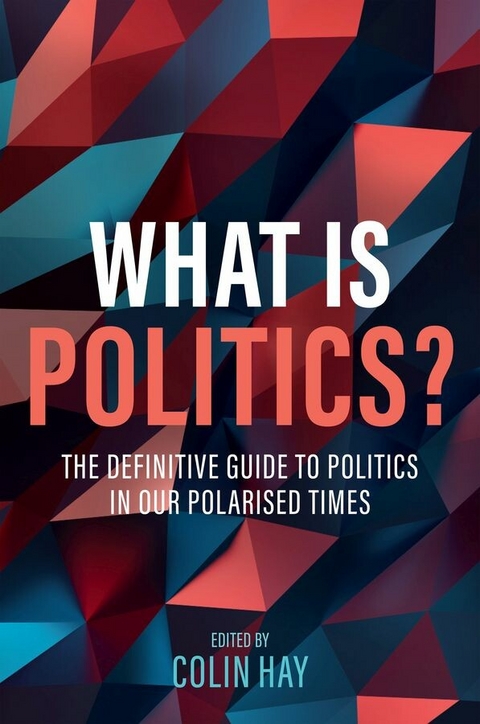
What is Politics? (eBook)
461 Seiten
Polity (Verlag)
978-1-5095-5907-7 (ISBN)
The definitive guide to politics in our polarized times
Politics is everywhere. It touches almost every aspect of our lives. And it is present wherever individuals face collective choices. It is hardly surprising, then, that politics so often divides us, above all in an age in which the collective choices we face seem more daunting and more consequential than they have perhaps ever been.
Exploring what it means to 'think politically' in these troubled times, this cutting-edge textbook reveals the many dimensions of politics. It does so by opening a series of analytic lenses through which we can make sense of politics and its impact upon societies and individuals. Each chapter, written by a leading scholar in the field, encourages us to view politics in a particular way, making a succinct and focused case for the insight this brings to our understanding of political practice, political behaviour, and political outcomes. Among the perspectives considered are politics as power, politics as moral choice, politics as identification, politics as ritual, politics as rhetoric, and politics as crisis management.
Written with the new student in mind, this probing introduction will be essential reading for all those who strive to make sense of politics in today's world.
Colin Hay is Professor of Political Science at Sciences Po, Paris, and founding Director of the Sheffield Political Economy Research Institute (SPERI) at the University of Sheffield.
The definitive guide to politics in our polarized times Politics is everywhere. It touches almost every aspect of our lives. And it is present wherever individuals face collective choices. It is hardly surprising, then, that politics so often divides us, above all in an age in which the collective choices we face seem more daunting and more consequential than they have perhaps ever been.Exploring what it means to 'think politically' in these troubled times, this cutting-edge textbook reveals the many dimensions of politics. It does so by opening a series of analytic lenses through which we can make sense of politics and its impact upon societies and individuals. Each chapter, written by a leading scholar in the field, encourages us to view politics in a particular way, making a succinct and focused case for the insight this brings to our understanding of political practice, political behaviour, and political outcomes. Among the perspectives considered are politics as power, politics as moral choice, politics as identification, politics as ritual, politics as rhetoric, and politics as crisis management.Written with the new student in mind, this probing introduction will be essential reading for all those who strive to make sense of politics in today's world.
1
What is politics?
Colin Hay
Introduction
Politics is something done, sometimes by us, more often than not by others, for us, in our name (if not necessarily for us), to us, even against us. When practised by others, it is often, if not invariably, tolerated, but rarely admired. It prompts a range of emotions: anger, fear, frustration, irritation, contempt, and, if perhaps more rarely, appreciation, empathy, elation, enthusiasm, and a sense of achievement. It is consequential. It makes the world different and without it we lack the capacity to make the world differently. The stakes are exceptionally high, existentially high.
It is not surprising, then, that it tends to divide us. We have different stakes in the consequences to which it gives rise and different views as to what constitutes a stake, let alone a legitimate stake, in those consequences. Indeed, we could even define politics as the means that societies (and groups within them) use to resolve (however temporarily) issues in which their members have or perceive themselves to have different stakes. And, understood in such terms, it often fails. Indeed, it seems to fail more often than not and perhaps more often than it used to.
One can tell a great deal about the times in which one lives from the popular associations and connotations of the word ‘politics’. If so, there is much that might concern us today. Until recently, it was still just about credible to suggest that whilst politics has never been much admired as a practice, a pursuit, or, worse still, a career, contemporary levels of political disaffection are not historically unprecedented. That was then … No-one is making that argument today. We seem to have entered a qualitatively new condition of political despair.
Politics, quite simply, is loathed; politicians are despised; and, should we have the good fortune to live in what we still regard as a democracy, those we elect to govern on our behalf have never had to do so in such a low-trust environment.
That is already bad enough. Yet it is made far worse by the troubled times in which we live. In the period following the global financial crisis and Covid, the challenges we face, both domestically and at a planetary level, have never been so threatening. They are both largely of our own making and, arguably for the first time in human history, of a truly existential kind. As that suggests, now might not seem like the best of times to have fallen out of love with politics so badly. For the stakes of our politics have never been higher. Yet confidence in our collective capacity to forge political solutions to even the most trivial of problems has never been lower.
Politics in troubled times
It might seem odd to begin the introduction to a collection entitled What is Politics? with quite such a morbid characterization of our troubled present. For what, you might ask, has any of this to do with the definition of this sometimes elusive concept?
A little more than one might imagine, I want to suggest.
Indeed, the above reflections are suggestive of at least two of the central themes of this book. The first comes from noting that they tend to prejudge in effect the central question that this collection poses by presuming a certain understanding (a definition, even) of politics. That understanding, crucially, is a lay understanding – arguably the predominant lay understanding of politics. The above paragraphs proceed, at least implicitly, from the very simple and no doubt familiar understanding of politics as what politicians do (see also Leftwich, 1984). Second, and perhaps more intriguingly still, that simple and intuitively appealing definition of politics is not one that is defended in any of the twelve chapters that follow. And that suggests that political analysts tend to view politics differently from citizens.
That they might do so seems, on the face of it, perplexing, even perhaps strangely perverse. And it is certainly important to be clear here. None of the chapters that follow, nor indeed this introduction, is suggesting that what politicians do is not politics. But one of the consistent messages of this collection is that politics is not just what politicians do, but potentially quite a lot besides. That is important because it leads to a rather different assessment of politics and, above all, its capacity to respond to the challenges we face today.
It is perhaps just a little too trite to suggest that if politics were nothing more than what politicians do, then we would indeed be doomed. But that certainly captures at least part of this. For if political analysts see in politics (as they understand it) at least a potential for the forging of solutions to problems that citizens seem increasingly sceptical of, it is not so much because they have a different assessment of the capacity, conduct, and competence of actually existing political elites but because they typically have in mind a rather broader understanding of politics itself.
Indeed, for almost all contemporary political analysts, politics is the necessary (if never in itself sufficient) condition of any solution to a common or collective challenge – such as is posed in a potentially existential way by the global climatic and environmental emergencies we face. If solutions are to be found, they have to be made. That process of ‘making’ is politics. This does not make political analysts any less sanguine than citizens about the prospects of actually existing politicians fashioning credible solutions to the problems we face. But it does make them rather more reluctant to give up on the very possibility of political solutions. For all solutions – or at least all that do not rely on fate or divine intervention – are political (see also Gamble, 2000).
The meaning of politics
After all of that, it might seem just a little prosaic to turn to the question of definition. But it is important nonetheless, as the preceding paragraphs have hopefully already served to suggest.
It is certainly tempting, above all in a collection like this posing the seemingly simple (and certainly singular) question ‘what is politics?’, to leave the definitions to others – notably those whose chapters follow. Indeed, anything else might be seen to abuse the privilege of editorship by imposing, in effect, a common definitional standard on those who might feel obliged to follow.
But that would be to misunderstand a little both the purpose of this collection and the content of the chapters to come. For as a collection its aim is at least subtly different from that of the two previous editions of this famous and venerable text (a text on which a whole generation of political analysts, including myself as a student, was raised).
Rereading the introductory essays to the first and second editions of What is Politics? penned by Adrian Leftwich in 1984 and 2004, respectively, it is clear that each chapter of each edition was chosen by the book’s founding editor to provide an introduction to a particular approach to political analysis proceeding from a different understanding – or definition – of politics. That is not how the following chapters have been selected. Each does indeed present a different and (more or less) distinct approach to political analysis, but not necessarily one predicated on a different definition of politics itself. Indeed, what is perhaps remarkable here is that although the range and diversity of the approaches to political analysis set out in the following chapters are greater than in either of the previous editions, the authors typically build the distinctiveness of the approach they present on common definitional foundations. In a discipline that is arguably more divided analytically than ever, and certainly more divided than it was in either 1984 or 2004, it would appear as if we have found some common ground at least in our understanding of our subject matter.
Adrian Leftwich would no doubt be pleased, not least as the common ground that I refer to here is close to that set out in his own substantive chapter back in the first edition (Leftwich, 1984). Perhaps more importantly still, it is credible to think that the greater reflexivity on the concept of the political that his book inspired has been a not insignificant factor in the identification of that common ground.
As that in turn suggests, editing What is Politics? today is a rather different task than it was when the project was first conceived, at least in part because the discipline – and the world to which it addresses itself – has moved on. The task that, as editor, I gave to each chapter author was not to propose an alternative definition of politics but to present and to make the case for seeing what might be called the ‘stuff’ of politics differently and, in so doing, to introduce a distinct perspective on politics, a distinct approach to political analysis.
Intriguingly, although these perspectives view politics and the political differently, revealing and illuminating different aspects of the stuff of politics in the process, they typically do not rely on distinct definitions or understandings of politics or the political. Indeed, the diverse array of approaches to political analysis that they present are invariably compatible with a range of rather different (albeit relatively general and inclusive) definitions of politics. And precisely because they are, this introductory chapter needs to address rather more directly than...
| Erscheint lt. Verlag | 2.12.2025 |
|---|---|
| Sprache | englisch |
| Themenwelt | Sozialwissenschaften ► Politik / Verwaltung ► Allgemeines / Lexika |
| Schlagworte | andrew heywood • Elections • Political Analysis • political methods • Political Opinion • Political parties • political theory • Politics • politics primer • Populism • Voting • what is politics? the best introduction to politics |
| ISBN-10 | 1-5095-5907-8 / 1509559078 |
| ISBN-13 | 978-1-5095-5907-7 / 9781509559077 |
| Informationen gemäß Produktsicherheitsverordnung (GPSR) | |
| Haben Sie eine Frage zum Produkt? |
 EPUB (Adobe DRM)
Kopierschutz: Adobe-DRM
Adobe-DRM ist ein Kopierschutz, der das eBook vor Mißbrauch schützen soll. Dabei wird das eBook bereits beim Download auf Ihre persönliche Adobe-ID autorisiert. Lesen können Sie das eBook dann nur auf den Geräten, welche ebenfalls auf Ihre Adobe-ID registriert sind.
Details zum Adobe-DRM
Dateiformat: EPUB (Electronic Publication)
EPUB ist ein offener Standard für eBooks und eignet sich besonders zur Darstellung von Belletristik und Sachbüchern. Der Fließtext wird dynamisch an die Display- und Schriftgröße angepasst. Auch für mobile Lesegeräte ist EPUB daher gut geeignet.
Systemvoraussetzungen:
PC/Mac: Mit einem PC oder Mac können Sie dieses eBook lesen. Sie benötigen eine
eReader: Dieses eBook kann mit (fast) allen eBook-Readern gelesen werden. Mit dem amazon-Kindle ist es aber nicht kompatibel.
Smartphone/Tablet: Egal ob Apple oder Android, dieses eBook können Sie lesen. Sie benötigen eine
Geräteliste und zusätzliche Hinweise
Buying eBooks from abroad
For tax law reasons we can sell eBooks just within Germany and Switzerland. Regrettably we cannot fulfill eBook-orders from other countries.
aus dem Bereich