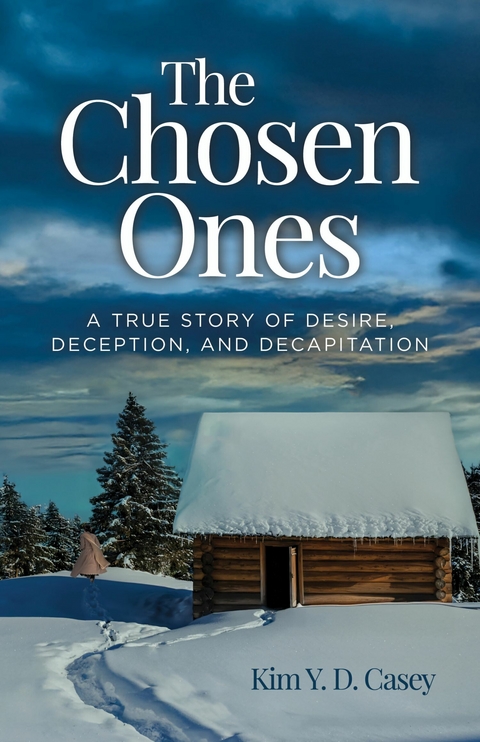
Chosen Ones A True Story of Desire, Deception, and Decapitation (eBook)
237 Seiten
Bookbaby (Verlag)
979-8-3178-2614-7 (ISBN)
Kim Casey has lived in Northern Ontario all of her life. She is a graduate of Confederation College and Lakehead University. Kim worked in the helping profession for several years before becoming a bestselling author.
Margaret Ellen Slack was accused of killing her husband, Thomas Blakely Carrothers. Newspapers throughout the country could not get enough of the scandalous story. They all reported that William Fotheringham, a young entrepreneur and close friend of the couple, had been Margaret Ellen's lover. This book delves into the lives of these three individuals and the events that led to their downfall.
Chapter One – Westminster Township
“And have no fellowship with the unfruitful works of darkness, but rather reprove them.”
(King James Bible, EPHESIANS 5:11)
County of Middlesex approximately 1880. Burland Lithographic Co. (lithographer), Burland Lithographic Co. (publisher). Object Number 912-71325-B79-SMALL. Courtesy of Toronto Public Library.
Thomas Blakely Carrothers Was Born In Westminster, Ontario, one of the largest townships in the County of Middlesex. Its boundaries were the Thames River on the north, Elgin County to the south, North Dorchester Township on the east, and west was Delaware.1 ‘“The settlers, both men and women, were strong and hardy; in fact, only the young and robust left the Old Land for the wilds of Canada.”’2 One of the first things they did was form logging bees, where groups of men would cut down ten acres or more of trees daily. And this would go on for about six weeks in the spring. “‘There were great races at these bees, and the men would sometimes get rather hot over them, but at night all would part good-naturedly.’”3 The settlers built their own dwellings, which were small log cabins ‘“covered with bark, clapboards or troughs and plenty of them had no floors.”’4 They also made their clothing. The linen came from the flax they grew on their farms. ‘“For the woollens, great flocks of sheep were kept, and their wool put through many changes, before the warm blankets or fullcoth were made.”’5
Archibald McMillan was the first to live in Westminster; he arrived before 1810. Seven years later, the population had grown to 428. They had 107 houses, two schools, one gristmill, and one sawmill. The first township meeting took place at McMillan’s tavern. In 1850, there were 4,525 people residing in Westminster. They had three gristmills, two carding machines, one fulling mill, and many schools.6
Thomas Blakely was born in 1860, and by this time, 6,285 people were residing in Westminster. According to the census report, 4,014 of them had been born in Canada. The origins of the rest were listed as United Kingdom 1907; United States 298; Coloured persons 60; Atlantic provinces 33; Prussia, German States and Holland 15; Indians 6; East and West Indies 4; Guernsey, Jersey and other British Islands 3; Spain and Portugal 2; At Sea 2; Not Known 2; and Switzerland 1.7 When it came to their religious affiliations, most of the Westminster citizens were either Presbyterian, Methodist or Anglican.8
The settlers’ presence in Westminster and the surrounding area devastated the First Nations people. Unable to lead their traditional way of life, they were placed on reserves in Caradoc and Delaware. The authorities claimed there were two reasons why the First Nations people had been forced off their land. One, they were not smart enough to understand its true worth. Two, the First Nations people had no real connection to the land because it was nothing more than “a camping-place for the itinerant red-man. He came here at intervals to take what the river, ponds and streams offered of the finny tribe; or the forest of game; or the soil of wild fruits or herbs.”9 The settlers believed they were the rightful owners of the land because they lived on it year-round and had transformed it into profitable farms. “Throughout the Province there cannot be found a more beautiful township, nor one where wealth and happiness are more equally distributed.”10 But nowhere in the settlers’ historical documents was there any formal acknowledgment that before their arrival, the First Nations people lived full and productive lives that did not involve clear-cutting the forests and wiping out the wildlife.
Thomas Blakely’s Father, Thomas Senior, Was born in Farnaght, County Fermanagh, Northern Ireland. He had eight siblings: Paul, Tirzah, Jane, Joseph, Elizabeth, William Junior, Samuel, and Nathaniel. Their parents, William Senior and Elizabeth, leased a “modestly comfortable” farm.11 William Junior married Elizabeth Graham in 1835, and they took over the Carrothers’ farm. That same year, Thomas Senior and his brother Nathaniel immigrated to Canada. They bought 200 acres of land in Derwent, Westminster.12 Nathaniel started working as a carpenter in London, Ontario. The following year, he married Margaret Kirkpatrick. Shortly later, Thomas Senior’s brother, Samuel, and five cousins immigrated to Canada. These new arrivals purchased 300 acres of prime land.
In 1843, at the age of thirty-three, Thomas Senior married Clarinda June Slack. The ceremony took place in the nearby town of St. Marys. She was also an immigrant. That same year, Clarinda June gave birth to their first son, Ephraim. They had fourteen more children: James, Rachel, Margaret, Maria, Mary Ann, Catherine, Ephraim, Emma, Elizabeth, William, Clarinda, Thomas Blakely, Mary Ann, and Eldon. Three of them died before reaching adulthood. Clarinda June passed away in 1864. She was about forty years old. Clarinda June was buried at Pond Mills Cemetery.
Thomas Carrothers Senior. Photo credit: Pat Carrothers Weber, Thomas Carrothers Senior's Great-Great-Granddaughter.
A year later, Thomas Senior married Mary Elizabeth Elliott, a forty-four-year-old spinster. Her parents, Ninian and Agnes, were born in Castleton, Roxburghshire, Scotland. They married in 1815 and then immigrated to Canada. On October 4, 1817, Ninian acquired a hundred acres in Westminster. Sixteen years later, he obtained a patent for the land and purchased an additional fifty acres.13 Agnes gave birth to ten children; their eldest daughter, Janet, married Samuel Carrothers, Thomas Senior’s brother. In 1866, Mary and Thomas Senior had a daughter, Agnes Helen (Lena) Carrothers. Right around this time, Thomas Senior’s brother Nathaniel had written a letter to the family back in Ireland, and instead of referring to Mary by her name, he called his new sister-in-law the Scotch woman.14
On June 12, 1847, Thomas Senior’s brother Joseph Carrothers and his family boarded the Marchioness of Evercorn in Derry, Ireland. Thomas Senior’s second-oldest sister, Jane, was also on the ship bound for Canada. The following day was Sunday, and like all faithful Christians, the Carrothers family was looking forward to a day of solemn worship. The ship was still at the dock, and with the captain nowhere to be found, many of the passengers began drinking. Joseph later wrote in a letter to his brother William Junior, “I have seen a Sabbath Day past such as I never expected to see and I pray God send us better ones…”15 But not all was lost; at noon, some of the passengers assembled on the deck and began singing hymns.
The voyage was long and demanding. Joseph suffered from seasickness the entire time. His youngest son, James, was the most resilient, and the rest of the Carrothers family were “worn to perfect weakness.”16 They arrived in Canada three weeks later, and Jane died outside of Montreal. But their ordeal was far from over, as the next portion of their journey involved taking boats and wagons. According to Joseph, this was even more challenging than crossing the ocean. Eight days later, he and his family arrived in Westminster. The Carrothers clan warmly greeted them. And just when Joseph thought the worst was over, his ten-year-old daughter Margaret died from exhaustion.
Thomas Senior gave a small portion of his land on Lot 7, Concession 4, to his older brother, Joseph. Two years later, on March 26, the generous man obtained a patent for his hundred acres. In December 1851, Westminster had three days of extreme cold. This trend continued into the new year, with four days in January and three in February when the settlers experienced an unusual drop in temperature.17 In 1853, people began buying Westminster’s land because its value was increasing. Many took out loans with interest rates ranging from twenty to thirty percent. Three years later, the economy took a turn for the worse, and the land value dropped. Many of the speculators were unable to repay their loans and went bankrupt. Fortunately, Thomas Senior and his relatives did not participate in these get-rich schemes, and they all continued to thrive.
By 1860, the Carrothers clan owned over 1,200 acres of land. “These settlers from Northern Ireland cleared and improved their forests farms and took a leading part in building churches, schools, roads and other community projects.”18 They constructed a trail through a swamp that came to be known as Dingman Road. The Carrothers were strong supporters of the conservative party, and it was estimated that they made up a third of Westminster’s voters.19 They were also well-known for their horticultural skills. It was a tradition that the Carrothers had brought with them from their ancestral home in Ireland. “The farm at Farnaght, however, was special as a repository of species with medicinal value and a mecca for medics employing herbal remedies.”20 The Carrothers’ farms in Westminster were close to each other, and they all had fruit trees and large vegetable gardens. They also cultivated ornamental gardens featuring...
| Erscheint lt. Verlag | 27.11.2025 |
|---|---|
| Sprache | englisch |
| Themenwelt | Sozialwissenschaften ► Politik / Verwaltung |
| ISBN-13 | 979-8-3178-2614-7 / 9798317826147 |
| Informationen gemäß Produktsicherheitsverordnung (GPSR) | |
| Haben Sie eine Frage zum Produkt? |
 EPUB (Adobe DRM)
Kopierschutz: Adobe-DRM
Adobe-DRM ist ein Kopierschutz, der das eBook vor Mißbrauch schützen soll. Dabei wird das eBook bereits beim Download auf Ihre persönliche Adobe-ID autorisiert. Lesen können Sie das eBook dann nur auf den Geräten, welche ebenfalls auf Ihre Adobe-ID registriert sind.
Details zum Adobe-DRM
Dateiformat: EPUB (Electronic Publication)
EPUB ist ein offener Standard für eBooks und eignet sich besonders zur Darstellung von Belletristik und Sachbüchern. Der Fließtext wird dynamisch an die Display- und Schriftgröße angepasst. Auch für mobile Lesegeräte ist EPUB daher gut geeignet.
Systemvoraussetzungen:
PC/Mac: Mit einem PC oder Mac können Sie dieses eBook lesen. Sie benötigen eine
eReader: Dieses eBook kann mit (fast) allen eBook-Readern gelesen werden. Mit dem amazon-Kindle ist es aber nicht kompatibel.
Smartphone/Tablet: Egal ob Apple oder Android, dieses eBook können Sie lesen. Sie benötigen eine
Geräteliste und zusätzliche Hinweise
Buying eBooks from abroad
For tax law reasons we can sell eBooks just within Germany and Switzerland. Regrettably we cannot fulfill eBook-orders from other countries.
aus dem Bereich