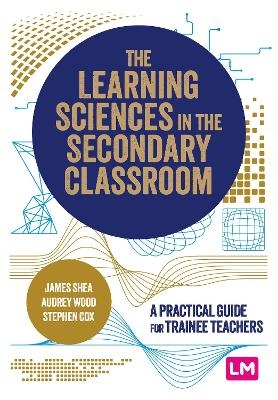
The Learning Sciences in the Secondary Classroom
SAGE Publications Ltd (Verlag)
978-1-5296-8749-1 (ISBN)
- Noch nicht erschienen (ca. Juni 2026)
- Versandkostenfrei
- Auch auf Rechnung
- Artikel merken
How do teachers use the Learning Sciences in secondary classrooms to deliver the curriculum, every day? The real art and science of teaching is in the synthesising of pedagogical knowledge and the application of that in your classroom, in your curriculum subject, everyday. This book supports new teachers to build the skills to do this and enables them to approach teaching with confidence and expertise.
*Practical guidance on applying the Learning Sciences to planning and teaching.
*Real life examples of how learning sciences have featured in effective teaching in schools.
*Guidance for new teachers on how to use research informed data collection methods to implement and evaluate teaching approaches.
*Essential knowledge on the Learning Sciences.
*Linked to the Initial Teacher Training Early Career Framework (ITTECF).
Dr James Shea is Principal Lecturer and the Initial Teacher Education Portfolio Leader at the University of Bedfordshire, overseeing all undergraduate and postgraduate teacher education programs. His primary focus is on educating teachers and collaborating with partnership schools through research and teacher education. He is a highly awarded academic whose research expertise covers key areas in cognitive science, including retrieval practice and the use of cognitive load theory in teaching, as well as GCSE student revision strategies. Dr. Audrey Wood is Senior Lecturer in Teacher Education and the course leader for post graduate secondary teacher education at the University of Bedfordshire. Her expertise is built on fifteen years of teaching secondary English in comprehensive schools, before moving into Initial Teacher Education (ITE) at the University of Huddersfield, where she led the Secondary English PGCE and managed various employment-based ITE courses. Stephen Cox is Lecturer in Education (Science) and the PGCE Secondary Science Lead Mentor at the University of Bedfordshire. He is a highly experienced educator, having spent 15 years as a Science and Drama teacher, covering Biology, Chemistry, Physics, and Applied Science across all secondary key stages. His dual background—with a science specialism in Biology (ecology) and a drama focus on physical theatre—provides him with a unique and valuable pedagogical perspective.
Part I
1.Introduction - Using the learning sciences in your teaching
2.The rise of the learning sciences in teaching
3.3.The learning sciences – blended or isolated in the classroom today?
Part II – The Learning Sciences
4.Behaviourism
5.Cognitivism
6.Constructivism
7.Connectivism
Part III – The art of planning and teaching with learning sciences
8.Synthesising the learning sciences in the classroom and beyond as teachers
9.How the learning sciences influence curriculum design and sequencing
10.Adaptations of planning to diverse learner needs
11.How learning sciences affect assessment design and preparation for assessment
Part IV – The future of learning sciences
12.Reflections and speculation on the future of learning sciences in teaching
| Erscheint lt. Verlag | 13.6.2026 |
|---|---|
| Verlagsort | London |
| Sprache | englisch |
| Maße | 171 x 246 mm |
| Themenwelt | Sozialwissenschaften ► Pädagogik ► Schulpädagogik / Sekundarstufe I+II |
| ISBN-10 | 1-5296-8749-7 / 1529687497 |
| ISBN-13 | 978-1-5296-8749-1 / 9781529687491 |
| Zustand | Neuware |
| Informationen gemäß Produktsicherheitsverordnung (GPSR) | |
| Haben Sie eine Frage zum Produkt? |
aus dem Bereich