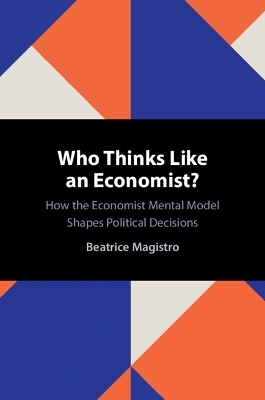
Who Thinks Like an Economist?
Cambridge University Press (Verlag)
978-1-009-76364-6 (ISBN)
- Noch nicht erschienen (ca. Juni 2026)
- Versandkostenfrei
- Auch auf Rechnung
- Artikel merken
Recent populist waves raise crucial questions about why economically harmful policies such as tariffs, Brexit, or immigration restrictions gain popular support. Conventional explanations focus on economic self-interest or cultural values; however, Beatrice Magistro's Who Thinks Like an Economist argues that the puzzle lies in how voters think. She introduces the innovative Economist Mental Model (EMM), which predicts attitudes toward trade, immigration, AI, and more. She explains that those adopting the Economist Mental Model are more likely to favor welfare-enhancing policies and prioritize cost-benefit information over partisan cues, while individuals with Alternative Mental Models (AMMs) show limited responsiveness to economic information and tend to support policies promising short-term relief at the expense of long-term welfare. Drawing on surveys and experiments in Italy, the UK, and the U.S., Magistro offers an indispensable guide for scholars and policymakers seeking to understand—and counter— the appeal of populist policies that ultimately harm society.
Beatrice Magistro is an Assistant Professor of AI Governance at Northeastern University. She studies political behavior and political economy, focusing on how individuals respond to socio-economic shocks. She published extensively on these topics. She has held positions at Caltech and the University of Toronto and earned her Ph.D. from the University of Washington.
1. Introduction; 2. What does it mean to think like an economist? A theoretical framework; 3. How do we measure who thinks like an economist?; 4. Thinking like an economist and brexit; 5. Attitudes toward globalization, intertemporal trade-offs, and time preferences: insights from Italy; 6. Thinking like an economist and time preferences: becoming patient; 7. Economic thinking and the rejection of zero-sum views; 8. Thinking like an economist and attitudes toward globalization in the US: reconciling aggregate gains and distributional consequences; 9. Decoding policy choices: how thinking like an economist shapes information processing; 10. Thinking like an economist and views toward artificial intelligence (AI); Conclusion; Appendix A-G; References; Index.
| Erscheint lt. Verlag | 30.6.2026 |
|---|---|
| Zusatzinfo | Worked examples or Exercises |
| Verlagsort | Cambridge |
| Sprache | englisch |
| Gewicht | 250 g |
| Themenwelt | Sozialwissenschaften ► Politik / Verwaltung ► Vergleichende Politikwissenschaften |
| Wirtschaft ► Volkswirtschaftslehre ► Wirtschaftspolitik | |
| ISBN-10 | 1-009-76364-4 / 1009763644 |
| ISBN-13 | 978-1-009-76364-6 / 9781009763646 |
| Zustand | Neuware |
| Informationen gemäß Produktsicherheitsverordnung (GPSR) | |
| Haben Sie eine Frage zum Produkt? |
aus dem Bereich