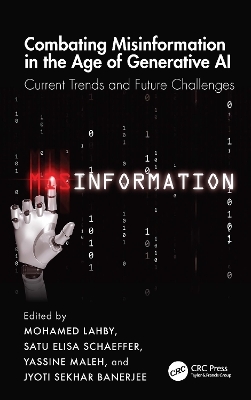
Combating Misinformation in the Age of Generative AI
CRC Press (Verlag)
978-1-041-04040-8 (ISBN)
- Noch nicht erschienen (ca. Juni 2026)
- Versandkostenfrei
- Auch auf Rechnung
- Artikel merken
The rapid advancement of Generative AI (GenAI) is revolutionizing and transforming a wide range of fields, with a notable impact on digital media and information dissemination. Digital platforms, including social media networks, have already grappled with the widespread proliferation of fake news at an increasing intensity are now facing an even bigger threat from machine-generated and machine-boosted fake news. With the increasing growth and sophistication of GenAI models for malicious ends, fake news is spreading rapidly, finding a fertile ground in digital media for largely unchecked dissemination of incorrect and misleading information. The scalability and diversity of current and emerging GenAI techniques present both opportunities and challenges in the field of fake news. On one hand, the ability to create highly realistic and persuasive content in large quantities with minimal effort, in real-time, makes GenAI a potent tool for spreading fake news and misinformation. On the other hand, those same capabilities can be harnessed to employ GenAI models to detect fake news and therefore hinder the spread. In this context, this book examines how GenAI techniques are contributing to combat fake news in digital media. A particular major challenge in combating fake news with GenAI is the explainability of the models: why a specific piece of news is determined to be fake or genuine. Tracing the origins of a specific piece of generated content—whether it stems from accurate or misleading data—requires extracting, interpreting, and representing in a legible manner vast parameter spaces and training data sources. This complexity of GenAI explainability makes it difficult to hold creators of fake news accountable and to ensure transparency in the content creation process. In this book, the authors focus on the positive potential of Generative AI and provide an overview of how it can be leveraged to combat fake news across diverse digital media platforms.
The book is structured around the following key topics:
• An overview of Generative AI and its relationship with fake news
• How Generative AI can be utilized to fight the spread of fake news
• Ensuring that the news we encounter on digital media platforms are not misleading or false
• Methods for verifying the authenticity of news sources and tracing the origins of information to ensure its credibility
• Practical insights into technological advancements and solutions related to the detection and analysis of fake news.
Finally, this book serves as a platform for the community to share innovative research on the use of Generative AI in detecting and mitigating the impact of false information across digital platforms. Readers will explore how Generative AI can revolutionize fact-checking, automate the identification of misleading content, and provide adaptive solutions to prevent the spread of fake news.
Prof. Mohamed Lahby (ORCID: https://orcid.org/0000-0002-8272-0487) is an Associate Professor at the Higher Normal School (ENS), University Hassan II of Casablanca, Morocco. He is also the Director of the Mathematics, Artificial Intelligence, and Digital Learning Laboratory (MIND-LAB). Since 2022, he has been recognized as a Senior Member of the IEEE. Prof. Lahby obtained his PhD in Computer Science in 2013 from the Faculty of Sciences and Technology of Mohammedia, University Hassan II of Casablanca. His research interests include wireless communication and networking, mobility management, QoS/QoE, the Internet of Things, smart cities, optimization, and machine learning. He has authored or co-authored more than 80 publications and has edited 15 books. He has actively participated in numerous international conferences and serves as a reviewer for several journals, including Ad Hoc Networks, Applied Computing and Informatics, and the International Journal of Disaster Risk Reduction. Prof. Lahby has also chaired several international workshops and special sessions, such as MLNGSN’19, CSPSC’19, MLNGSN’20, MLNGSN’21, AI2SC’20, WCTCP’20, CIOT’22, ISGTA’23, and ISGAIE’2025. Prof. Elisa Schaeffer is an Associate Professor of Applied Digital Intelligence at the School of Continuing Studies of McGill University in Canada. She has a keen interest in computational intelligence, and her research explores potential applications of graph theory and machine learning on topics from areas such as social sciences, medicine, economics, and forestry. She is passionate about digital learning, real-time and asynchronous, and an early adopter of emerging software and hardware solutions to facilitate teaching and research, especially open-source solutions. Prof. Yassine Maleh is an Associate Professor of Cybersecurity and IT Governance at Sultan Moulay Slimane University, Morocco. He is the founding chair of IEEE Consultant Network Morocco and founding president of the African Research Center of Information Technology & Cybersecurity. He is a senior member of IEEE and a member of the International Association of Engineers IAENG and The Machine Intelligence Research Labs. Dr Maleh has made contributions in the fields of information security and privacy, Internet of things security, wireless and constrained networks security. His research interests include information security and privacy, Internet of things, networks security, information system, and IT governance. He has published over than 140 papers (book chapters, international journals, and conferences/workshops), 30 edited books, and 5 authored books. He is the editor-in-chief of the International Journal of Information Security and Privacy (IJISP), and the International Journal of Smart Security Technologies (IJSST). He serves as an associate editor for IEEE Access (2019 Impact Factor 4.098), the International Journal of Digital Crime and Forensics (IJDCF), and the International Journal of Information Security and Privacy (IJISP). He is a series editor of Advances in Cybersecurity Management, by CRC Taylor & Francis. He was also a guest editor of many special issues in IEEE Transactions on industrial informatics, IEEE Engineering Management Review, Big Data Journal, Sensors, etc.... He has served and continues to serve on executive and technical program committees and as a reviewer of numerous international conferences and journals such as Elsevier Ad Hoc Networks, IEEE Network Magazine, IEEE Sensor Journal, ICT Express, and Springer Cluster Computing. He was the Publicity chair of BCCA 2019 and the General Chair of the MLBDACP 19 symposium and ICI2C’21 Conference. He received Publons Top 1% reviewer award for 2018 and 2019. Dr. Jyoti Sekhar Banerjee, B.Tech, M.E, Ph.D. (Engg.), is currently serving as the Head of the Department in the Computer Science and Engineering (AI & ML) Department at the Bengal Institute of Technology, Kolkata, India and visiting researcher (Post Doc) at Nottingham Trent University, UK. Additionally, He is also the Professor-in-Charge, R & D and Consultancy Cell of BIT. He has teaching and research experience spanning 18 years and completed one IEI funded project. He is a member of the CSI, IEEE, ISTE, IEI, ISOC, IAENG and fellow of IETE. He is the present honorary Secretary-cum-Treasurer, of the ISTE WB Section. He is the current honorary Secretary of the Computer Society of India, Kolkata Chapter. He is also the Executive Committee Member of the IETE, Kolkata Centre. He has published over fifty-five papers in various international journals, conference proceedings, and book chapters. He is the lead author of “A Text Book on Mastering Digital Electronics: Principle, Devices, and Applications”. He has also co-authored another book and is currently processing six edited books in reputed international publishers like Springer, CRC Press, De Gruyter, etc. Presently he is also processing two more textbooks; those are now in press. His areas of research interests include Computational Intelligence, Cognitive Radio, Sensor Networks, AI/ML, Network Security, Different Computing Techniques, IoT, WBAN (e-healthcare), Expert Systems.
Part I. Misinformation in the Age of GenAI: State-of-the-Art. Chapter 1 Social Awareness, Disinformation, and Reputational Management in the Age of Artificial Intelligence. Chapter 2 Aligning Generative AI with Educational Values: An Ethical Response to Digital Misinformation. Part II. Large Language Models (LLMS) for Misinformation Detection. Chapter 3 AI-Driven Threats and Countermeasures: Securing the Information Space Against Synthetic Media and Deepfakes. Chapter 4 Zero Trust Architectures and Cybersecurity Frameworks for Mitigating AI-Enabled Misinformation Campaigns. Chapter 5 Decentralizing Truth: A Blockchain-Based Framework for Trustworthy Information in the GenAI Era. Chapter 6 An AI-Augmented Human-in-the-Loop (HITL) Approach for Misinformation Prevention in the Digital Age. Part III. Case Studies and Practical Solutions. Chapter 7 Factors Influencing Misinformation in the Context of GenAI: The Case of Vietnam. Chapter 8 Analysis for Usage of ChatGPT by Students in Academic Contexts. Chapter 9 Mapping the Economics of Water Misinformation in the Generative AI–Driven Era: Modeling Insights on Education, Policy, and Smart Detection. Chapter 10 Quantifying the Economic Implications of AI-Driven Misinformation: Evidence from ESG, Global Trade, Logistics, Education, and Innovation for Sustainable Development. Part IV. Ethical Challenges and Future Trends. Chapter 11 Role of Data Protection Law in Combating Generative AI Misinformation: A Visible Threat to Privacy. Chapter 12 Emerging Trends and Challenges in Generative Artificial Intelligence (GenAI) and Misinformation: HR Perspectives. Chapter 13 Future Trends in AI-Driven Misinformation Detection and Prevention.
| Erscheint lt. Verlag | 30.6.2026 |
|---|---|
| Zusatzinfo | 46 Tables, black and white; 33 Line drawings, black and white; 2 Halftones, black and white; 35 Illustrations, black and white |
| Verlagsort | London |
| Sprache | englisch |
| Maße | 156 x 234 mm |
| Themenwelt | Informatik ► Theorie / Studium ► Künstliche Intelligenz / Robotik |
| Sozialwissenschaften ► Kommunikation / Medien ► Kommunikationswissenschaft | |
| ISBN-10 | 1-041-04040-7 / 1041040407 |
| ISBN-13 | 978-1-041-04040-8 / 9781041040408 |
| Zustand | Neuware |
| Informationen gemäß Produktsicherheitsverordnung (GPSR) | |
| Haben Sie eine Frage zum Produkt? |
aus dem Bereich