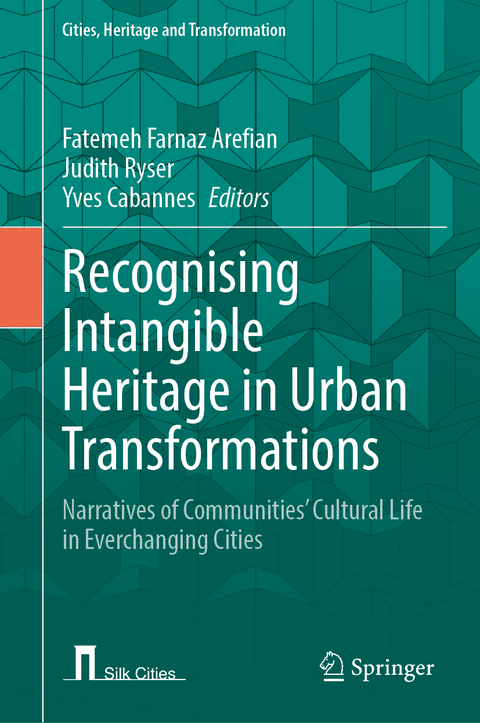
Recognising Intangible Heritage in Urban Transformations
Springer International Publishing (Verlag)
978-3-032-16140-6 (ISBN)
- Noch nicht erschienen - erscheint am 07.04.2026
- Versandkostenfrei
- Auch auf Rechnung
- Artikel merken
The notion of intangible heritage as a key urban element is underexplored, yet inherently intertwined with urban life that can influence and be influenced by urban policies and practices. This book undertakes the fundamentally interdisciplinary tasks of conceptualizing intangible heritage and recognizing communities' roles as its stewards.
From celebration of new years to cultural expressions in daily life, such as religious practices, music and food, intangible heritage is an integral part of communities and individual lives, often considered a natural extension of their being . Cultural practices are intertwined with human existence. Traditions and cultural expressions do not happen in isolation; they are conditioned by socio-cultural and urban spatiality.
The book offers compelling narratives, explorations, and testimonies on the intangible nature of heritage, and it highlights the challenge of the invisibility of heritage in urban discussions. This volume unpacks links between space, community, and heritage and interconnections between cities, urban characteristics, and the intangible heritage of communities in both normal and disastrous contexts. Contributions offer innovative and exploratory methods and representations of under-explored cases, balancing practical strategies and policy-oriented approaches with storytelling and experiential components.
Dr Fatemeh Farnaz Arefian Farnaz is the founder of Silk Cities (www.silk-cities.org) and honorary research fellow at University College London (UCL), UK. She has an interdisciplinary background in Development Planning, Urban Design and Architecture. Her research and professional activities focus on identifying and investigating under-explored complex matters which nevertheless cities and communities deal with in real-world either in normal or disastrous situations in historic and contemporary contexts.
Emeritus Prof. Yves Cabannes was a development planner and urban specialist. Before joining University College London in 2006, he lectured at Harvard University Graduate School of Design and was the regional Coordinator of the UN-Habitat/UNDP Urban Management Program for Latin America and the Caribbean. His research and practice interests, include policies and community-led initiatives leading to higher urban systems and city-region sustainability, embracing multiple entry points such as urban agriculture & food sovereignty & short local food chains, participatory planning and budgeting, affordable housing, appropriate technologies, collective and communal land regimes or climate change adaptation. This book has been published posthumously.
Judith Ryser in her cosmopolitan professional life in London, Paris, Berlin, Geneva (United Nations), Stockholm and Madrid has been focusing on built environment sustainability, researching, reviewing, writing on cities in the knowledge society. She is an honorary life member of ISOCARP (International Society of City and Regional Planners), ex-Vice President, General Rapporteur of the 50th anniversary congress 2015, editor and writer of several publications (i.a. "ISOCARP, 50 Years of Knowledge Creation and Sharing", with Teresa Franchini 5th & 6th editions of the International Manual of Planning Practice), curator of Urban Conversations and Special Sessions at the 60th anniversary ISOCARP congress in Siena.
PART I:From localised cultural expressions to broader urban experience.- Linking Intangible Heritage to Urban Development.-Safeguarding Measures of Intangible Cultural Heritage: The Portuguese Case of Traditional Craftmanship Domain.- Cultural Heritage of Transforming Morphologies: From Havelis to Mahallas in Shahjahanabad.- Living Heritage: From Bases to Extensions.- PART II:Turning intangible heritage from invisible to visible.- Mapping Intangible Heritage: Narrative Infrastructure Influence on Newcomers Sense of Place of University Park, Denver.- Under the Skin of Yazd and London: Narrative Approach and Practicing Citizen Participation in Urban Design projects.- Decision-making and community-vision in the management of El Kef s identity: Barriers and opportunities.- Faded Persian Gardens; How May Keep Them Alive?.- PART III: Resilience, community and the continuity of intangible heritage.- Intangible Cultural Heritage: Creating Cultural Resilience in Displaced Palestinian refugee communities.- Mouneh: Food Practices in Aleppo s Post-war Residential In-Between Spaces.- Dance in Public Space: An Intangible Cultural Heritage Facing Oblivion in Iranian Cities.
| Erscheint lt. Verlag | 7.4.2026 |
|---|---|
| Reihe/Serie | Cities, Heritage and Transformation |
| Zusatzinfo | Approx. 240 p. |
| Verlagsort | Cham |
| Sprache | englisch |
| Maße | 155 x 235 mm |
| Themenwelt | Geschichte ► Teilgebiete der Geschichte ► Kulturgeschichte |
| Sozialwissenschaften | |
| Schlagworte | cultural practices • intangible heritage • Resilience • sustainability • Urban recovery |
| ISBN-10 | 3-032-16140-1 / 3032161401 |
| ISBN-13 | 978-3-032-16140-6 / 9783032161406 |
| Zustand | Neuware |
| Informationen gemäß Produktsicherheitsverordnung (GPSR) | |
| Haben Sie eine Frage zum Produkt? |
aus dem Bereich