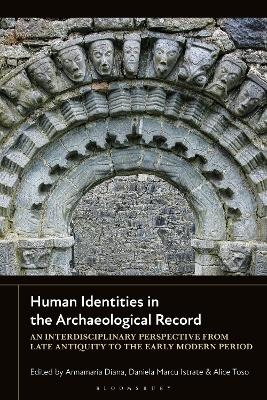
Human Identities in the Archaeological Record
Bloomsbury Academic (Verlag)
978-1-350-53624-1 (ISBN)
- Noch nicht erschienen (ca. Juni 2026)
- Versandkostenfrei
- Auch auf Rechnung
- Artikel merken
Retracing the origin, development and survival of individual and collective identities of past human societies, this volume features a global and interdisciplinary range of case studies from Late Antiquity to the early modern period covering regions such as England, Romania, Ireland, Portugal, the Horn of Africa and Australia. The contributors delve into the archaeological record to detect not only biological and cultural affinity, but also evidence of diversity and ‘otherness’ in past human landscapes. Through the lens of burial customs, dietary habits, life-style changes, paleopathological evidence, everyday use objects and belief systems, this book highlights archaeology’s crucial role in unearthing forgotten – and even obliterated – identities, while also unveiling the recurrence of universal human values that transcend time and space.
Organised chronologically, this volume draws together perspectives from various disciplines such as archaeology, bioarchaeology, zooarchaeology, forensic anthropology, archaeosciences, anthropology and historical archaeology. As a result, this book elucidates the importance of holistic approaches to the analysis of material culture and skeletal remains, which are often the only indisputable remnants of the existence of minorities and proof of diversity survival.
Alice Toso is Assistant Professor in Bioarchaeology at the University of Bonn, Germany. Her research focuses on using anthropological and biomolecular methods to assess social inequality, health, nutrition and mobility patterns. Annamaria Diana is a Bioarchaeologist and independent scholar based in Romania. Her research interested include archaeological sites and materials spanning from the Neolithic to the medieval period in Romani, Italy, Morocco, Georgia, the UK and the United Arab Emirates. Daniela Marcu Istrate is Senior Archaeologist at the Vasile Pârvan Institute of Archaeology, Romania. Her research interests include medieval archaeology and osteoarchaeology in Transylvania and Hungary.
List of Illustrations
List of Contributions
Introduction
Annamaria Diana (Independent Scholar, Romania), Daniela Marcu Istrate (Archaeology Institute V. Parvan, Romania) and Alice Toso (University of Bonn, Germany)
Part I - Belonging, Resilience and Spirituality
1. Evaluating Identity via Similarity in Deviation from Conformity in the Treatment of the Dead in Post-medieval England and Scotland, United Kingdom
Diana Swales (University of Dundee, UK)
2.Martyrdom narratives and identity formation at the edge of the Roman Empire. The case of Epictetus and Astion from Halmyris,
Ciprian Cretu (Anthropology Institute F. Rainer, Romania) and Dorian Andrei Soficaru (Anthropology Institute F. Rainer, Romania)
3.Irish Identity Reflected in Pre-famine Headstone Iconography
Gerry Mullins (Independent Scholar, Ireland)
Part II - Stories From the Burial Context
4. Marginalised Communities in Late Medieval Lisbon: A Multi-isotopic Diet and Mobility Study of the Rua Das Lagares 74 Necropolises
Rebecca Anne Macroberts (Hercules Laboratory and In2past, University of Évoran Portugal), Lucy Shaw Evangelista (Independent Scholar, Portugal), Marina Lourenço (University of Coimbra, Portugal), Cristina Barrocas Dias (University of Évora, Portugal), Hermínia Vasconcelos Vilar (University of Évora, Portugal), Bernd R. Schöne (University of Mainz, Germany), Anne-France Maurer (University De Évora, Portugal)
5. A history of violence? Atypical and deviant burial patterns at Turda Veche’s Reformed Church cemetery, Transylvania
Horatiu Dorin Groza (History Museum of Turda, Romania) and Annamaria Diana (Independent Scholar, Romania)
6. Grips and Grip plates: Getting a hold on identity in post-medieval Yorkshire, England
Diana Swales (University of Dundee, UK)
Part III - Biocultural Transitions
7. Exploring transition and identity through an interdisciplinary study of the third- to seventh-centuries CE Northamptonshire: a theoretical discussion
Alvaro Felipe Ortega-González (University of Leicester, UK)
8. Animals as witness to cultural identities: the Spanish imprint of the colonization of the Americas
Aurélie Manin (University of Bordeaux, France), Noémie Tomadini (National History Museum of Bordeaux, France) and Ophélie Lebrasseur (Centre for Research on Biodiversity and the Environment, France)
9. The Taste of the Land: Isotopic Evidence of Urban and Rural Identities in Medieval Portugal Alice Toso (University of Bonn, Germany), Cleia Detry (University of Lisbon, Portgual), Ines Simão (Era Arqueologia SA, Portugal), Jaoquina Soares (University of Lisbon, Portgual), Ana Margarida Arruda (University of Lisbon, Portgual), and Michelle Alexander (University of York, UK)
10. Paddock to plate at the Barracks: meat cuts as a socioeconomic indicator in nineteenth-century colonial Triabunna (Tasmania, Australia) Madeleine E. Lucas (Independent Scholar, Australia), Sofia C. Samper Carro (Australian National University, Australia), D. A. Lenton (Australian National University, Australia), Catherine J. Frieman (Australian National University, Australia), and James L. Flexner (University of Sydney, Australia)
Part IV - Expressions of Individuality
11. New insights on the identity of a seventh-century horse rider. The case of grave 104 bis from Târgsor
Erwin Gáll (Archaeology Institute V. Parvan, Romania), Andrei Dorian Soficaru (Anthropology Institute F. Rainer, Romania), Ana Stefan, Andrei Magureanu (Institute of Archaeology ‘Vasile Pârvan’, Romania), Gergely Szenthe (Hungarian National Museum, Hungary) and Bogdan Ciuperca (Prahova County Museum of History and Archaeology, Romania)
12. Archaeological storytelling, or stories about the ‘other’? Cognitive archaeology and its potential to understand emotional actions toward the deceased
Patrycja Godlewska (Nicolaus Copernicus University in Torun, Poland)
13. Brick by brick: constructing anthropomorphic graves for the early nobility
Daniela Marcu-Istrate (Archaeology Institute V. Parvan, Romania
14. ‘In a community of pipes is a community of hearts’: glazed tobacco pipes as a reflection of identity
Ionu?-Cosmin Codrea (Museum of Dacian and Roman Civilisation, Romania)
Part V - Reclaiming and Protecting Identities
15. After the storm: counteracting the impact of catastrophic weather events on the Indigenous archaeological record with creative mitigating solutions in the Midwestern United States
Elizabeth C. Reetz (University of Iowa, USA) and John F. Doershuk (University of Iowa, Archaeologist, USA)
16. The Roman-Catholic Bulgarians of Transylvania and the Franciscan Monastery in Vintu de Jos: historical and archaeological evidence of an eighteenth-century diaspora
Sebastian Ovidiu Dobrota (Archaeology Institute V. Parvan, Romania)
17. Identity without context: Integrating anthropological and forensic methods for the analysis of isolated archaeological skulls
Annamaria Diana (Independent Scholar, Romania), Daniel O’Meara (Independent Scholar, Ireland) and Julieta Gómez García-Donas
Epilogue
Annamaria Diana (Independent Scholar, Romania), Daniela Marcu-Istrate
(Archaeology Institute V. Parvan, Romania) and Alice Toso (University of Bonn, Germany)
Notes
Bibliography
Index
| Erscheint lt. Verlag | 11.6.2026 |
|---|---|
| Zusatzinfo | 46 bw illus |
| Verlagsort | London |
| Sprache | englisch |
| Maße | 156 x 234 mm |
| Themenwelt | Geisteswissenschaften ► Archäologie |
| Geschichte ► Allgemeine Geschichte ► Mittelalter | |
| Sozialwissenschaften | |
| ISBN-10 | 1-350-53624-5 / 1350536245 |
| ISBN-13 | 978-1-350-53624-1 / 9781350536241 |
| Zustand | Neuware |
| Informationen gemäß Produktsicherheitsverordnung (GPSR) | |
| Haben Sie eine Frage zum Produkt? |
aus dem Bereich