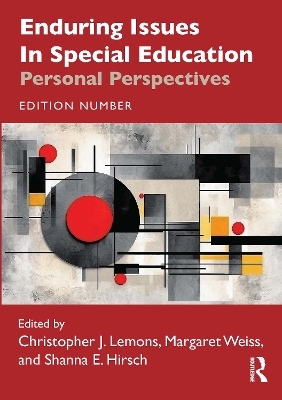
Enduring Issues in Special Education
Routledge (Verlag)
978-1-032-79246-0 (ISBN)
- Noch nicht erschienen (ca. Juni 2026)
- Versandkostenfrei
- Auch auf Rechnung
- Artikel merken
The book’s objective, in addition to informing readers about the issues, is to ask readers to consider critical questions related to each issue. The book organizes 30 chapters into seven sections using the same structuring principles as the first edition—what, why, who (students and professionals), where, and how (now and in the future). Like the first edition, each chapter includes the author’s personal perspectives, suggested resources, and discussion questions. A core addition is a section on the future of special education research, policy, and practice.
Christopher J. Lemons is a Professor of Special Education in the Graduate School of Education at Stanford University. Shanna E. Hirsch is an Associate Professor of Special Education at the University of Maryland. Margaret Weiss is an Associate Professor of Special Education at George Mason University.
Section 1: What is Special Education 1. What is Special Education and What Makes it Special? 2. What is Specially Designed Instruction?: A Core Feature of Special Education Section 2: Why Do We Have Special Education 3. What Can History Tell Us About Enduring Issues in Special Education? 4. The Individuals with Disabilities Education Act: The Intersection of Law, Policy, and Evidence-based Practices Section 3: Who Could Recieve Special Education? 5. Who Could Receive Special Education Services and How Could Educators Identify Which Students Are to Receive Special Education Services? 6. Honoring the Intersectionality of Diverse Learners with Disabilities 7. What is Disproportionality? Why Is this an Enduring Issue in Special Education? Section 4: Who Could Provide and Support Special Education Services? 8. The Collaborative Nature of Special Education: Why Is It Important? 9. What is the Role of Special Educators? 10. What is the Role of the General Education Teacher? 11. What is the Role of Paraeducators? 12. What is the Role of Related Service Providers? 13. Supporting Mental Health and Well-Being within Special Education 14. What is the Role of Family Partners? Section 5: Where Could Special Education Happen? 15. Can Special Education be Everything Everywhere All at Once? Why the Continuum of Alternative Placements is Both Necessary and Good 16. Inclusive Early Childhood Special Education: Building Equity, Access, and Belonging 17. Overview of Elementary Special Education 18. Considerations for Middle and High-School Special Education 19. Considerations for Postsecondary Education for Students with Intellectual Disability Section 6: How Could Special Education Be Practiced? 20. The Role of Research in Instructional Practice in Special Education 21. How Could Special Education Implement Evidence-based Strategies for Reading? 22. Addressing the Enduring Issue of Writing Achievement: Evidence-Based Strategies for Students with Disabilities 23. Research-Validated Approaches for the Teaching and Learning of Mathematics 24. How Special Educators Support Social, Emotional, and Behavioral Well-Being in Students with Emotional and Behavioral Disorders 25. Data in Action: Implementing Data-Based Instruction in Schools 26. How Could Technology Support and Enhance How We Practice Special Education? Section 7: Where Could Special Education Research, Policy and Practice Go? 27. Where Could Special Education Research Go? 28. How Do Special Education Workforce & Working Conditions Affect the Future of Special Education Practice? 29. The Future of Special Education Teacher Preparation 30. Do We Still Need Special Education?
| Erscheint lt. Verlag | 8.6.2026 |
|---|---|
| Zusatzinfo | 16 Tables, black and white; 39 Line drawings, black and white; 92 Halftones, black and white; 131 Illustrations, black and white |
| Verlagsort | London |
| Sprache | englisch |
| Maße | 178 x 254 mm |
| Gewicht | 453 g |
| Themenwelt | Sozialwissenschaften ► Pädagogik ► Allgemeines / Lexika |
| Sozialwissenschaften ► Pädagogik ► Bildungstheorie | |
| Sozialwissenschaften ► Pädagogik ► Didaktik | |
| Sozialwissenschaften ► Pädagogik ► Sonder-, Heil- und Förderpädagogik | |
| ISBN-10 | 1-032-79246-9 / 1032792469 |
| ISBN-13 | 978-1-032-79246-0 / 9781032792460 |
| Zustand | Neuware |
| Informationen gemäß Produktsicherheitsverordnung (GPSR) | |
| Haben Sie eine Frage zum Produkt? |
aus dem Bereich