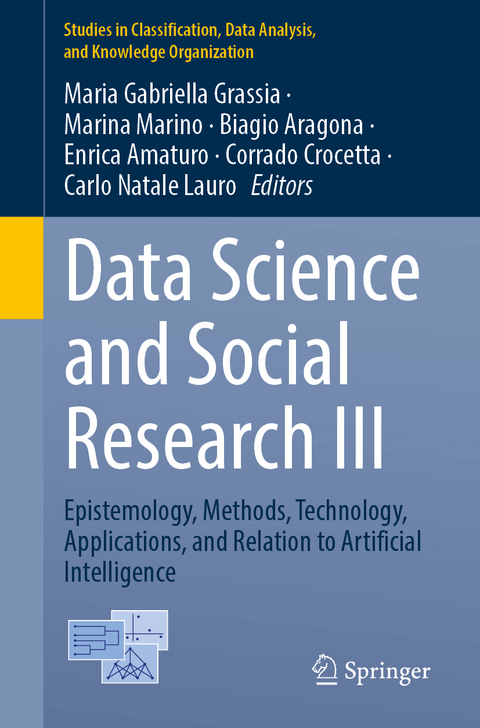
Data Science and Social Research III
Springer International Publishing (Verlag)
9783032159229 (ISBN)
- Noch nicht erschienen - erscheint am 20.03.2026
- Versandkostenfrei
- Auch auf Rechnung
- Artikel merken
This volume reflects the state of the art in social data science and comprises a selection of peer-reviewed papers from the 4th International Conference on Data Science and Social Research, DSSR 2024, held in Naples, Italy, March 25 27, 2024. Drawing on statistics and computational methods within data science, it explores the opportunities and challenges that the data revolution poses to social research, addressing key areas such as sustainable development, social inequalities, public health, communication, and futures studies.
The contributions examine complex social systems and present new social research on human behavior and society, using large datasets gathered from a variety of sources, such as social media and communication systems, or produced through controlled experiments, along with new methodological advancements for extracting social knowledge from large-scale datasets. Methodological, ethical, and digital data quality issues pertaining to social platforms are covered, with a focus on both the study of spatial data as well as sustainability, including sustainable tourism, and integrated systems are examined to take advantage of new sources of social data.
Maria Gabriella Grassia is Full Professor of Social Statistics at the Department of Social Sciences of the University of Naples Federico II, Italy, where she also serves as Head of the Research Committee for the Ph.D. Program in Social Sciences and Statistics. She is the coordinator of the second level master s program in Management, Coordination, and Direction of Territorial Health, Social, and Socio-Assistance Facilities. From 2008 to 2012, she was Member of the Council of the Italian Statistical Society (SIS). She has participated in several national and international projects, including PRIN 2022 Future of Sustainability and the PNRR Extended Partnership GRINS. Her research areas include multivariate methods for textual data, composite indicators, and health care studies.
Marina Marino is Associate Professor of Statistics at the Department of Social Sciences of the University of Naples Federico II, Italy, where she is also a member of the research committee for the Ph.D. program on social science and statistics. She has participated in several national and international projects, including PRIN 2022 Future of Sustainability. Her chief research areas are computational statistics, data mining, classification and clustering, statistical analysis of interval-valued data and textual data.
Biagio Aragona is Associate Professor of Sociology at the Department of Social Sciences of the University of Naples Federico II, Italy, where he teaches social research methods and digital methods and big data. He is also the director of the master s degree in Digital Sociology and Web Analysis, deputy director of the Southern Centre for Digital Transformation and director of the FAST Observatory. Since 2024 he is the secretary and designated president of the Research Committee 33 on Logic and Methodology of the International Sociological Association.
Enrica Amaturo was Full Professor of Sociology at the Department of Social Sciences, University of Naples Federico II, Italy, until October 2025, when she retired. Within the same department, she also served as Head of the Research Committee for the Ph.D. Program in Social Sciences and Statistics until May 2025. She was the President of the Italian Sociological Association, a member of the Italian Commission on Social Exclusion and Editor-in-Chief of the AIS Journal of Sociology, and in 2020 she was a member of the task force of the Presidency of the Council for the COVID-19 emergency, chaired by Vittorio Colao. She was awarded the title of Officer of the Order of Merit of the Italian Republic by the President of the Republic. Her main interests are methods for the analysis of new media, mixed-methods, and the analysis of social exclusion.
Corrado Crocetta is Full Professor of Statistics at the Department of Research and Humanistic Innovation, University of Bari Aldo Moro. He earned his Ph.D. in Statistics at the University of Bari, in consortium with the Universities of Naples Federico II and Chieti, following postgraduate studies at the London School of Economics, and graduated summa cum laude in Economics and Business from Bari. He began his academic career at the University of Foggia, where he served as Researcher, Associate Professor, and later Full Professor of Statistics until 2021. Since then, he has held his current chair at Bari. He has served as President of the Italian Statistical Society (SIS) and as Director of the Interuniversity Research Center on Population, Environment and Health (CIRPAS). His research focuses on multivariate statistical methods applied to sustainability, sustainable tourism, education, health, and labor market studies. He has coordinated and contributed to numerous national and international projects, including PRIN 2022 Future of Sustainability, the AMICA Project on active aging, and the PNRR Extended Partnership GRINS.
Preface.- S. Acampa: Exploring Sociotechnical Imaginaries: A Digital Mixed Methods ResearchDesign to Analysis Emerging Technologies Narratives.- F. Accordino, D. Luzi, F. Pecoraro: Tracking data reuse in social sciences: a problematic issue.- M. Agovino, F. Corbisiero, S. Monaco: From Crisis to Sustainability. Post-Pandemic Tourism in Vesuvius National Park (Italy).- G. Anatriello, M. Carlini: Reputation management web: the case study of Anas.- E. Barca: Practical Consequences of Wolpert s Theorem in Addressing the Issue ofMissing Environmental Data.- D. Bellani, E. Clerici, N. Kulic, D. Mantovani, L. Vergolini: Misconceptions of social positioning across time and space.- P. Belloni, M. Silan: A simulation study to compare MARMoT adjustment and Template Matching in a multiple treatment framework.- F. Bitonti, F. Benassi, A. Mazza, S. Strozza: Spatio-temporal analysis of Sri Lankans settlement patterns in Italy: an inter- and intra-urban appraisal.- M.C. Catone, S. Cataldi: Crowdsourcing platforms in social research: methodological and ethical issues.- R. Cataldo, R. di Lorenzo, M-G. Grassia,M. Marino, R.Mazza, V. Voytsekhovska: European State of Future Index (ESOFI): the impact of sustainable dimensions on the future of the European Union.- E. Ciurleo, P. Iaquinta: Beyond satisfaction: an analysis of the determinants of Italian regional rail transport.- C. C. De Falco, C. Ambrosio, V. Laezza: Does it Still Make Sense to Use X in Social Research?.- A.M. De Mascellis, M. Misuraca, G. Scepi, M. Spano: An automatic framing approach to analyse newspaper and press language.- S. Balzano, H. Demni, E. Pascucci, L. Natale, G. Porzio: Sustainable mobility and where you live: insights from a survey.- A.M. D Uggento, L. Fabbris, I. Pepe, R. Quarato: Voting as a sign of Italian young people s political willpower.- R. Fabbricatore, R. Romano, C. Davino: Towards a general conceptual framework for measuring the capacity to aspire in high school students.- C. Felaco, S. Acampa: Algorithm as Cupid: Exploring Users Algorithm Awareness in Dating Apps.- F. R. Lenzi, M. Cavagnuolo, V. Esposito, F. Iazzetta: Exploring the frontiers of digital social research: Analysis of biases in digital data and implication for online social research.- R. Lombardo, E.J. Beh: Examining Sparse Archaeological Data using a New Correspondence Analysis Framework.- R. Mazza, D. Torre, C. Volpe, S. Paesano, M. Marino,S. Balzano: The new virality: a long-lasting tale of social media effectiveness.- S. Mugnoli, F. Lipizzi, A. Sabbi: ISTAT new enumeration areas 2021 for spatial analysis.- G. M. Padricelli, E. Amaturo, N. Crescentini, G. Punziano: Problematizing Digital Data Quality: The Role of the Researcher in Digital Traces Quality Assessment.- S. Paesano, M.-G. Grassia, R. Mazza, S. Rocco, D. Sacco, F. D Agostino, V. Di Palma: Emurstat: Decisions support system for emergency department.- S. Paesano, D. Sacco, M.G. Grassia, F. P. Pastena, F. D Agostino, V. Di Palama,S. Massa, C. Massa: Assessment of blue triage codes through the C.A.R.E. plot. A new approach in Emergency Department.- S. G. Parolin, F. Dal Cero, G. Bernardinis, M. Silan: From Screen
| Erscheint lt. Verlag | 20.3.2026 |
|---|---|
| Reihe/Serie | Studies in Classification, Data Analysis, and Knowledge Organization |
| Zusatzinfo | Approx. 400 p. |
| Verlagsort | Cham |
| Sprache | englisch |
| Maße | 155 x 235 mm |
| Themenwelt | Sozialwissenschaften ► Soziologie ► Empirische Sozialforschung |
| Schlagworte | Big Data • Computational Social Sciences • Data Quality • Data Science • large data sets • SDGs 8, 11, 12 • social data science • Social Inequality • Social Research • Spatial Data • Statistics in the social sciences • Sustainable tourism |
| ISBN-13 | 9783032159229 / 9783032159229 |
| Zustand | Neuware |
| Informationen gemäß Produktsicherheitsverordnung (GPSR) | |
| Haben Sie eine Frage zum Produkt? |
aus dem Bereich