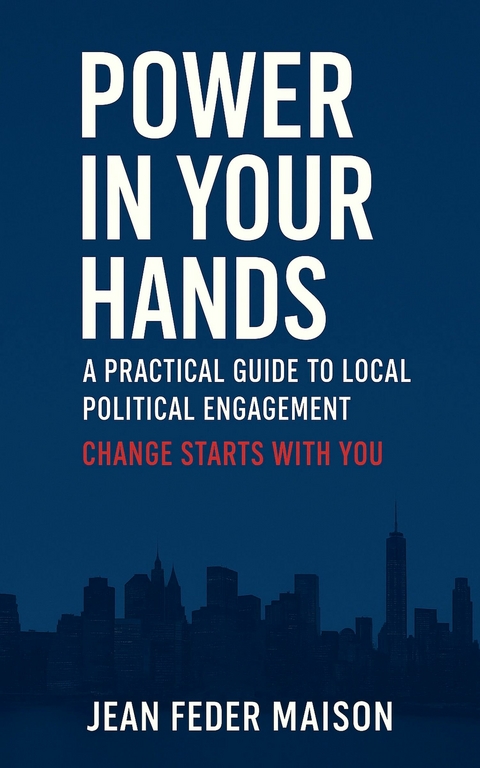
Power in Your Hands (eBook)
398 Seiten
Publishdrive (Verlag)
979-8-90148-336-7 (ISBN)
A comprehensive handbook that empowers citizens to participate in local governance and community decision-making. This guide explains how local government works and provides strategies for civic engagement, from attending town meetings to organizing community campaigns. Readers learn to navigate city councils, school boards, and planning commissions while developing skills to communicate with elected officials and drive change in their communities. Perfect for concerned parents, engaged neighbors, and aspiring local leaders seeking to transform political awareness into action.
Preface
"Power in Your Hands: A Practical Guide to Local Political Engagement"
When I first ran for my local school board, I thought I understood politics. I had studied political science, followed national elections religiously, and could debate federal policy with the best of them. Yet, when it came to understanding how decisions were made about my child's classroom size, the pothole on my street, or the new development going up in my neighborhood, I realized I knew remarkably little. Like many Americans, I had been looking up at the grand stage of national politics while missing the theater of change happening right in my own backyard.
This book was born from that awakening and from the hundreds of conversations I've had since with community members who feel disconnected from the political process, not because they don't care, but because they don't know where to start. Time and again, I've heard variations of the same refrain: "My vote doesn't matter," "Politics is too complicated," "I wouldn't know what to do even if I tried." These sentiments break my heart because they reflect a fundamental misunderstanding of where power truly resides in our democracy.
The truth is this: while we watch presidential debates and track congressional votes, the decisions that most immediately affect our daily lives—the quality of our children's education, the safety of our neighborhoods, the cleanliness of our water, the condition of our roads—are made by people whose offices you can walk into, whose phone numbers you can call, and whose meetings you can attend. Local politics is not just accessible; it is designed to be participatory. Yet somewhere along the way, we've lost sight of this foundational principle of democratic governance.
Over the past decade, as both a scholar of political engagement and an active participant in local government, I've witnessed firsthand the transformative power of community involvement. I've seen a group of concerned parents successfully advocate for increased school funding. I've watched neighbors organize to save a beloved community center from closure.
I've observed how a single individual speaking at a city council meeting sparked a policy change that benefited thousands. These are not exceptional stories—they are everyday examples of democracy in action, happening in communities across our nation.
What makes local political engagement so powerful is not just its accessibility, but its immediacy. When you advocate for a crosswalk at a dangerous intersection and see it installed months later, you witness the direct impact of your involvement. When you attend a zoning meeting and help shape the development of your neighborhood, you are literally building the future of your community. This kind of tangible change is rare in our national politics, where individual voices can feel lost in the noise. At the local level, your voice doesn't just matter—it can be decisive.
Yet, despite this potential for impact, local politics remains chronically under-engaged. Voter turnout for local elections often hovers below 20 percent. City council meetings are sparsely attended. School board positions go uncontested. This disengagement has consequences. When communities don't participate, decisions get made by a small minority—often those with vested interests that may not align with the broader public good. Empty seats at public meetings are not just missed opportunities; they represent a surrender of power.
This guide is designed to change that. Whether you're frustrated with a local issue, inspired to make a difference, or simply curious about how your community works, this book will give you the tools, knowledge, and confidence to engage effectively. I've structured it to take you from understanding why local politics matters to knowing exactly how to make your voice heard and your involvement count.
Part 1 establishes the foundation—why local politics deserves your attention and how it fits into our broader system of governance. You'll discover the surprising ways that local decisions shape your daily life and learn why local engagement often yields more meaningful results than focusing solely on national politics.
Part 2 demystifies the structure of local government. You'll learn who makes decisions in your community, where your tax dollars go, and how to navigate the often-confusing landscape of municipal governance. Understanding the system is the first step to changing it.
The remaining sections provide practical, actionable strategies for engagement—from attending your first city council meeting to organizing your neighbors around a cause, from effectively communicating with elected officials to running for office yourself. Each chapter includes real-world examples, practical exercises, and resources to help you apply what you've learned.
I want to be clear about what this book is and isn't. This is not a partisan guide—the principles of effective local engagement transcend political affiliation. Whether you lean left, right, or somewhere in between, these tools will help you advance the issues you care about. This is also not a book that promises easy solutions or overnight change. Real engagement requires commitment, patience, and persistence. But I can promise you this: the investment is worth it.
Some of you reading this may be thinking, "I don't have time for this." I understand. We're all busy, juggling work, family, and countless other responsibilities. But here's what I've learned: engaging in local politics doesn't require you to become a full-time activist. Even small acts—attending one meeting, making one phone call, casting your vote in a local election—can make a difference. And once you start, once you see that your involvement matters, you may find yourself wanting to do more.
Others may be thinking, "I don't know enough about politics." That's precisely why I wrote this book. You don't need to be an expert to participate effectively. You need to care about your community and be willing to learn. Everything else can be taught, and I intend to teach it to you.
As you read this guide, I encourage you to approach it not as a textbook to be absorbed passively, but as a workbook to be engaged with actively. Take notes. Highlight passages that resonate with you. Complete the exercises. Most importantly, don't just read about engagement—practice it. Identify one issue in your community that matters to you and commit to acting, however small, before you finish this book.
My hope is that this guide will be the beginning of your journey into local political engagement, not the end. That it will spark curiosity, inspire action, and ultimately help you recognize the power you already possess to shape your community. Democracy is not a spectator sport, and change does not happen by accident. It happens because people like you decide that their community matters enough to get involved.
The power truly is in your hands. Let's learn how to use it.
Dr. Youseline V. Maison
November 2025
Introduction
The Case for Local Political Engagement
In the fall of 2019, Sarah Martinez sat in her living room, scrolling through news about the latest political drama in Washington, D.C. She felt the familiar mix of frustration and helplessness that had become her default response to politics. Meanwhile, three blocks away, her city council was voting on a zoning change that would allow a developer to build a high-rise apartment complex on the site of the neighborhood park where her children played every afternoon. Sarah had no idea the meeting was happening. By the time she learned about the decision two weeks later, it was too late to contest it.
Sarah's story is not unique. Across America, millions of engaged, intelligent citizens follow national politics with passion while remaining entirely disconnected from the local political decisions that most directly shape their lives. We debate federal policies over dinner, share political commentary on social media, and watch election results with bated breath—all while the decisions about our schools, streets, water quality, public safety, and neighborhood character are made in meetings we don't attend, by officials whose names we don't know, through processes we don't understand.
This disconnect represents one of the great paradoxes of American democracy: we are most engaged where we have the least individual impact, and least engaged where our individual voices matter most. This book aims to resolve that paradox by making the case for local political engagement and providing you with the tools to practice it effectively.
The Local Politics Deficit
Let's start with some sobering numbers. In the 2020 presidential election, despite a global pandemic, approximately 67% of eligible voters cast ballots—one of the highest turnout rates in modern American history.
Compare that to local elections, where turnout routinely falls below 20%, and in some municipalities, dips into single digits for off-cycle elections. In the 2019 municipal elections across America's largest cities, average voter turnout was just 15%. Some school board elections, which determine policies affecting millions of children, see turnout rates of less than 10%.
But the engagement gap extends far beyond voting. City council meetings, where crucial decisions about land use, budgets, and local ordinances are made, often draw audiences you could count on two hands. Planning commission hearings, school board meetings, and county commissioner sessions routinely conduct business with more officials than citizens in attendance. Public comment periods—those precious minutes of democracy where any resident can...
| Erscheint lt. Verlag | 23.11.2025 |
|---|---|
| Sprache | englisch |
| Themenwelt | Sozialwissenschaften ► Politik / Verwaltung ► Politische Theorie |
| Sozialwissenschaften ► Politik / Verwaltung ► Staat / Verwaltung | |
| Schlagworte | change start with you • Politic • political engagement • politic book • politic science • Power in Your Hands: A Practical Guide to Local |
| ISBN-13 | 979-8-90148-336-7 / 9798901483367 |
| Informationen gemäß Produktsicherheitsverordnung (GPSR) | |
| Haben Sie eine Frage zum Produkt? |
 EPUB (Ohne DRM)
Digital Rights Management: ohne DRM
Dieses eBook enthält kein DRM oder Kopierschutz. Eine Weitergabe an Dritte ist jedoch rechtlich nicht zulässig, weil Sie beim Kauf nur die Rechte an der persönlichen Nutzung erwerben.
Dateiformat: EPUB (Electronic Publication)
EPUB ist ein offener Standard für eBooks und eignet sich besonders zur Darstellung von Belletristik und Sachbüchern. Der Fließtext wird dynamisch an die Display- und Schriftgröße angepasst. Auch für mobile Lesegeräte ist EPUB daher gut geeignet.
Systemvoraussetzungen:
PC/Mac: Mit einem PC oder Mac können Sie dieses eBook lesen. Sie benötigen dafür die kostenlose Software Adobe Digital Editions.
eReader: Dieses eBook kann mit (fast) allen eBook-Readern gelesen werden. Mit dem amazon-Kindle ist es aber nicht kompatibel.
Smartphone/Tablet: Egal ob Apple oder Android, dieses eBook können Sie lesen. Sie benötigen dafür eine kostenlose App.
Geräteliste und zusätzliche Hinweise
Buying eBooks from abroad
For tax law reasons we can sell eBooks just within Germany and Switzerland. Regrettably we cannot fulfill eBook-orders from other countries.
aus dem Bereich