


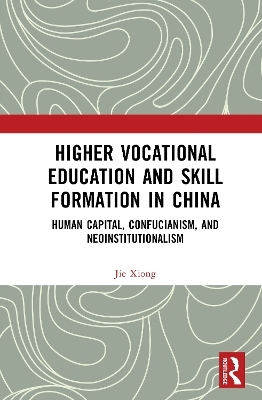
Higher Vocational Education and Skill Formation in China
Human Capital, Confucianism, and Neoinstitutionalism
Seiten
2026
Routledge (Verlag)
978-1-041-06678-1 (ISBN)
Routledge (Verlag)
978-1-041-06678-1 (ISBN)
- Noch nicht erschienen (ca. April 2026)
- Versandkostenfrei
- Auch auf Rechnung
- Artikel merken
This book examines how China’s higher vocational education (HVE) has been developed as a means of skill formation from multiple perspectives including policy, history, culture, sociology, and comparative studies.
Through systematic analysis of relevant skill formation policies issued between 1980 and 2019, the book reveals domestic and global policy contexts, positive and negative policy effects, and theoretical and practical policy implications for China’s HVE based on multiple analytical frameworks including human capital, Confucianism, neoinstitutionalism, and UNESCO’s ISCED Level 5. It concludes that China’s HVE has been developed by mainly following the country’s distinctive political economy and history, but that it neglects the dominant local culture, which in turn has led to unsolved and newly emerged challenges impeding HVE’s high-quality development.
Demonstrating the key steps required to develop and improve vocational higher education to serve skill formation, this book will be a valuable resource to students and scholars of vocational and technical education, comparative education, higher education, sociology of education, policy studies, and China studies.
Through systematic analysis of relevant skill formation policies issued between 1980 and 2019, the book reveals domestic and global policy contexts, positive and negative policy effects, and theoretical and practical policy implications for China’s HVE based on multiple analytical frameworks including human capital, Confucianism, neoinstitutionalism, and UNESCO’s ISCED Level 5. It concludes that China’s HVE has been developed by mainly following the country’s distinctive political economy and history, but that it neglects the dominant local culture, which in turn has led to unsolved and newly emerged challenges impeding HVE’s high-quality development.
Demonstrating the key steps required to develop and improve vocational higher education to serve skill formation, this book will be a valuable resource to students and scholars of vocational and technical education, comparative education, higher education, sociology of education, policy studies, and China studies.
Jie Xiong is an Education Assessor at International Qualifications Assessment Service (IQAS), Government of Alberta, Canada.
Part 1: Policy Context 1. Political Economy as the Decisive Driving Force 2. Human Capital as Policy Rationale Part 2: Policy Effects 3. Social Changes and Cultural Conflicts 4. Social Justice Part 3: Policy Implications 5. Understanding Higher Vocational Education in China: A Neoinstitutionalist Perspective 6. Non-university Higher Education as a World Model: A Comparative Study 7. Conclusion and Reflections on Some New Trends
| Erscheint lt. Verlag | 21.4.2026 |
|---|---|
| Zusatzinfo | 10 Tables, black and white; 4 Line drawings, black and white; 4 Illustrations, black and white |
| Verlagsort | London |
| Sprache | englisch |
| Maße | 156 x 234 mm |
| Themenwelt | Sozialwissenschaften ► Pädagogik ► Allgemeines / Lexika |
| Sozialwissenschaften ► Pädagogik ► Bildungstheorie | |
| Sozialwissenschaften ► Pädagogik ► Erwachsenenbildung | |
| Sozialwissenschaften ► Soziologie ► Spezielle Soziologien | |
| ISBN-10 | 1-041-06678-3 / 1041066783 |
| ISBN-13 | 978-1-041-06678-1 / 9781041066781 |
| Zustand | Neuware |
| Informationen gemäß Produktsicherheitsverordnung (GPSR) | |
| Haben Sie eine Frage zum Produkt? |
Mehr entdecken
aus dem Bereich


aus dem Bereich
ihr individueller Weg: von der Themensuche zum Doktortitel
Buch | Softcover (2025)
UTB (Verlag)
CHF 26,45
Einführung in die Theorie transformatorischer Bildungsprozesse
Buch | Softcover (2023)
Kohlhammer (Verlag)
CHF 47,60


