


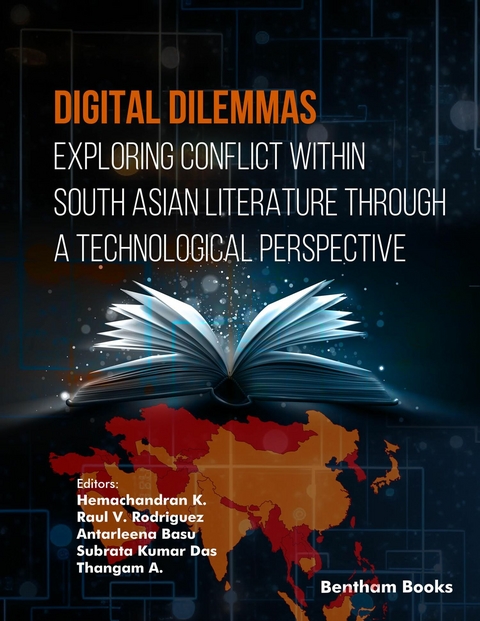
Exploring Conflict within South Asian Literature through a Technological Perspective (eBook)
185 Seiten
Bentham Science Publishers (Verlag)
979-8-89881-090-0 (ISBN)
This collection brings together scholars and practitioners to explore how literature and technology shape spaces of resistance, belonging, and innovation, from LGBTQ+ Insta-poetry and diaspora testimonies to the geopolitics of Palestine/Israel through Indian perspectives Spanning thirteen chapters this comprehensive study offers a multidimensional view of how digital interventions are reshaping narratives of conflict and community in the region.Contributors explore diverse themes including internet disruptions, emergent versus residual cultures, colonial guilt, digital storytelling, translation in conflict communication, and the use of social networks for language learning. Key Features Examines how digital technologies mediate conflict, identity, and literary expression in South Asia. Maps out intersections between traditional and emergent cultural forms across literature, media, and geopolitics. Showcases original case studies on LGBTQ+ expression, diaspora narratives, internet disruptions, and digital pedagogy. Analyzes colonial and postcolonial legacies through new readings of texts and cultural practices. Offers comparative, interdisciplinary approaches linking literature, digital humanities, and social sciences.
Introduction: At the Crossroads of Conflict(s), Literature and Digital Interventions from a South Asian Perspective
Antarleena Basu1, *
Abstract
This introductory article aspires to weave the disparate concepts of conflict studies, literary studies, and digital technology in the context of South Asia, and explore how varied conflicts find representation through South Asian literature and language in this era of digital revolution. In other words, this article aspires to reconsider the conception of conflict studies, expand the parameters of defining, constructing, and comprehending conflict in the digital era, and explore how conflicts of varied accord get represented in writings, be it in literary texts or digital writings. The paper initiates by charting the various trajectories of conflict(s) in the context of South Asia, delves into exploring the discords that have risen as an effect of digital transformation, and further elucidates on the literary representations of these conflicts through an analytical exploration of literature and language across genres. The study showcases how technological advancement can not only transform conflict dynamics in South Asia but also alter how literary studies are defined, demarcated, and practiced because of these instantaneous and abrupt shifts. The paper concludes by briefly reflecting on the varied articles on conflict, digital technological transformation, and literature that are featured in this book, thereby contributing to the study of digital transformation, conflict, and literature in the context of South Asia.
* Corresponding author Antarleena Basu: Department of English, School of Liberal Arts and Humanities, Woxsen University, Hyderabad, India; E-mail: antarleena.basu@woxsen.edu.in
INTRODUCTION: EXPLORING SOUTH ASIA AS A REGION OF CONFLICTS
Since times immemorial, South Asia as a region has been plagued by innumerable conflicts that have ruptured the landscape and lives of the people of this geo-sociopolitical terrain. From a broad perspective, “conflict is an actual or perceived opposition of interests, understandings, and values… [and] it has to do
with differences of various kinds, and how humans, anywhere in the world, manage them” (Ranjan, 2016, 117), thereby encapsulating labyrinths of intertwined discords and differences. Given that this region is a conglomeration of heterogeneity in terms of culture, language, religion, and ethnicity, among others, these conflicts have stemmed from various factors including territorial disputes, religious differences, historical grievances, ethnic tensions, economic inequalities, cultural rigidities, (anti)globalization and geopolitical rivalries. By extension, conflicts have also arisen around questions of identity, caste, gender, class, migration, climate, and displacement in this region. Hence, as Muni observes, it is crucial to recognize South Asia as a space girdled by conflicts of various orders:
South Asia has earned a status of its own as an important area of focus in conflict studies; and why not? After all, it is a region that has witnessed five full-scale inter-state conflicts, where adversaries are nuclear-armed and Asia’s major powers, some of its states have earned the distinction of becoming a part of the hub of global terrorism and where no country has been free from insurgencies and separatist movements (2013, p. 1).
In fact, since its very conception, territorial conflicts have shrouded this geo-political space, its history marked by recurrent conquests and conflicts, and its present impacted by the replaying of those ancient discordances, alongside new avenues of differences. He further observes that the two primary causes of conflicts in South Asia are “their colonial legacies and turbulent processes of post-independence nation and state-building” (Muni, 2013, p. 5). As noted by Wolpert, India, and Pakistan were created in 1947 to remain in conflict (2011) – a prophecy that, regretfully, has come to be the living reality with three wars fought (1947-49, 1965 – 1971, and 1999) already, war-like situations in 1987, 1990 and 2002, and a series of terror attacks that have only added to the existing animosity (2010). Both the Institute of Peace and Conflict Studies (IPCS) in Delhi and The Pak Institute of Peace Studies have been organizing annual conferences and computing updates on conflicts in South Asia respectively, thereby charting the trajectories of geo-sociopolitical conflicts in the subcontinent. Aside from inter-nation conflicts, civil wars and separatist insurgencies have also ruptured the subcontinent. For instance, the Sri Lankan conflict is recorded to have been fought between the government of Sri Lanka and Liberation Tigers of Tamil Eelam (LTTE) from 1983 to 2009, and the discord between the two communities, that is, the minority Tamils and the majority Sinhalese existed long before and continues to exist even today, thereby assigning a ‘protracted’ nature to this conflict (Bryan Pfaffenberger 1995; Uyangoda 2007). Even though the Civil War officially ended in 2009 with the Sri Lankan government declaring victory over the separatists, the discords remain as the “Sinhala extremism continues to poison Sri Lanka” (Subramaniam 2013), and justice remains denied to the victims of the war crimes (Ganguly 2023). At about the same time as the Sri Lankan civil war, Nepal too, was gripped by a protracted armed civil war that witnessed strife between the Government of Nepal and the Communist Party of Nepal (Maoist). Similarly, in India, even after the abrogation of Article 370 in 2019, tensions remain high in the Kashmir valley, and the separatist ethos is far from extinguished (Aryal and Muneer, 2023). Such conflicts have thwarted the existence of many, causing death, displacement, and suffering, thereby impacting the psyche of the people of this subcontinent. It is to be noted that geo-political conflicts are mostly amalgamated with varied layers of discords, be it ethnic, religious, linguistic, economic, or cultural differences, among others, and are, mostly, never a singular reason for discords to develop.
Another key factor causing conflict in South Asia is religion where “religious loyalties are very much intermixed in the concept of nationalism” which are, in turn, responsible for the “growth of fundamentalism” (Mohanty, 2009, p. 1202). Religion has functioned as one of the pivotal markers of conflict in this geo-political region – a space where not only the value systems of Abrahamic religions collide with the ethics of non-Abrahamic religions, but also a space where the many non-Abrahamic religions strive to establish their codes and ideals by laying out their differences, and at times, witness discord with the very religions or subsects of the religion. Many of the South Asian countries have been severely impacted by “religiously motivated radicalization, extremism, and violence (Ahmed, 2023). Beginning with the Partition of India (1947), which was riffed by communal tensions between Hindus, Muslims, and Sikhs, to the Anti-Sikh riots of 1984 after the assassination of Prime Minister Indira Gandhi by her Sikh bodyguards, South Asia continues to bleed due to inter-religious clashes even today. Likewise, even though the Sri Lankan civil war was not essentially a religious conflict, the identity of the Sinhalese as Buddhists and the Tamils as Hindus (or Christians) adds another labyrinth to the nature of this war. Nepal too has witnessed multiple clashes between Hindus and Muslims, and in 2023, a lockdown had to be imposed to temper down the interreligious conflict (AP, The Hindu). Again, conflicts based on linguistic identity also play a pivotal role in shaping this geo-political region where multiple linguistic groups compete for cultural, political, and socio-economic significance. Most notable of the language movements in South Asia is the Bengal Language movement or Bangla bhasha andolôn which advocated for acknowledging Bengali as the co-lingua franca of the then Pakistan, and which partly contributed to the formation of Bangladesh as a separate nation-state in 1971 (Deb 2021, p. 59). In recent times, the country was swirled into another such language rift when Amit Shah, the home minister of India, pushed for the “one nation, one language agenda” claiming that Hindi is the “uniting” language of the country since most of the citizens speak Hindi, or are familiar with the language (The Telegraph, 2019). This outraged people of other linguistic groups in India, and the statement drew sharp criticism from opposition parties, thereby forcing Shah to tone down his promotion of the language. Besides, regional movements in India like the Gorkhaland movement are, in many ways, a demand for linguistic recognition alongside recognition of ethnicity: the Gorkhas primarily want a separate state carved out of Bengal for the Nepali-speaking Gorkhas of India (Pradhan 2012).
Alongside language, gender intersects with conflict in...
| Erscheint lt. Verlag | 27.10.2025 |
|---|---|
| Reihe/Serie | Digital Dilemmas |
| Sprache | englisch |
| Themenwelt | Sozialwissenschaften ► Pädagogik |
| Sozialwissenschaften ► Politik / Verwaltung | |
| ISBN-13 | 979-8-89881-090-0 / 9798898810900 |
| Informationen gemäß Produktsicherheitsverordnung (GPSR) | |
| Haben Sie eine Frage zum Produkt? |
 EPUB (Ohne DRM)
Digital Rights Management: ohne DRM
Dieses eBook enthält kein DRM oder Kopierschutz. Eine Weitergabe an Dritte ist jedoch rechtlich nicht zulässig, weil Sie beim Kauf nur die Rechte an der persönlichen Nutzung erwerben.
Dateiformat: EPUB (Electronic Publication)
EPUB ist ein offener Standard für eBooks und eignet sich besonders zur Darstellung von Belletristik und Sachbüchern. Der Fließtext wird dynamisch an die Display- und Schriftgröße angepasst. Auch für mobile Lesegeräte ist EPUB daher gut geeignet.
Systemvoraussetzungen:
PC/Mac: Mit einem PC oder Mac können Sie dieses eBook lesen. Sie benötigen dafür die kostenlose Software Adobe Digital Editions.
eReader: Dieses eBook kann mit (fast) allen eBook-Readern gelesen werden. Mit dem amazon-Kindle ist es aber nicht kompatibel.
Smartphone/Tablet: Egal ob Apple oder Android, dieses eBook können Sie lesen. Sie benötigen dafür eine kostenlose App.
Geräteliste und zusätzliche Hinweise
Buying eBooks from abroad
For tax law reasons we can sell eBooks just within Germany and Switzerland. Regrettably we cannot fulfill eBook-orders from other countries.
aus dem Bereich


