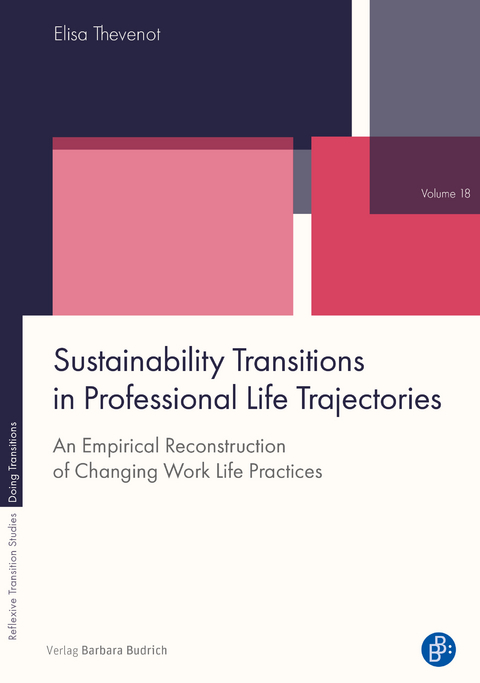
Sustainability Transitions in Professional Life Trajectories
Verlag Barbara Budrich
978-3-8474-3192-3 (ISBN)
- Noch nicht erschienen (ca. März 2026)
- Versandkostenfrei
- Auch auf Rechnung
- Artikel merken
1 Introduction
2 Connecting work, sustainability and life course in research
2.1. Prevalent forms of relations linking work transitions and life course
2.2. Prevalent forms of relations linking sustainability and life course
2.3. Prevalent forms of relations linking work transitions and sustainability
3 Research foci and questions within a Doing Transitions framework
4 Outline of the theoretically informed perspective
4.1. Discourse, Practice and Implicit Knowledge
4.2. Practice theoretical approach to frame social phenomena
4.2.1 Ontological assumptions and grammar
4.2.2 Practice theory’s contribution to the sustainability transitions (STs) field
4.2.3 Practice theory’s application from everyday life studies to life course studies
4.3. Practice Theoretical foci: circulation, suffusion and variation
4.4. Practice Theory made empirically applicable
5 Reflexive Methodology - Presupposing, creating and interpreting empirical data
5.1. Exploring, situating, revising
5.2. Creating empirical data: framing, collecting, sampling
5.2.1 Biographical narrative frame
5.2.2 Preparing and collecting
5.2.3 Unaddressed dimensions and implications
5.3. Method of analysis
6 Empirical reconstruction: Three ways to recount worklife transitions - Typology (I)
6.1. Narrating a Professional Breach Transition (Type A)
6.1.1 Framing of an unsatisfactory previous life and an unlikely but necessary exit
6.1.2 Experiencing holistic transformations
6.1.3 Unloading dissonance and passing on a fitting story
Summarizing Type A: Breach transition narratives
6.2. Narrating a professional Cohesive Transition (Type B)
6.2.1 Framing of a consistent life path
6.2.2 Losing and regaining control over one’s life trajectory
6.2.3 Solving dissonance by framing of a purposeful trajectory
Summarizing Type B: Cohesive transition narratives
6.3. Narrating a professional Balancing act transition (Type C)
6.3.1 Framing of an ascending career track
6.3.2 Weighing in gains and minimizing loss of past conveniences
6.3.3 Overlooking dissonance by keeping life spheres separate
Summarizing Type C: Balancing act transition narrative
7 Interim conclusions considering Typology I
7.1 Doing ecological transition by doing narratives of worklife transitions
7.2 Doing ‘successful’ worklife transition by doing ecological transition
7.3 The making of an ecological transition master narrative
8 Empirical reconstruction: Four approaches to doing ecological transition - Typology (II)
8.1. Disrupting approach to doing ecological transition (Type 1)
8.1.1 Creating Bogeymen Counter horizons
8.1.2 Being an alternative
8.1.3 Changing paradigms to change the world
8.2. Representing approach to Doing sustainability (Type 2)
8.2.1 Relying on best practice
8.2.2 Being an example for
8.2.3 Changing oneself to change the world
8.3. Intervening approach to Doing ecological transition (Type 3)
8.3.1 Making oneself necessary
8.3.2 Being a driving force
8.3.3 Changing spaces to change the world
8.4. Calculating approach to Doing ecological transition (Type 4)
8.4.1 Reacting to a changing world
8.4.2 Being a professional
8.4.3 Changing at the top to change the world
8.5. Summary of the second typology (Typology II)
9 Bridging the two typologies: relations, linkages and learnings
10 Conclusion and outlooks
Bibliography
| Erscheint lt. Verlag | 16.3.2026 |
|---|---|
| Reihe/Serie | Reflexive Übergangsforschung – Doing Transitions ; 18 |
| Verlagsort | Leverkusen-Opladen |
| Sprache | englisch |
| Maße | 148 x 210 mm |
| Themenwelt | Sozialwissenschaften ► Pädagogik ► Erwachsenenbildung |
| Schlagworte | Biografische Erzählungen • Biografisches Lernen • biographical learning • Biographical Narratives • Career • Karriere • Lebensweg • life course • Qualitative Methode • qualitative methodology • transition, professional trajectory • Übergang, berufliche Laufbahn |
| ISBN-10 | 3-8474-3192-7 / 3847431927 |
| ISBN-13 | 978-3-8474-3192-3 / 9783847431923 |
| Zustand | Neuware |
| Informationen gemäß Produktsicherheitsverordnung (GPSR) | |
| Haben Sie eine Frage zum Produkt? |
aus dem Bereich