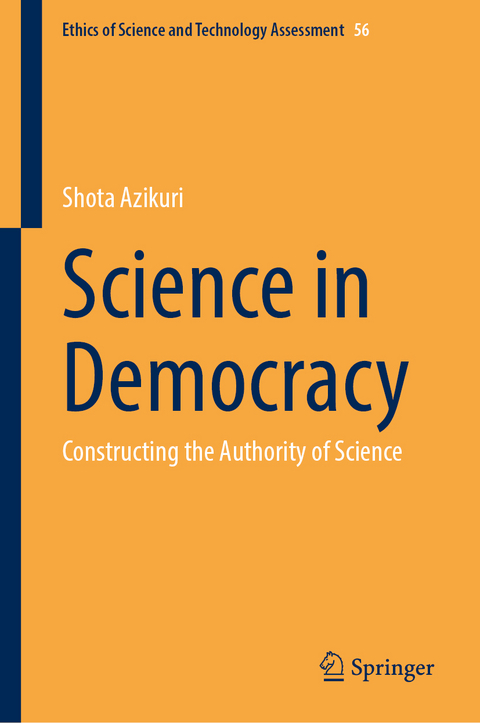
Science in Democracy
Springer International Publishing (Verlag)
978-3-032-15496-5 (ISBN)
- Noch nicht erschienen - erscheint am 10.02.2026
- Versandkostenfrei
- Auch auf Rechnung
- Artikel merken
This book deals with the issue of integrating science into democratic decision-making, emphasizing the need to balance the epistemic qualities of science with democratic values. The central question is not whether to rely on science, but how to do so effectively without undermining democratic principles or scientific integrity. The work criticizes the traditional Weberian division of labor, which separates the roles of scientists and the public, and argues that this division often overlooks the complexities of modern science and democratic decision-making. It highlights the challenges of maintaining both the truth-seeking function of science and the political function of democracy. In turn, the book identifies the epistemic dependence of the public on scientific experts and explores how this dependence interacts with the ideal of autonomy. A significant focus is placed on the problem of specialization in modern science. The book argues that the cognitive division of labor, while necessary for scientific advancement, creates barriers to public understanding and engagement. This specialization complicates the transmission of scientific knowledge and poses a challenge to maintaining democratic oversight and participation. Three main models of integrating science into democracy are examined: the trust model, the epistemic authority model, and the democratic authority model. While each model offers valuable insights, none of them appears to be sufficient on its own. Therefore, the author proposes a synthesized approach that incorporates trust, epistemic rigor, and democratic principles. By addressing the interrelated challenges of specialization, epistemic dependence, and democratic legitimacy, this book presents a comprehensive normative framework for integrating science into democratic decision-making.
Shota Azikuri holds a joint Ph.D. in Philosophy from the University of Münster and Ilia State University. His research lies at the intersection of political theory, social epistemology, and the philosophy of science, exploring how democratic authority can be reconciled with the challenges posed by scientific expertise and specialization in modern society.
.- Introduction.- Autonomy and Authority of Reason.- Critique of the Trust in Science Model for Democratic Decision-Making, etc.
| Erscheint lt. Verlag | 10.2.2026 |
|---|---|
| Reihe/Serie | Ethics of Science and Technology Assessment |
| Zusatzinfo | VI, 124 p. |
| Verlagsort | Cham |
| Sprache | englisch |
| Maße | 155 x 235 mm |
| Themenwelt | Geisteswissenschaften ► Philosophie ► Allgemeines / Lexika |
| Naturwissenschaften | |
| Sozialwissenschaften ► Pädagogik ► Bildungstheorie | |
| Schlagworte | Collaborations across Disciplines • Cross-Disciplinary Interface Management • Cross-Disciplinary Quality Control • democratic decision-making • Epistemic Authority Model • Public engagement • scientific authority • Trust in Science |
| ISBN-10 | 3-032-15496-0 / 3032154960 |
| ISBN-13 | 978-3-032-15496-5 / 9783032154965 |
| Zustand | Neuware |
| Informationen gemäß Produktsicherheitsverordnung (GPSR) | |
| Haben Sie eine Frage zum Produkt? |
aus dem Bereich