


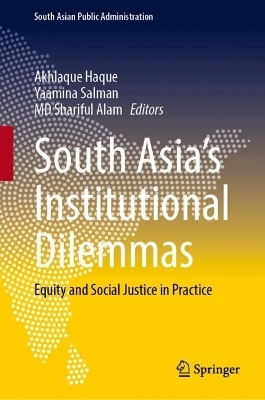
South Asia’s Institutional Dilemmas
Springer International Publishing (Verlag)
978-3-032-15325-8 (ISBN)
- Noch nicht erschienen - erscheint am 27.03.2026
- Versandkostenfrei
- Auch auf Rechnung
- Artikel merken
This edited volume explores the complex interplay between institutions, equity and social justice in South Asia. The book addresses critical questions concerning institutional development, governance practices, reforms, and the promotion of equitable and just societies in the South Asian region, while also examining the region's progress towards achieving the United Nations Sustainable Development Goals (SDGs). Chapters focus on topics such as the role of local governments and grassroots organization in fostering equity and social change, new methodological approaches to studying diversity and equity in governance, and barriers to inclusion in policymaking and implementation.
Bringing together diverse perspectives and research, this volume aims to provide a comprehensive understanding of how institutional dynamics shape equity and justice in South Asia, and how these can be leveraged to achieve the SDGs, ensuring sustainable development and social cohesion. As such, the volume will be of interest to scholars and students of public administration, governance, South Asian politics, comparative policy, gender, and the SDGs.
Akhlaque Haque is a professor in the Department of Political Science and Public Administration at the University of Alabama in Birmingham. His work appears widely in major journals and peer-reviewed publications, with a focus on public administration, urban affairs, and public health, and some of these have earned national and international recognition. Dr. Haque serves on editorial boards of several journals and holds leadership positions in national commissions and organizations like NASPAA and ASPA in the United States. He serves as the editor of the Springer South Asian Public Administration (SAPA) Series. As a Senior Fulbright scholar, he has led international training workshops for scholars and senior civil servants from Bangladesh, India, and Sri Lanka. Dr. Haque is the President of the South Asian Network for Public Administration (SANPA). Yaamina Salman is Professor at the Institute of Administrative Sciences (IAS), University of the Punjab, a pioneer institution in public administration education in Pakistan. She serves as Associate Editor (Developing World) for Public Management Review and is a Board Member of the Center for Service Excellence at the University of Edinburgh Business School and Secretary (Academic Affairs) of South Asian Network for Public Administration (SANPA). Her research interests focus on public sector reform and collaborative governance.Md. Shariful Alam is a former secretary to the Government of Bangladesh and is currently a professor at the Department of Political Science, Dhaka International University. With over thirty years of professional experience, he brings a combined wealth of knowledge from his work with the government of Bangladesh as a career civil servant and several international development organizations, including the World Bank, USAID, UNICEF, DANIDA, ADB, EU, and WFP. His areas of expertise include project management, monitoring, and evaluation. He holds a PhD from the Asian Institute of Technology, a Master of Science in Urban Environmental Management from Wageningen Agricultural University in the Netherlands, a Master of Social Science in Political Science from Chittagong University in Bangladesh, and a Bachelor of Law from the National University in Bangladesh.
Institutions, Equity, and Social Justice in South Asia Relationships and Critical Insights.- Barriers Within: Gender disparities in Public Sector Academia in Pakistan.- Equity in the Balance: Public-Private Philanthropic Partnerships in Pakistan s Higher Education.- Struggles for Justice and Equality on Campus Reforms: Unions, State Power, and the Erosion of Intellectual Discourse in Pakistan.- Best practices to facilitate social and linguistic migrants social inclusion in Global Citizenship Education: Bridging Bangladesh and Italy.- From Margins to Mainstream: Decentralized Governance, Inclusion and Community Participation for Women in India's Local Governance.- Reproductive Justice and the SDGs: Addressing the Punishment of Women Under Honour Norms in South Asia.- Regional politics and Institutional Dilemmas in South-east Asia: Implications for Democratization, Social Justice and Accountable Governance in the Maldives and Bangladesh.- Achieving Gender Equality for Sustainable Development through Quota in Rural Local Governance in India: Changes, Challenges and Concerns.- Digitization and the Transformation of Governance in India: Social Justice in the Digital Age.
| Erscheint lt. Verlag | 27.3.2026 |
|---|---|
| Reihe/Serie | South Asian Public Administration |
| Zusatzinfo | X, 844 p. 3 illus., 1 illus. in color. |
| Verlagsort | Cham |
| Sprache | englisch |
| Maße | 155 x 235 mm |
| Themenwelt | Sozialwissenschaften ► Politik / Verwaltung ► Politische Systeme |
| Sozialwissenschaften ► Politik / Verwaltung ► Staat / Verwaltung | |
| Schlagworte | caste • Diversity, Equity and Inclusion • Gender equality • Governance • Public Institutions • SDGs • Service Delivery • Social Justice • South Asia |
| ISBN-10 | 3-032-15325-5 / 3032153255 |
| ISBN-13 | 978-3-032-15325-8 / 9783032153258 |
| Zustand | Neuware |
| Informationen gemäß Produktsicherheitsverordnung (GPSR) | |
| Haben Sie eine Frage zum Produkt? |
aus dem Bereich


