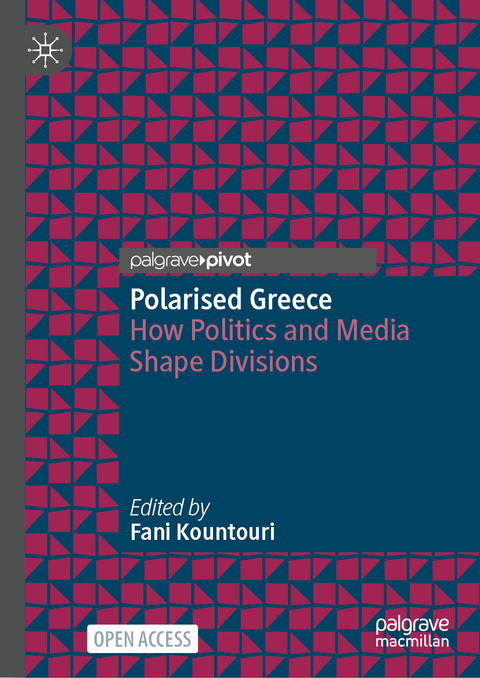
Polarised Greece
Springer International Publishing (Verlag)
978-3-032-15202-2 (ISBN)
- Noch nicht erschienen - erscheint am 11.03.2026
- Versandkostenfrei
- Auch auf Rechnung
- Artikel merken
This open access book of a collective volume offers a comprehensive understanding of political polarization and its implications for democracy. The recent revival of the concept in political debates and academic literature reflects growing concerns about how polarized societies affect democratic norms. In increasingly divided environments, opposing camps express mutual distrust or even hostility, fuelling the rise of extremist parties, hate speech, and anti-political sentiment. Based on a funded research project (Hellenic Foundation for Research and Innovation (H.F.R.I.) Project No 4527) the volume develops a theoretical and methodological framework to explore how oppositions are constructed across different actors and levels, contributing to an integrated and comprehensive approach of political polarization enriching the study of political competition and cleavages in Greece, while also offering insights of broader comparative and international significance.
Internationally, studies on political polarization are reviving but remain fragmented across disciplines. In Greece, systematic interdisciplinary research has been scarce. This volume bridges that gap by integrating political science, sociology, and communication, analyzing the shift from issue-based to affective polarization through mixed qualitative and quantitative methods.
Focusing on the profoundly polarizing decade between 2010 and 2020, the book situates polarization within multiple overlapping crises the debt crisis, the refugee crisis, democratic backsliding, the COVID-19 pandemic, and the Prespa Agreement. These crises redefined the socio-political landscape intensifying existing divisions and generating new lines of conflict: memorandum versus anti-memorandum, pro versus anti-immigration, pro versus anti Europe and nationalist versus cosmopolitan identities. By analyzing how antagonistic narratives construct enemies political opponents, minorities, or external actors like the EU as threats to national, economic, or cultural stability, the volume demonstrates how such rhetoric fuels polarization. This p
Fani Kountouri received her Ph.D. (with distinction) in Political Science from the Department of Political Science, University Pantheon Sorbonne I Paris. She is Associate Professor of Political Communication at the Department of Political Science and History of the Panteion University of Athens. She teaches courses on political science, political communication, sociology of public problems, public policy, political elites and methods in political science. She is the author of two books (in Greek): Political Publicity and Power.Political Parties and Media during the 2000's (Tipothito G. Dardanos, 2011) and Public Problems on Political Agenda (e-book, Kallipos, 2015). She is co-editor (with M. Kakepaki)of the edited volume Parliamentary Elites in Transition. Political Representation in Greece (Palgrave, 2023). She has published in Greek, French and English in edited volumes and peer reviewed journals. She is a visiting professor at the University of Paris VIII, Vincennes-SaintDenis, a member of the Horizon research programme on trust in governance and director of an ELIDEK research programme on political polarisation. Her research interests include political strategies,political communication, political representation, the impact of the media in contemporary democracies, and the agenda and framing process of public issues.
CHAPTER 1.- Divided we stand?- Mapping Polarization IN POLITICS AND MEDIA IN GREECE.- CHAPTER 2.- Democracy Threat Framing and Polarization in Parliamentary Discourse.- CHAPTER 3.- Who is the enemy?- Top-Down Polarization in Party Manifestos and Parliamentary Discourse (2012 2023).- CHAPTER 4.- Framing Affective Polarization: The Memoranda Debates in Greece (2010-2015).- CHAPTER 5.- From Threat to Humanitarianism: The Evolving Polarization of Migration in Greek Parliamentary and Press Narratives.- CHAPTER 6.- The Nation under threat.- Greek political debate on the Prespa Agreement: polarisation and realignment.- Athena Skoulariki.- CHAPTER 7.- The Emotional Politics of Polarization.- Media Responses to Parliamentary Discourse in Greece (2010-2022).
| Erscheint lt. Verlag | 11.3.2026 |
|---|---|
| Zusatzinfo | VII, 181 p. 15 illus. in color. |
| Verlagsort | Cham |
| Sprache | englisch |
| Maße | 148 x 210 mm |
| Themenwelt | Sozialwissenschaften ► Kommunikation / Medien ► Kommunikationswissenschaft |
| Sozialwissenschaften ► Politik / Verwaltung ► Politische Systeme | |
| Schlagworte | Affective polarization • bottom-up polarization • challenges for democracy • Cleavages • Divisions • Greece crises • issue polarization • media • open access • Parliamentary speeches • polarization • Public discourses • Social Media • top-down polarization |
| ISBN-10 | 3-032-15202-X / 303215202X |
| ISBN-13 | 978-3-032-15202-2 / 9783032152022 |
| Zustand | Neuware |
| Informationen gemäß Produktsicherheitsverordnung (GPSR) | |
| Haben Sie eine Frage zum Produkt? |
aus dem Bereich