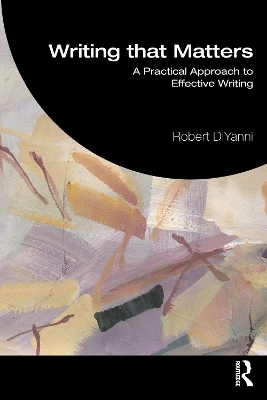
Writing that Matters
Routledge (Verlag)
978-1-041-17226-0 (ISBN)
- Noch nicht erschienen (ca. Juni 2026)
- Versandkostenfrei
- Auch auf Rechnung
- Artikel merken
This compelling guide is an invaluable companion to Reading Literature and Thinking through Words. Robert DiYanni helps readers hone their craft, solidifying knowledge, and discovering new skills. Part One deals with fundamentals and considers what writing is in its essence: a way to think and to learn; a series of processes; and a way to develop the habit of writing—regular writing for practical purposes, including writing from reading. Parts Two and Three focus on style and structure with lots of expert analysis and practical exercises. Part Four reveals how to take your writing to the next level through learning important lessons from some of the best of teachers—master writers who continue to produce entertaining and thought-provoking work.
Throughout the book, readers have opportunities to develop their ability and take pleasure in the progress they make using language to clarify their thinking and explain it to others. It provides students with expert guidance for analyzing and interpreting works of art, literature, and music.
Robert DiYanni is Professor of Humanities at New York University, USA where he serves on the faculties of the School of Professional Studies and the Stern School of Business, following a decade in the College of Arts and Science. His publications include The Pearson Guide to Critical and Creative Thinking (2014), Critical and Creative Thinking: A Brief Guide for Teachers (2015), and Critical Reading Across the Curriculum (with Anton Borst; 2017).
Preface
PART I: ESSENTIALS
Chapter 1. Writing to Learn
Writing Sentences, Writing Paragraphs
Sentences—Beginning Thinking
Paragraphs—Developing Thinking
Final Thoughts
Applications and Considerations
Chapter 2. The Habit of Writing
Motivations for Writing
10 Obstacles to Writing
10 Strategies for Developing the Habit of Writing
Connecting Reading and Writing
The Need for Feedback
Applications and Considerations
Chapter 3. Writing from Reading
Annotating
Freewriting
Using a Double-Column Notebook
Summarizing
Applications and Considerations
Chapter 4. The Writing Process
Pre-writing—Thinking and Planning
Drafting
Revising
Three Aspects of Revising
Impediments to Writing
Final Thoughts
Applications and Considerations
PART II: STYLE
Chapter 5. Words
General and Specific, Abstract and Concrete
Clichés
Colloquialisms
Slang
Jargon
Euphemisms
Sound and Sense
English Borrowings from Other Languages
Etymology
Denotation and Connotation
Loaded Words
The Power of Words: Connotation in Action
The Prevalence of Metaphor
Metaphor and Meaning
Metaphor and Politics
Applications and Considerations
Chapter 6. Sentences (and Punctuation)
The Cumulative Sentence
The Periodic Sentence
The Parallel and Antithetical Sentence
The Inverted Sentence
The Interrupting Sentence
The Fragmentary Sentence
The Questioning Sentence
Sentence Length
Sentence Variety
Punctuation and the Sentence
Colon and Semo-colon
Dash
Double-Dash and Parentheses
Applications and Considerations
Chapter 7. Paragraphs
Paragraph Organization
Time and Space
Importance and Climax
Combining Paragraphs—Unity and Coherence
Joyas Voladoras, Brian Doyle
Some Thoughts on the Common Toad, George Orwell
Notes on Style and Structure
Further Notes on Thought
Applications and Considerations
PART III: STRUCTURE
Chapter 8. Aspects of Form
Two-Part Forms
Before-After
Problem-Solution
Three-Part Forms
Revision and Form
Form in Nature and Art
Applications and Considerations
Chapter 9. Modes of Discourse
Narration
Description
Argumentation
Discourse Modes Combined
Richard Powers, “One, Two, Three…Infinity”
Applications and Considerations
Chapter 10. Patterns of Exposition
Definition
Illustration
Enumeration
Process Analysis
Comparison and Contrast
Classification
Cause and Effect Analysis
Applications and Considerations
PART IV: MASTERY
Chapter 11. Master Class
Leslie Jamison, “A Street Full of Splendid Strangers”
Close Reading
Style
Diction
Syntax
Figurative Language and Allusion
Structure
Substance
Chapter 12. Writing with the Masters
George Orwell
Annie Dillard
Adrienne Rich
E. B. White
Joan Didion
Lydia Davis
Maxine Hong Kingston
John McPhee
Robert A. Caro
Mary Karr
William Zinsser
Jhumpa Lahiri
Ursula K. Le Guin
Zadie Smith
Appendix: Writing, Thinking, and AI
References
Index
| Erscheint lt. Verlag | 25.6.2026 |
|---|---|
| Verlagsort | London |
| Sprache | englisch |
| Maße | 156 x 234 mm |
| Themenwelt | Geisteswissenschaften ► Sprach- / Literaturwissenschaft ► Anglistik / Amerikanistik |
| Geisteswissenschaften ► Sprach- / Literaturwissenschaft ► Literaturwissenschaft | |
| Sozialwissenschaften ► Kommunikation / Medien ► Kommunikationswissenschaft | |
| ISBN-10 | 1-041-17226-5 / 1041172265 |
| ISBN-13 | 978-1-041-17226-0 / 9781041172260 |
| Zustand | Neuware |
| Informationen gemäß Produktsicherheitsverordnung (GPSR) | |
| Haben Sie eine Frage zum Produkt? |
aus dem Bereich