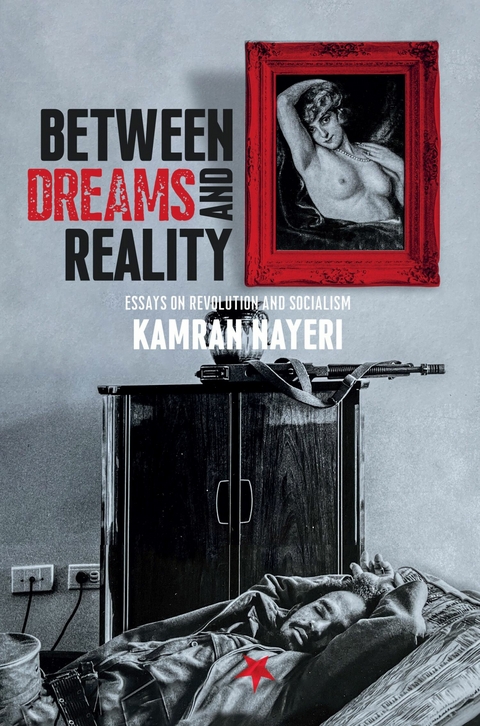
Between Dreams and Reality (eBook)
344 Seiten
Bookbaby (Verlag)
979-8-3178-2365-8 (ISBN)
Kamran Nayeri, Ph.D. is a political economist who taught and researched for 30 years at State University of New York, Downstate Medical Center, University of California, Berkeley, and Office of the President, University of California. He has been a socialist since 1971 and has developed the theory of Ecocentric Socialism.
In the 1970s, it was believed that a third of humanity lived in countries considered to be socialist. Today, there are no countries considered socialist or claiming to be advancing toward socialism. This book explains this reality through a critique of socialist theories, starting with those of Marx and Engels. The argument is anchored in the study of the Iranian revolution of 1979 and the Cuban revolution of 1959. The book concludes with a revision of Marx and Engels' theory of society and history, historical materialism, based on the knowledge gained in fields such as archaeology, anthropology, biology, and the worldviews of hunter-gatherers, as well as the worldviews of indigenous peoples, utilizing ecological animistic materialism instead of the nineteenth-century materialism.
Chapter Two.
A Brief History of the Iranian Trotskyist Movement 1971–19822
In this chapter, I will outline the significant junctures in the history of the Iranian Trotskyist movement (1971–1982) to achieve two goals simultaneously: to examine the actual functioning of our movement and how the theory of the vanguard party was carried out in the case of Iran, especially during the Iranian Revolution. I present this history intertwined with my role in it as I happened to play a role in significant junctures in this history. At the same time, I want the reader to know that while I have ensured my account is supported by documentary evidence, it is my account of our history. Perhaps others would tell a somewhat different story depending on the role they played in it.
As I will explain below, the Iranian Trotskyist movement originated in the US to form the Sattar League in 1971, and with a few years’ delay in England, in the formation of Supporters of Fourth International in Europe and the Middle East, which I will denote as the Kand-o-Kav group (the name of their magazine) for brevity. My account for the early years focuses on the Sattar League. The two groups fused in the aftermath of the February 1979 revolution. Thus, my decision to recount the history of our movement often through my own direct experiences, which of necessity lacks details about the early years of the Kand-o-Kav group. I hope others will write about our shared history, shedding light on aspects I did not consider myself knowledgeable enough to write about.
Becoming a Trotskyist
In the fall of 1971, when I was a sophomore at the University of Texas at Austin (UT-Austin), I considered myself a socialist after reading Erich Fromm’s book The Concept of Man in Marx (1961). Marx’s focus on alienation as the root cause of social problems in capitalist society, along with his view of socialism as an unalienated society, appealed to me. Fromm, a psychoanalyst, was affiliated with the Institute for Social Research in Germany. Inspired by Marx’s writings, these thinkers criticized capitalism and examined social, cultural, and philosophical issues in pursuit of human liberation. They became known as Frankfurt School.
Although the Frankfurt School project was more in line with my temperament, I was soon drawn into daily political activity against the dictatorship of Mohammad Reza Pahlavi and for the development of the Iranian socialist movement. Thus, I postponed a systematic study of Marx’s theories for decades.
As an activist in the Iranian Student Association (ISA) at UT-Austin, I was soon forced to side with either Trotskyist or Maoist currents.
On October 22, 1972, twelve writers, poets, and filmmakers, including Khosrow Golsorkhi (January 23, 1944–February 18, 1974) and Keramat Daneshian (October 2, 1946-February 18, 1974) were arrested on charges of plotting to kidnap and assassinate the Shah and his family at the Shiraz Film Festival.
At a meeting of the ISA, I called for the formation of a committee to fight for the freedom of the twelve. Ali Shakeri, a Maoist who was the ISA Organizational Secretary, deferred any activity in this regard to the “guidance” of the US Organization of the Confederation of Iranian Students abroad.
The Confederation was organized by Iranian students in Europe and the US to oppose the dictatorship of Mohammad Reza Pahlavi, the Shah, who was reinstated to power after a CIA–MI6 coup d’état in August 1953 that overthrew the nationalist government of Mohammad Mossadegh. Pro-Beijing and pro-Moscow Stalinists, as well as the nationalists of the National Front, took its leadership. However, the pro-Moscow Tudeh Party members and supporters were expelled by the Maoists as the split between Mao and Khruschev widened. The Maoist groups dominated the Confederation, and each tried to use ISAs they dominated as a front organization for their party. Before the 1979 Iranian revolution, the Confederation split into competing sections, each under the control of a Maoist group.
Eventually, Shakeri reported to the ISA meeting that the US Organization of the Iranian Students Association opposed defending all twelve because some of them were liberals, and the government might have arrested them along with the revolutionaries so that they could testify against the revolutionaries in court. Although I was not familiar with the revolutionary defense policy at that time, I believed that the ISA had a duty to defend the rights of all victims of the Shah’s regime, regardless of their political beliefs. The Trotskyists and some independent students also agreed with this principle, and soon we formed a temporary committee to fight for the freedom of the twelve.
The Maoist leadership of the ISA expelled all those who were actively involved in the defense committee. Those expelled formed a Democratic ISA and began publishing a stenciled magazine named Payam-e Daneshjoo (Student’s Message).
As a result, independent students became more open to Trotskyism, and some began reading Trotsky’s books, such as The Revolution Betrayed: What Is the Soviet Union and Where Is It Going? (1936) and The Third International After Lenin (1928).
After reading Trotsky, I was drawn to his internationalist conception of socialism and commitment to world revolution, as opposed to Stalin’s Russian nationalist notion of “socialism in one country.” I admired Trotsky for his fight against the Stalinist counterrevolution.
At the same time, I gravitated to the US Socialist Workers Party (SWP). I began to read about its history and attended its conferences and conventions. The SWP traced its history back to its founder, James P. Cannon, and the Bolsheviks and the Russian socialist revolution. A son of Irish immigrants, Cannon joined the Socialist Party of America in 1908 and the Industrial Workers of the World (IWW) in 1911. He was a leader of the Communist Party, which was founded under the influence of the Russian socialist revolution in November 1917. Cannon was a member of the Executive Committee of the Communist International. When attending the Sixth Congress of the Communist International in Moscow in 1928, Cannon obtained a copy of Trotsky’s critique of the draft political program, which was based on Stalin’s theory of socialism in one country and his policy of class collaboration with the “national bourgeoisie” during the 1927 Chinese Revolution. Cannon was expelled from the Communist Party for his agreement with Trotsky’s views. Together with Max Shachtman and Martin Abern, Cannon founded the Communist League of America as a Left Opposition party in late 1928, alongside Max Shachtman and Martin Abern. He became its National Secretary. Canon served in that position until 1953. In 1923, Trotsky organized the Left Opposition within the Communist Party of the Soviet Union, which Stalin disbanded, and Trotsky was sent into internal exile.
In 1938, on Trotsky’s initiative, Left Opposition parties established the Fourth International based on the programmatic document Trotsky (1938) drafted: The Death Agony of Capitalism and the Tasks of the Fourth International: The Mobilization of the Masses around Transitional Demands to Prepare the Conquest of Power, better known as The Transitional Program.
James P. Cannon and the Vanguard Party
In the article “The Revolutionary Party & Its Role in the Struggle for Socialism” (1967)
Cannon wrote: “The greatest contribution to the arsenal of Marxism since the death of Engels in 1895 was Lenin’s conception of the vanguard party as the organizer and director of the proletarian revolution.” He added: “It is deep-rooted in two of the weightiest realities of the 20th century: the actuality of the workers’ struggle for the conquest of power, and the necessity of creating a leadership capable of carrying it through to the end.” (Cannon 1967; my emphasis). Perhaps Cannon did not know, and I certainly did not know at the time, that the phrase in italic in the quotation above represent a radical break with Marx’s theory of the proletariat and socialism as I will discuss in this chapter and elsewhere in the book.
However, in What Is to Be Done? Lenin wrote:
“There could not have been Social-Democratic [socialist] consciousness among the workers. It would have to be brought to them from without.” Thus, he placed the vanguard party (Leninist party) ahead of the working class in the fight for socialism. Trotsky, who embraced Lenin’s theory of the vanguard party in 1917 when he joined the Bolshevik Party as one of its top leaders, devoted the Fourth International to this conception of the proletariat and socialist revolution. Its programmatic document opens with this assertion: “The world political situation as a whole is chiefly characterized by a historical crisis of the leadership of the proletariat” (Lenin, 1902).
Moreover, in the 1960s, when...
| Erscheint lt. Verlag | 13.11.2025 |
|---|---|
| Sprache | englisch |
| Themenwelt | Sozialwissenschaften ► Politik / Verwaltung |
| ISBN-13 | 979-8-3178-2365-8 / 9798317823658 |
| Informationen gemäß Produktsicherheitsverordnung (GPSR) | |
| Haben Sie eine Frage zum Produkt? |
 EPUB (Ohne DRM)
Größe: 4,0 MB
Digital Rights Management: ohne DRM
Dieses eBook enthält kein DRM oder Kopierschutz. Eine Weitergabe an Dritte ist jedoch rechtlich nicht zulässig, weil Sie beim Kauf nur die Rechte an der persönlichen Nutzung erwerben.
Dateiformat: EPUB (Electronic Publication)
EPUB ist ein offener Standard für eBooks und eignet sich besonders zur Darstellung von Belletristik und Sachbüchern. Der Fließtext wird dynamisch an die Display- und Schriftgröße angepasst. Auch für mobile Lesegeräte ist EPUB daher gut geeignet.
Systemvoraussetzungen:
PC/Mac: Mit einem PC oder Mac können Sie dieses eBook lesen. Sie benötigen dafür die kostenlose Software Adobe Digital Editions.
eReader: Dieses eBook kann mit (fast) allen eBook-Readern gelesen werden. Mit dem amazon-Kindle ist es aber nicht kompatibel.
Smartphone/Tablet: Egal ob Apple oder Android, dieses eBook können Sie lesen. Sie benötigen dafür eine kostenlose App.
Geräteliste und zusätzliche Hinweise
Buying eBooks from abroad
For tax law reasons we can sell eBooks just within Germany and Switzerland. Regrettably we cannot fulfill eBook-orders from other countries.
aus dem Bereich