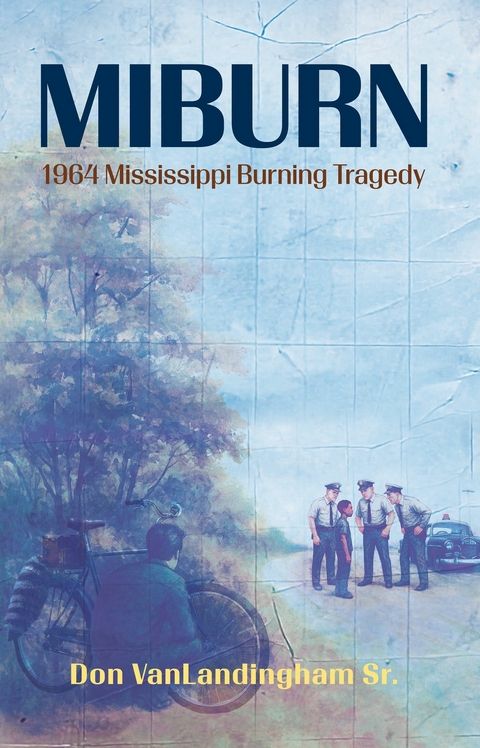
MIBURN (eBook)
200 Seiten
Bookbaby (Verlag)
979-8-3178-2395-5 (ISBN)
Don VanLandingham Biography Don spent his formative years in Jackson, Mississippi, from the sixth through the eleventh grades. His father, a career FBI agent was transferred for the 7th time to the Savannah, GA office, but Don returned to Mississippi in 1958 having graduated from college with a degree in accounting. He joined a local firm in Jackson and stayed in Mississippi until 1965 when he moved his family to Georgia, He specialized in forensic accounting and retired in 2000 where he took up his hobbies of fishing and kayaking. He discovered he had a gift of writing and has written two other books. Corruptacy is a novel about the bankruptcy industry, and Powhatan Justice spends a story of crime and betrayal in a small Appalachian town. He is married, the father of four children and two step-sons; grandfather to five and great-granddad to seven. At this writing he and his wife, Linda, have been married 36 years.
"e;He'll be back,"e; said one of the Ku Klux Klan members to the crowd of supporters. "e;His kind always comes back, and when he does, we'll be ready for him. We're organized, and we'll get him, and he'll be sorry he ever heard of the great state of Mississippi!"e; A rebel cheer went up with fists in the air. The Civil Rights Act of 1964, signed by President Johnson on July 2, 1964, marked the beginning of the end of the segregation of the races in the United States. Many people believe the Act would not have had the success it had if there had not been the public outrage occurring, because of the tragic murders of Michael Schwerner, James Chaney and Andrew Goodman just a few days before the signing of the Act. These three young men were among the hundreds of volunteering young people from all over the nation who were a part of "e;Freedom Summer"e;, the voter registration drive organized by the Student Nonviolent Coordinating Committee (SNCC). This book is about the events leading up to the murders in Neshoba County, Mississippi, the backgrounds of the victims, the search for their bodies and their ruthless Ku Klux Klan killers, and the resulting trial before a White Mississippi jury. Although this story is a novel it accurately portrays the major events as they occurred.
Part 1:
The Storm Clouds
Introduction
Following the Civil War, the South struggled for years, trying desperately to regain the political, economic, and social status it enjoyed before the war. Nowhere was this more evident than in Mississippi. Blacks were no longer slaves but found very little relief in their new role as tenant farmers. Former slave owners used the same shacks that formerly held their slaves as rundown shanties for the blacks’ new role as farmers. They toiled the same land as they always had; the only difference was they got paid for it, that is, until the plantation owner came knocking at their door within a couple of hours after paying the week’s wages and then collected the weekly rent, leaving a small amount for food.
On the weekend, to keep the new free citizens in line, friends of the plantation owner who were members of a fledging fraternal group known as the Ku Klux Klan would dress up in white hoods and masks and call on the neighborhood. Wearing their spooky uniform, they would ride up to a black’s home at night and demand water. The Klansman would gulp it down and demand more, having actually poured the water through a rubber tube that flowed into a concealed leather bottle. After draining several buckets, the rider would exclaim that he had not had a drink since he died on the battlefield. He would then get back on his horse and ride away. Since most of the former slaves were very superstitious, this would usually have its desired effect.
Following the U.S. Supreme Court’s decision in 1954 of Brown v. Board of Education, the state of Mississippi began to use more aggressive and imaginative tactics to try to intimidate blacks. In an effort to regain the state’s political status, the Mississippi State Sovereignty Commission was formed to try to regain the state’s former economic status through the birth of the White Citizens’ Council, and the social and police effort saw the rebirth of the dreaded Ku Klux Klan.
The Mississippi State Sovereignty Commission, formed in 1956, became the imaginative tool of then Governor J.P. Coleman. Its purpose was to provide an investigative branch within the state government to maintain racial segregation by investigating and monitoring the activities of the civil rights movement. It enlisted spies from both races to pass information on to its investigators. Getting help from the blacks was easy because there were many black schoolteachers who received their salaries from the counties where they taught. Implied economic threats were used to convince many to help the commission with damaging information about those that tried to interrupt the status quo. Prior to Ross Barnet becoming governor in 1960, the commission’s aim appeared to be educational and keeping down racial tension. That aim was tame in comparison to the commission’s activities after Barnet became governor.
He fired those from within the commission with whom he disagreed and appointed those who would become more militant in their activities. He doubled the number of investigators and embarked the commission on a mission that reminded many of Hitler’s Gestapo.
Many wondered aloud where the FBI was in all of this. Many believe FBI Director J. Edgar Hoover sympathized with the commission. Several of the commission’s investigators were former FBI agents, and at least two personal letters were written in 1959 from Hoover to the commission’s chief investigator. There also appeared to be close ties with the commission and the White Citizens’ Council.
The White Citizens’ Council1 was formed in 1954 in the delta town of Indianola. Its organizers and members were primarily bankers, plantation owners, doctors, lawyers, legislators, merchants, teachers, and preachers. The council sought to prevent the enforcement of the Brown v. Board of Education decision. Council members publicly renounced the use of violence, but its subtle suggestions encouraged racial intimidations against blacks. As an example, black school teachers were expected to keep the council informed about meetings in the black communities under threat of their dismissal as school teachers. Therefore, the council’s real success lay in its ability to levy economic reprisals on those who supported and actively pushed for desegregation. It was common knowledge that many members of the White Citizens’ Council were also members of the Ku Klux Klan.
The Ku Klux Klan1 was born following the Civil War near Pulaski, Tennessee, by six young former Confederate veterans as a social club but soon developed into America’s first terrorist organization. Operating primarily in the South, the Klan’s objects of hate were—and are—blacks, Jews, Catholics, and, more recently, the Hispanics. The official uniform is a ghoulish-looking white mask and a white cape, which is supposed to resemble the ghost of a confederate soldier. They set fire to wooden crosses with blazing torches.
Former Confederate General Nathan Bedford Forest became the first imperial wizard of the Klan. Following the Civil War, the KKK, as it became known, spread mischief and then terror, primarily among the black communities. Much of the Klan’s early reputation was based on mischief, but soon the mischief turned ugly. The armed white men riding into black communities at night reminded many blacks of the pre–Civil War slave patrols.
Klansmen riding with their faces covered intensified the blacks’ fear. Physical whippings of black “trouble-makers” were commonplace. Clashes followed between Klansmen and blacks or Klansmen and northerners, known as carpetbaggers, who had come South. Thousands of whites from Tennessee, Alabama, Georgia, and Mississippi joined the Klan, causing people to become alarmed about the escalating violence, not necessarily because they had sympathy for the victims, but because the violence was getting out of control. After all, anyone could put on a sheet and a mask and ride into the night to commit assault, robbery, rape, arson, or murder whether a member of the Klan or not.
By early 1868, stories about Klan activities were appearing in newspapers nationwide, and reconstruction governors realized they faced a terrorist organization. Orders went out from state capitals and Union army headquarters to suppress the Klan. Several attempts were made to infiltrate the organization. However, this proved to be unsuccessful, as evidenced by the infiltrators being killed or mutilated.
In 1871, Congress held hearings on the Klan and passed a tough anti-Klan law. Under the new federal law, Southerners lost their jurisdiction over the crimes of assault, robbery, and murder, and the president was authorized to declare martial law. Night riding and the wearing of masks were expressly prohibited. Consequently, hundreds of Klansmen were arrested even though few actually went to prison. Therefore, for all practical purposes, this ended the Ku Klux Klan’s first era of terror.
However, in the South, another series of events occurred that helped breathe life back into the Klan several decades later. The old cry of white supremacy created a feeling that blacks had to be kept in their place. The 1890s marked the beginning of the Deep South’s most divisive attempts to keep blacks politically, socially, and economically powerless. Most state segregation laws date from that period. It was also the beginning of a series of lynchings of blacks by white mobs.
After the turn of the century, a Spanish American War veteran turned preacher turned salesman by the name of William J. Simmons collected a group of eager men together in 1915. On Thanksgiving eve, Simmons herded his group onto a hired bus and drove them from Atlanta to nearby Stone Mountain. There, before a cross of pine boards, Simmons lit a match, and the Ku Klux Klan of the twentieth century was born.
The purpose of his Klan was graphically illustrated by Simmons when he was introduced to an audience of Georgia Klansmen. Standing before the Klansmen, he drew a Colt automatic pistol, a revolver, and a cartridge belt from his coat and arranged them on the table before him. Plunging a Bowie knife into the table beside the guns, he issued an invitation: “Now let the niggers, Catholics, Jews, and all others who disdain my imperial wizardry come out!”
By the late summer of 1921, nearly one hundred thousand people had enrolled in the invisible empire. At ten dollars a head (tax free, since the Klan was a benevolent society), the profits were impressive, and its violence was clearly revealed. A wave of repression punctuated by lynchings, shootings, and whippings swept over the nation in the early and mid-1920s, and many communities were firmly in the grasp of the Klan’s terror. The victims were usually blacks, Jews, Catholics, Mexicans, and various immigrants, but sometimes they were white, Protestant, and female. Klansmen would attack people they considered immoral or traitors to the white race.
During the 1930s, the nation wallowed in the Great Depression, and the Klan was shrinking to such a degree that it became primarily a fraternal society whose leaders urged KKK members to stay out of trouble. After Franklin Roosevelt took office, the Klan began to complain that he was bringing too many Catholics and Jews into the government. Later, they added the charge that the New Deal was tinged with communism. The red menace was used more and more by Klansmen as their...
| Erscheint lt. Verlag | 15.11.2025 |
|---|---|
| Sprache | englisch |
| Themenwelt | Sozialwissenschaften ► Politik / Verwaltung |
| ISBN-13 | 979-8-3178-2395-5 / 9798317823955 |
| Informationen gemäß Produktsicherheitsverordnung (GPSR) | |
| Haben Sie eine Frage zum Produkt? |
 EPUB (Ohne DRM)
Größe: 3,4 MB
Digital Rights Management: ohne DRM
Dieses eBook enthält kein DRM oder Kopierschutz. Eine Weitergabe an Dritte ist jedoch rechtlich nicht zulässig, weil Sie beim Kauf nur die Rechte an der persönlichen Nutzung erwerben.
Dateiformat: EPUB (Electronic Publication)
EPUB ist ein offener Standard für eBooks und eignet sich besonders zur Darstellung von Belletristik und Sachbüchern. Der Fließtext wird dynamisch an die Display- und Schriftgröße angepasst. Auch für mobile Lesegeräte ist EPUB daher gut geeignet.
Systemvoraussetzungen:
PC/Mac: Mit einem PC oder Mac können Sie dieses eBook lesen. Sie benötigen dafür die kostenlose Software Adobe Digital Editions.
eReader: Dieses eBook kann mit (fast) allen eBook-Readern gelesen werden. Mit dem amazon-Kindle ist es aber nicht kompatibel.
Smartphone/Tablet: Egal ob Apple oder Android, dieses eBook können Sie lesen. Sie benötigen dafür eine kostenlose App.
Geräteliste und zusätzliche Hinweise
Buying eBooks from abroad
For tax law reasons we can sell eBooks just within Germany and Switzerland. Regrettably we cannot fulfill eBook-orders from other countries.
aus dem Bereich