


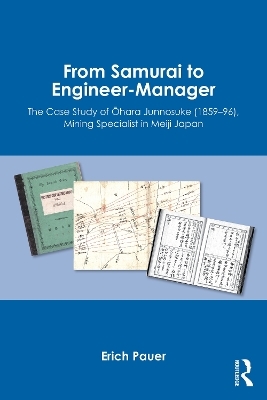
From Samurai to Engineer-Manager
Pallas Publications (Verlag)
978-90-485-7070-6 (ISBN)
- Noch nicht erschienen (ca. Mai 2026)
- Versandkostenfrei
- Auch auf Rechnung
- Artikel merken
From Samurai to Engineer-Manager reconstructs the life and work of the Japanese mining engineer Ōhara Junnosuke in the early decades of Japan’s industrialization.
While Japan's political and socio-economic development during the Meiji period has been extensively researched, the technological/technical foundations that were crucial to its success have remained largely obscure. Drawing on unique, mostly handwritten sources including lecture notes, internship and work experience reports, travelogues and diaries, the example of Ōhara Junnosuke illustrates the beginnings of engineering education in Japan and its intertwining with the subsequent professional career of the protagonist. Born in 1859 into a samurai family, Ōhara Junnosuke studied at the Imperial College of Engineering in Tōkyō, the first higher technical school in Japan. He worked for the Ministry of Public Works, then joined a private mining company as head manager of the Ōmori Mine in Iwami, where he oversaw the construction of a modern silver production plant. His premature death in 1896 ended a promising career.
Ōhara’s education and professional career are in many ways typical of Japan’s emerging technical elite and their contribution to the industrialization. The book will be of interest to scholars in the fields of history of technology, economic history and history of education not only concerning Japan, but in general.
Erich Pauer is Professor emeritus of Japanese Studies at the University of Marburg (Germany) and presently engaged in the Centre Européen d’Études Japonaises d’Alsace (CEEJA) in Colmar, France. He has written widely on Japan’s history of technology and economic development from the Edo period to World War II. His recent publications include Technical Knowledge in Early Modern Japan (ed. with Ruselle Meade 2020), Accessing Technical Education in Modern Japan 2 vols. (ed. with Regine Mathias, 2022).
1. Prologue: Some personal remarks on the history of the Ōhara Papers 2. Technical education on the eve of Japan’s industrial revolution – An overview 3. Ōhara Junnosuke: Engineer and manager – A biographical sketch 4. To new shores 5. From civil service to private industry 6. Conclusion 7. Epilogue Appendix 1 William Gray Dixon, The Land of the Morning. An account of Japan and its people, based on a four years’ residence in that country Appendix 2 Kōgaku-ryō narabi ni sho kisoku Appendix 3 Examination papers for the entrance examination to the Imperial College of Engineering References Index
| Erscheint lt. Verlag | 15.5.2026 |
|---|---|
| Zusatzinfo | 96 Halftones, color; 96 Illustrations, color |
| Verlagsort | Amsterdam |
| Sprache | englisch |
| Maße | 156 x 234 mm |
| Themenwelt | Geisteswissenschaften ► Geschichte ► Regional- / Ländergeschichte |
| Sozialwissenschaften ► Soziologie ► Spezielle Soziologien | |
| ISBN-10 | 90-485-7070-0 / 9048570700 |
| ISBN-13 | 978-90-485-7070-6 / 9789048570706 |
| Zustand | Neuware |
| Informationen gemäß Produktsicherheitsverordnung (GPSR) | |
| Haben Sie eine Frage zum Produkt? |
aus dem Bereich


