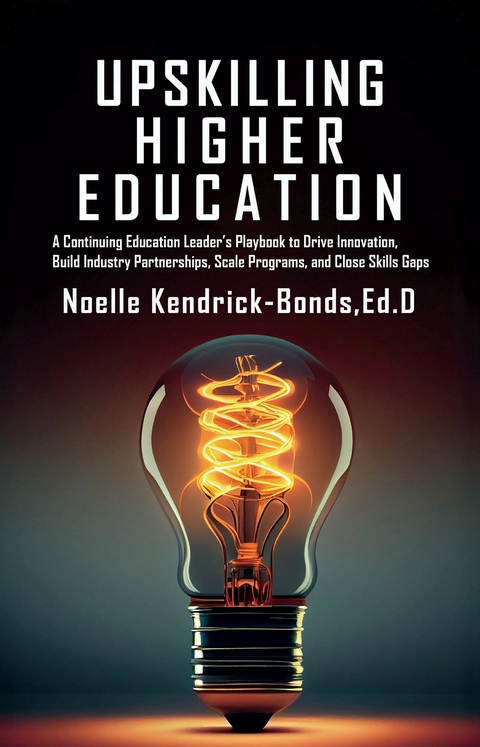
Upskilling Higher Education: A Continuing Education Leader's Playbook to Dr. (eBook)
236 Seiten
Bookbaby (Verlag)
979-8-3178-2200-2 (ISBN)
Noelle Kendrick-Bonds, Ed.D, is a visionary leader in upskilling, workforce education, and business development, with a career spanning over a decade across higher education, ed-tech solutions, and business development. As the founder and CEO of MODRN Education, she specializes in bridging the critical gaps between higher education, industry, and workforce needs-empowering institutions and individuals alike through innovative partnerships, transformative course design, and holistic consulting. Through thousands of hours of working with higher education institutions, dozens of industry associations, individual companies, workforce development organizations in the US and abroad, and studying various product types and their challenges, benefits, and funding models, she made it her mission and business to understand the ecosystem of upskilling education and what it would take for universities to play a strong role in providing industry education. A systems thinker at heart, Noelle's multifaceted expertise enables her to deliver actionable solutions that drive real-world impact for organizations and learners worldwide. Noelle has also spent 13 years teaching professional adult learners and has developed and taught undergraduate and graduate courses in business, liberal arts, and political science programs at multiple universities. Her learner-centered approach and practical curriculum design have impacted students across generations and industries. Beyond academia, Noelle's journey includes service as a K-12 educator, city commissioner, and U.S. Army veteran with tours in Iraq and Afghanistan. Her academic credentials-a Doctorate in Education and Organizational Leadership from Northeastern University, a Master's in Public Policy and Public Administration from Northwestern University, and a Bachelor's in Political Science from Campbell University-reflect her lifelong commitment to learning, leadership, and educational innovation. Driven by a passion to transform lives through education, Noelle stands as a catalyst for change, dedicated to cultivating tomorrow's leaders and fostering a culture of continuous growth.
In a rapidly changing workforce landscape, higher education and continuing education leaders face unprecedented pressure to deliver upskilling programs that are both relevant and financially sustainable. This book delivers a candid, experiential, and research-driven exploration of why many university certificates and micro-credentials struggle in today's competitive market-and reveals what institutions must do differently to succeed. Drawing on deep industry insight, the author uncovers the pitfalls of simply repackaging traditional courses and content, clarifies the crucial distinctions between professional development and advancement education, and emphasizes the importance of aligning offerings with real industry needs and employer expectations. Packed with practical frameworks and best practices for product development, pricing, partnerships, and marketing, this essential guide challenges leaders to move beyond outdated mindsets and embrace agility, flexibility, and market alignment. With clear explanations, real-world examples, and actionable solutions, it equips institutions-whether new to workforce education or seeking to revitalize existing programs-with the tools and strategies needed to build high-impact, market-driven upskilling initiatives that truly bridge the skills gap and secure their place in the future of work. Building on this unique perspective, the book is crafted at the intersection of product development, business development, workforce education, and higher education innovation. The author's extensive experience spans thousands of hours working directly with higher education institutions, industry associations, workforce development organizations, and a diverse range of employers. This first-hand exposure is combined with rigorous research into upskilling initiatives from corporates, academic providers, and industry groups to distill the most effective product development practices across sectors. Readers benefit from a sharply integrative approach one that breaks down the silos between higher education, industry, and workforce training, offering actionable frameworks for leaders who seek to design, launch, and scale compelling upskilling solutions that serve both organizational and learner needs.
Chapter 1
Mindsets: The Impacts of Higher Education Culture and Models on Upskilling Products and the Need for Radical Paradigm Shifts
“We don’t see the world as it is; we see it as we are.”
– Anaïs Nin
It is said that there is no greater challenge than to see outside the bounds of our own perspective—something that we no doubt teach in higher education. But how well we become students of our own lessons is the question; in higher education, sadly, the answer is not often well enough. Anyone who works in higher education knows that the cultural challenges within higher education are strong, if not insurmountable, in many cases. And so, the next lesson to learn is admitting we have a problem—and then actually doing something about it. At some point, we have to stop talking and start doing things differently: one person at a time, one project at a time, one product at a time, one meeting at a time, one process at a time. This is especially relevant when we create industry or workforce education products from our own higher education lens. Do you see the problem already?
The Fears of the Wild West and Unrealistic Prayers for Regulation
Before addressing other mindset challenges in higher education, let’s cover the notion of “the Wild West” and its implications. In higher education, we are accustomed to a highly regulated environment with numerous governing bodies dictating what we can and cannot do, including regional or national accreditors, the Department of Education, Federal Student Aid, and state departments of education.
When it comes to college degrees and federal and state financial aid, this highly regulated landscape makes sense. Higher education institutions are the gatekeepers and influencers of the American economy and the American dream. Therefore, the education they offer—its alignment with the economy—and the significant investments made by both students and the government toward college degrees must be carefully monitored and regulated. In this context, oversight is essential. However, we are now talking about a whole new world: the world of upskilling, where short-term, non-credit workforce education exists without such oversight.
I have often heard the upskilling market described as “the Wild West,” usually expressed with anxiety, confusion, and even disdain. Many higher education leaders have been calling for more oversight of these products for a couple of reasons: 1) To remove the unknown. As it stands, there is no transparency around product outcomes or sales/enrollments of higher education non-credit products. Not being able to track each other and the sale of these products through something like IPEDS seems to give many people real anxiety around producing them, since there is no way to easily know what is working or what is not for others. 2) In hopes of a framework, standard definitions, or some level of consistency that would make it easier to produce products that had a market, met the needs of that market, ensured employers knew that it was quality, and ultimately told us all what to do and what not to do.
Unfortunately, I would argue that neither of those things is ever likely to happen, addressing the fears of the Wild West — even after the passage of recent legislation providing Pell Grant funding for some short-term credentials — at least not in the way many have hoped. In the world of upskilling, you are entering a landscape dominated by a variety of corporate and nonprofit competitors that have been present for decades. Before this bill, I would have stated that this was a space where no reasonable jurisdiction existed for accreditation bodies and where the state or any form of government had few grounds to enforce anything; where there is no federal or state financial aid, there is no oversight. After this “Big Beautiful Bill” was passed, it appears that only higher education institutions will face regulations and oversight in this multi-billion-dollar landscape. While some higher education leaders consider this a victory — and no doubt the funding is a good thing — this Wild West will most certainly remain so for the following reasons:
- This is a multi-billion-dollar industry that has long existed before higher education entered the scene. There remains no organization or government body capable of overseeing the entire landscape. There are literally millions of these types of products in the global upskilling market today, the vast majority of which will continue to live outside of any regulatory bodies or funding. Any new regulation will apply only to higher education institutions and some of those products, which could prove to be detrimental in the upskilling space, where flexibility to meet market needs and compete is necessary.
- Currently, employers across various industries have expressed concerns about higher education’s ability to prepare their future workforce to meet their needs. Adding accreditation to non-credit certificates, by the same accreditors that oversee college degrees and for-credit certificates now does nothing to solve that problem. How many degree programs are in the market today that shouldn’t be?
- Even with funding for these products, that doesn’t mean there will be any universal standards for product development, outcomes assessment, etc. Meeting industry needs is the primary purpose of the product, and products will vary greatly depending on the job and their intended purpose. Additionally, we have little evidence to believe that the government would collect in-depth data on these products. Right now, for degree programs, we can see completion rates in aggregate data, but not the juicy details of how degree programs were built, what frameworks or best practices are used from one institution to another, what students think of their degree, and what job it got them in the end, etc. For workforce education products currently funded by the multi-billion-dollar federal WIOA fund, there is no consolidated data source for any of those products or their outcomes. These products and their outcomes are tracked locally at the workforce development board level and by the states, even though they are receiving federal workforce education funds. Given the goals of the current administration, it would seem unlikely that a massive federal government system would be created for such a purpose, and even if it were, consider what you currently receive from IPEDS. This is not the kind of data and frameworks that higher education leaders have envisioned.
- We have a president and an education secretary who are steadily trying to dismantle the education department, have already gutted it, and are on a mission to move nearly everything out of it and place it under the states. If and when that happens remains to be seen; however, he has three and a half more years to work toward this. In addition, higher education accreditation bodies are also in the spotlight and under scrutiny, and there may be many sweeping changes on the horizon as well.
- While new Pell Grant funding may apply to short-term credentials meant to get someone a job — which the MODRN Education Upskilling Framework refers to as professional advancement education—that doesn’t mean that it will ever apply to micro-credentials and other micro-products used strictly for upskilling and professional development of particular skills, which is a vast market that is more aligned to the needs of employers. These are far less likely to qualify and therefore be regulated, even for higher education institutions.
- In terms of the business and sales impact, while Pell Grant funding may be helpful for some who are financially qualified — provided they are not already receiving maximum Pell for a college degree—many more professionals need upskilling who are not qualified for that kind of funding and will continue to have to pay for their own continuing education out of pocket. This still ensures a highly competitive landscape with other workforce education providers, regardless of any new financial aid, and many products will not qualify for any financial aid.
- Lastly, at this time, Pell Grant is only available for products that have already existed for at least one year before July 2026, and is restricted to programs that have had greater than a 70% completion rate and a 70% job placement rate within 180 days of completion, with value added earnings that exceed the median price of the program, in addition to other requirements about leading to industry recognized credentials, etc. Sadly, these requirements already eliminate the vast majority of higher education products currently available on the market. This bill is putting regulations on funding for current products, but thus far, it is doing little to advance anything moving forward.
The statement, “Be careful what you wish for” rings true here. Any data that comes from this is unlikely to be the answered prayer of some higher education leaders. Universities will continue to have to create their own products, track their outcomes, and make their own case for them as a business, just like any other that must prove its products work. I do worry about the impact that any new regulations will have on higher education products trying to compete in this space. There will never be a body overseeing the free market of corporations, industry associations, private consultants, and others that currently dominate this space. No one can make them create products in a certain...
| Erscheint lt. Verlag | 12.11.2025 |
|---|---|
| Sprache | englisch |
| Themenwelt | Sozialwissenschaften ► Pädagogik ► Erwachsenenbildung |
| ISBN-13 | 979-8-3178-2200-2 / 9798317822002 |
| Informationen gemäß Produktsicherheitsverordnung (GPSR) | |
| Haben Sie eine Frage zum Produkt? |
 EPUB (Ohne DRM)
Größe: 1,5 MB
Digital Rights Management: ohne DRM
Dieses eBook enthält kein DRM oder Kopierschutz. Eine Weitergabe an Dritte ist jedoch rechtlich nicht zulässig, weil Sie beim Kauf nur die Rechte an der persönlichen Nutzung erwerben.
Dateiformat: EPUB (Electronic Publication)
EPUB ist ein offener Standard für eBooks und eignet sich besonders zur Darstellung von Belletristik und Sachbüchern. Der Fließtext wird dynamisch an die Display- und Schriftgröße angepasst. Auch für mobile Lesegeräte ist EPUB daher gut geeignet.
Systemvoraussetzungen:
PC/Mac: Mit einem PC oder Mac können Sie dieses eBook lesen. Sie benötigen dafür die kostenlose Software Adobe Digital Editions.
eReader: Dieses eBook kann mit (fast) allen eBook-Readern gelesen werden. Mit dem amazon-Kindle ist es aber nicht kompatibel.
Smartphone/Tablet: Egal ob Apple oder Android, dieses eBook können Sie lesen. Sie benötigen dafür eine kostenlose App.
Geräteliste und zusätzliche Hinweise
Buying eBooks from abroad
For tax law reasons we can sell eBooks just within Germany and Switzerland. Regrettably we cannot fulfill eBook-orders from other countries.
aus dem Bereich