


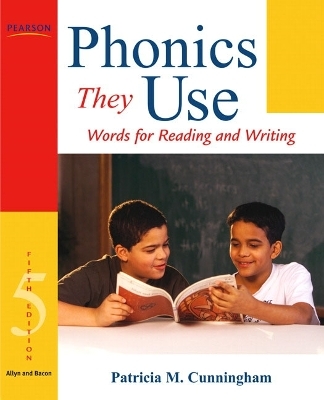
Phonics They Use
Pearson (Verlag)
978-0-205-60888-1 (ISBN)
- Titel erscheint in neuer Auflage
- Artikel merken
Long-positioned and long-respected as a bestseller by both pre-service and practicing teachers of reading, this affordable text offers a coherent collection of practical, hands-on activities that provide a framework for teaching phonics. The Fourth Edition continues to emphasize that what matters is not how much phonics students know but what they actually use when they need phonics for decoding a new word, for reading and spelling a new word, and for writing. Rather than subscribe to a single theory, Pat Cunningham stresses a balanced reading program—-incorporating a variety of strategic approaches--tied to the individual needs of children. Packed with new activities and strategies for teaching reading, this book is an invaluable resource for any new or veteran teacher.
Now teachers have access to a new grade-level series Making Words that offers fresh multi-level activities and lessons for the kindergarten through fifth grade classroom. Based on the active and innovative approach to making words that teachers and their students have grown to love in Phonics They Use, this new series is the best resource you can have on hand for motivating your students to learn words!
Take a Peek at What's New to the Edition!
New Chapter on Making Words in Kindergarten (Ch. 4) describes and provides sample lesson plans on how teachers can make each kindergarten student a letter of the alphabet, using a big letter card, to teaching them how to begin to form words.
New Chapter on Making Words in Upper Grades (Ch. 11) describes and provides sample lessons on how making words has been adapted for use of older students in upper grades, by emphasizing the prefixes, suffixes, roots and spelling changes that are the important decoding and spelling patterns for polysyllabic words.
Inclusion of hints and suggestions for English Language Learners scattered throughout the chapters, which help make phonics and spelling instruction more successful for ELLs as they learn to read and write. These “For English Language Learner” boxes include a variety of ways teachers have adapted the Phonics They Use activities to include their children learning English.
Patricia M. Cunningham The day I entered first grade, I decided I wanted to teach first grade. In 1965, I graduated from the University of Rhode Island and began my teaching career teaching first grade in Key West, Florida. For the next several years, I taught a variety of grades and worked as a curriculum coordinator and special reading teacher in Florida and Indiana. From the very beginning, I worried about children who struggled learning to read and devised a variety of alternative strategies to teach them to read. In 1974, I received my Ph. D. in Reading Education from the University of Georgia. I developed the Making Words activity while working with Title One teachers in North Carolina where I was the Director of Reading for Alamance County Schools. I have been the Director of Elementary Education at Wake Forest University in Winston Salem, North Carolina since 1980 and have worked with numerous teachers to develop hands-on engaging ways to teach phonics and spelling. In 1991, I published Phonics they Use: Words for Reading and Writing, which is currently available in its fourth edition. Along with Richard Allington, I published Classrooms that Work and Schools that Work. Dottie Hall and I have worked together on many projects. In 1989, we began developing the Four Blocks Framework, a comprehensive approach to literacy which is used in many schools in the United States and Canada. Dottie Hall and I have worked together to produce many books, including the first Making Words books and the Month by Month Phonics Books. These Making Words by Grade Level books are in response to requests by teachers across the years to have making words lessons with a scope and sequence tailored to their grade level. We hope you and your students will enjoy these making words lessons and we would love to hear your comments and suggestions.
Introduction
Part One Building The Foundation for Phonics They Can Use
Chapter 1 Early Reading and Writing Activities
Early Reading Concepts
Shared Reading of Predictable Books
Predictable Charts
Writing
Getting to Know You
Summary
Chapter 2 Phonological and Phonemic Awareness
Developing Phonological Awareness
Developing the Concept of Rhyme
Teaching Blending and Segmenting
Using Names to Build Phonological and Phonemic Awareness
Summary
Chapter 3 Concrete Words, Letter Names, and Sounds
Names
Alphabet Books
Letter Actions and Foods
Key Words for Sounds
Changing a Hen to a Fox
Guess the Covered Word
Chapter 4 Making Words in Kindergarten
How the Foundational Activities are Multilevel
Part Two Fluency
Chapter 5 Fluency Activities
Independent Reading Develops Fluency
Daily Writing Develops Fluency
Rereading Develops Fluency
Fluency Development Lessons
Summary
Chapter 6 High-Frequency Words
Building Meaning for High-Frequency Words
Doing A Word Wall
On-the Back Activities
Other Word Wall Practice Activities
Portable and Take Home Word Walls
Theme Boards
How Fluency Activities and Word Wall are Multilevel
Part Three Using Phonics and Spelling Patterns
Chapter 7 Making Words
A Sample Making Words Lesson
Making Words Homework Additional Making Words Lessons
Summary
Chapter 8 Rhyme-Based Decoding and Spelling Activities
Learning the Most Common Rhyming Patterns
Rounding up the Rhymes
Using Words You Know
Reading/Writing Rhymes
Summary
Chapter 9 Spelling Activities
What Looks Right?
Word Sorting and Hunting
How Part Three Activities are Multilevel
Part Four Big Words
Chapter 10 Decoding and Spelling Big Words
Teaching Common Prefixes and Suffixes
Teaching Common Root Words
The Nifty Thrifty Fifty
Big Word Collectors
Modeling How to Figure Out a Big Word
Word Detectives
The Wheel
Mystery Word Match
Summary
Chapter 11 Making Words in Upper Gades
A Third Grade Making Words Lesson
A Fourth Grade Making Words Lesson
A Fifth Grade Making Words Lesson
How the Big Words Activities are Multilevel
Part Five Coaching, Assessment and Research
Chapter 12 Coaching for Strategic Decoding and Spelling
Coaching during Writing Conferences
Coaching during Reading
Summary
Chapter 13 Assessment
What is Assessment?
Assessing Early Reading Behaviors
Assessing Word Strategies
The Names Test
Summary
Chapter 14 The Theory and the Research–The Why Underlying the How
My Personal Phonics History
What We Know About How Good Readers Read Words
What We Know About How Children Learn to Read Words
The Research and Phonics They Use
Chapter 15 Phonics Terminology for Teachers
| Erscheint lt. Verlag | 29.4.2009 |
|---|---|
| Sprache | englisch |
| Maße | 191 x 232 mm |
| Gewicht | 485 g |
| Themenwelt | Geisteswissenschaften ► Sprach- / Literaturwissenschaft ► Sprachwissenschaft |
| Sozialwissenschaften ► Pädagogik ► Berufspädagogik | |
| Sozialwissenschaften ► Pädagogik ► Schulpädagogik / Grundschule | |
| ISBN-10 | 0-205-60888-4 / 0205608884 |
| ISBN-13 | 978-0-205-60888-1 / 9780205608881 |
| Zustand | Neuware |
| Informationen gemäß Produktsicherheitsverordnung (GPSR) | |
| Haben Sie eine Frage zum Produkt? |
aus dem Bereich


