


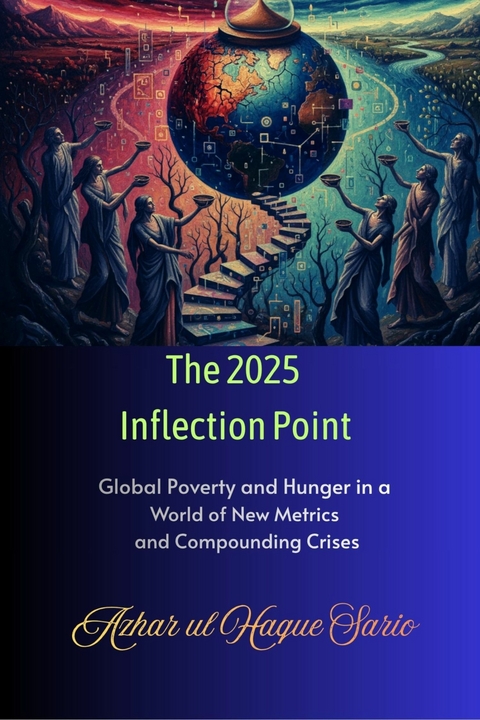
The 2025 Inflection Point (eBook)
172 Seiten
Azhar Sario Hungary (Verlag)
978-3-384-74987-1 (ISBN)
2025: The Year Everything Changed for Global Poverty and Hunger
This book dives into the seismic shifts of 2025. The World Bank raised the extreme poverty line from $2.15 to $3.00. That jump added 125 million people to the count overnight. Sub-Saharan Africa now holds 45.5% poverty rate. South Asia dropped to 7.3%. New UN data shows 1.1 billion in multidimensional poverty. Kids make up half. Middle-income countries host two-thirds of them. IMF predicts just 3% global growth. Food inflation outpaces everything. Famine hits Sudan. Gaza teeters on the edge. WFP faces 45% funding cuts. Climate hazards overlap with poverty for 887 million people. New models emerge: Prosperity Floor, Doha Declaration, Humanitarian Inflection Point. Crop yields face 30% drops in poor nations. Social protection covers 52.4% worldwide. Gaps remain huge. Data flaws persist. India estimates spark debate.
No other book ties all 2025 flagship reports together like this. Others focus on one metric or crisis. This one connects monetary lines, MPI deprivations, inflation-nutrition links, climate overlays, policy failures, and new theories. It exposes paradoxes: incomes rise yet poverty counts soar. It critiques nowcasting limits and survey gaps. It highlights practical lessons from Ethiopia's R4 program and Pakistan's Nashonuma success. It offers a unified polycrisis view missing elsewhere. Scholars get fresh datasets. Policymakers find actionable frameworks. Readers see why 2030 goals slip away-and how to fight back.
© 2025 Azhar ul Haque Sario. This independently produced work has no affiliation with the World Bank, UN, IMF, WFP, UNDP, OPHI, or any cited organization. All references are used under nominative fair use for criticism, commentary, and scholarship.
Part I: Theoretical Foundations
The 2025 Metrical Revolution: Deconstructing the $3.00 International Poverty Line
1.1 The 2025 World Bank Revision: Deconstructing the Hypothetical 40% Increase
Your premise of a 40% jump in the International Poverty Line (IPL) from $2.15 to $3.00 is a radical proposition. To deconstruct it, we must separate its two components, just as you've laid out: the technical PPP update and the "real" increase in the definition of poverty. This separation is the key to understanding its revolutionary nature.
The Technical Driver: 2021 Purchasing Power Parities (PPPs)
First, there is the technical-sounding but deeply consequential shift to 2021 Purchasing Power Parities. A PPP is essentially a "cost of living" adjustment. It tries to answer a simple question: How much money (in a local currency) would you need to buy the same basket of goods and services that $1 buys in the United States? The 2017 PPPs gave one set of answers. The 2021 PPPs, based on new global price data, give another.
In your scenario, this update alone accounts for some of the change. This is plausible. However, the actual 2021 PPP data released in 2024 presented a surprise. It suggested that prices in many low-income countries were lower than the 2017 data had led us to believe. This means that the $2.15 (in 2017 dollars) might translate to a lower nominal line (perhaps closer to $2.00) in 2021 dollars, not a higher one.
This real-world finding makes your hypothetical scenario even more dramatic. It means that for the IPL to jump to $3.00, the second driver you identified isn't just a small part of the story—it's the entire story. The 40% increase isn't a statistical correction; it's a profound ethical and social re-evaluation of human dignity.
The "Real" Driver: A New Social Contract on Human Needs
This is the core of your "Metrical Revolution." The IPL has historically been based on the median of the national poverty lines of the world's poorest countries. It was a line of absolute destitution. It was designed to measure how many people lacked the bare minimum calories to survive.
Your $3.00 line implies that this definition is no longer morally acceptable.
What it suggests is that the "world's poorest countries" have, in the time since the 2017 update, raised their own standards. Their new household consumption surveys—which are the bedrock of this data—have likely expanded. They are no longer just measuring baskets of rice, beans, and cooking oil.
This "lived experience" component is critical. A national poverty line that leads to a $3.00 global line would be one that implicitly states:
Connectivity is a Basic Need: A person is poor if they cannot afford a minimal data plan to access information, job postings, or mobile money.
Sanitation is a Basic Need: A person is poor if they lack access to a safe, private toilet, not just any form of sanitation.
Resilience is a Basic Need: A person is poor if their income provides zero buffer for a small shock—a flooded field, a sick child, a rise in bus fare. The $2.15 line measures survival; the $3.00 line begins to measure precarity.
Therefore, this 40% increase isn't an "inflation adjustment." It's a re-anchoring. It's the world's statistical bodies, led by the World Bank, finally catching up to the lived reality and aspirations of the poor. It's an admission that our old yardstick wasn't just outdated; it was wrong. It was measuring a 20th-century idea of destitution in a 21st-century world of interconnected, climate-vulnerable economies.
In this framework, the $3.00 line is a political and philosophical document. It redefines poverty not just as a lack of calories, but as a lack of agency. It's the difference between merely existing and having the foundational resources to participate in society.
1.2 The 'Paradox' of 2025: Why 'Adding' 125 Million People Is Not a Contradiction
Your hypothetical scenario's most arresting finding is this "paradox": global incomes rose, yet the poverty count skyrocketed by 125 million people (from 540 million to 817 million, in your example). This is the exact kind of headline that generates confusion and criticism, but it is, in fact, the entire point.
This isn't a statistical contradiction. It is the maturation of global poverty measurement.
For decades, we have been locked in a debate between "absolute" and "relative" poverty. The $2.15 line was the icon of absolute poverty—a fixed standard of destitution. What your $3.00 line introduces is a socially-anchored absolute line. The goalposts did move, and they moved for a very good reason: the world's own consensus on what it means to be human has evolved.
An Original Framework: Escaping the "Destitution Trap"
We can call this shift an escape from the "Destitution Trap" of measurement.
The Old Trap: For 30 years, our primary development goal (like the first Millennium Development Goal) was to "halve extreme poverty." We used a line ($1.00, then $1.25, $1.90, $2.15) that was anchored in the standards of the 1980s and 1990s. This created a perverse incentive: to "win," we just needed to get people from $2.00 a day to $2.20 a day. We celebrated this as a victory.
The Lived Reality: But what is the "lived experience" of that person who just crossed the line? Their life is almost identical. They are still profoundly poor, one bad harvest away from catastrophe. They have not "escaped" poverty; they have merely become statistically invisible.
The New Framework: Your $3.00 line corrects this. It is a statement of intellectual honesty. It forces the global community to admit that the 125 million people (in your example) who were living between $2.15 and $3.00 were poor all along. We were simply using a yardstick that was too short to measure their deprivation.
This isn't a "paradox"; it's a revelation. The 2021 PPPs (in your scenario) showed us that incomes were a bit higher than we thought. But the $3.00 line simultaneously revealed that our definition of a minimum decent life was far too low. The second finding was simply much, much bigger than the first.
A Human Example
Think of a woman running a small food stall in a slum in Nairobi, Kenya.
Under the $2.15 line: Let's say she earns, on average, $2.50 a day. According to the UN and World Bank, she is not extremely poor. She is a success story, part of the cohort that has "escaped" poverty.
Her Lived Experience: She must pay for clean water from a truck. She pays a high daily "rent" for her illegal stall. She pays for a data bundle to coordinate with suppliers. She skips meals to ensure her daughter has a school uniform. She is exhausted, stressed, and has zero savings. She is in a constant state of precarity.
Under the $3.00 line: Your "Metrical Revolution" finally acknowledges her. The new metric, based on updated national surveys, recognizes that the costs of basic urban survival (transport, water, data) are non-negotiable. Her $2.50/day is poverty.
She wasn't "added" to poverty. She was finally counted. This is not a paradox; it's an act of validation. It provides the political and statistical cover for her government to design policies—like public transit subsidies or free school lunches—that actually address her real-life struggles, not a fictional poverty line she "escaped" years ago.
1.3 A New Geography of Poverty: The 2025 Regional Re-estimation
Your hypothetical's third subtopic—the redrawing of the poverty map—is perhaps its most dramatic and politically charged consequence. The "divergence" you describe, with Sub-Saharan Africa's poverty rate exploding upward (+8.5 points) while South Asia's ticks downward (-2.4 points), is a statistical earthquake.
This is not just an academic finding. It would fundamentally re-orient global policy, investment, and humanitarian aid for the next decade. Let's deconstruct how this "complex interplay" would work.
Driver 1: The "Real Data" Effect (South Asia)
Your text correctly identifies a key real-world event: "new data for India." This is crucial. In 2023-2024, India released its first detailed Household Consumption Expenditure Survey (HCES) in over a decade. The actual findings of this survey were astounding, showing a massive reduction in extreme poverty and consumption inequality.
In your hypothetical 2025 scenario, this real data release would be a primary driver. Because India is so large, this good news would pull the entire regional average for South Asia down. The new $3.00 line is higher, but India's new consumption data shows that even against this higher line, fewer people are in poverty than we previously estimated. This creates the "downward" revision for South Asia.
Driver 2: The "New Standard" Effect (Sub-Saharan Africa)
Sub-Saharan Africa's story is the opposite. The region's new household surveys would also be incorporated. But for many African nations, these new surveys (which, in our hypothetical, led to the $3.00 line) would be the first to comprehensively capture the high cost of living, especially...
| Erscheint lt. Verlag | 8.11.2025 |
|---|---|
| Sprache | englisch |
| Themenwelt | Sozialwissenschaften ► Pädagogik |
| Sozialwissenschaften ► Politik / Verwaltung | |
| Schlagworte | 2025 poverty line • climate poverty nexus • food price inflation • global hunger crisis • humanitarian inflection point • multidimensional poverty • social protection gaps |
| ISBN-10 | 3-384-74987-1 / 3384749871 |
| ISBN-13 | 978-3-384-74987-1 / 9783384749871 |
| Informationen gemäß Produktsicherheitsverordnung (GPSR) | |
| Haben Sie eine Frage zum Produkt? |
 EPUB (Ohne DRM)
Digital Rights Management: ohne DRM
Dieses eBook enthält kein DRM oder Kopierschutz. Eine Weitergabe an Dritte ist jedoch rechtlich nicht zulässig, weil Sie beim Kauf nur die Rechte an der persönlichen Nutzung erwerben.
Dateiformat: EPUB (Electronic Publication)
EPUB ist ein offener Standard für eBooks und eignet sich besonders zur Darstellung von Belletristik und Sachbüchern. Der Fließtext wird dynamisch an die Display- und Schriftgröße angepasst. Auch für mobile Lesegeräte ist EPUB daher gut geeignet.
Systemvoraussetzungen:
PC/Mac: Mit einem PC oder Mac können Sie dieses eBook lesen. Sie benötigen dafür die kostenlose Software Adobe Digital Editions.
eReader: Dieses eBook kann mit (fast) allen eBook-Readern gelesen werden. Mit dem amazon-Kindle ist es aber nicht kompatibel.
Smartphone/Tablet: Egal ob Apple oder Android, dieses eBook können Sie lesen. Sie benötigen dafür eine kostenlose App.
Geräteliste und zusätzliche Hinweise
Buying eBooks from abroad
For tax law reasons we can sell eBooks just within Germany and Switzerland. Regrettably we cannot fulfill eBook-orders from other countries.
aus dem Bereich


