Zum Hauptinhalt springen
Nicht aus der Schweiz? Besuchen Sie lehmanns.de
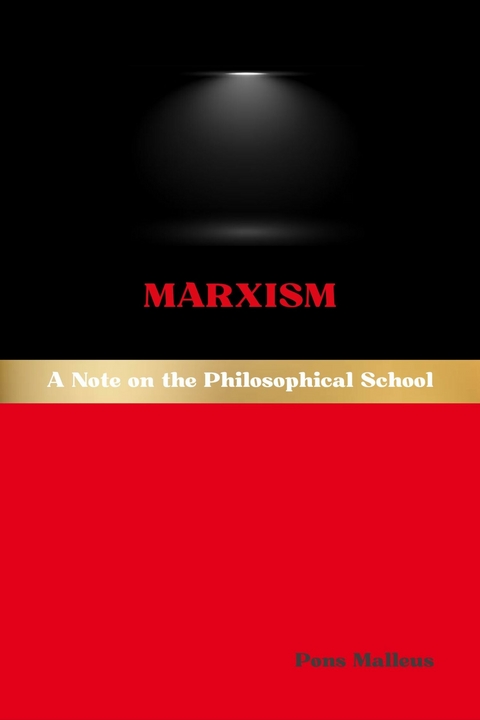
Marxism: A Note on the Philosophical School -  Pons Malleus

Marxism: A Note on the Philosophical School (eBook)

(Autor)

eBook Download: EPUB
2025 | 1. Auflage
106 Seiten
Publishdrive (Verlag)
978-0-00-109900-5 (ISBN)
Systemvoraussetzungen
5,99 inkl. MwSt
(CHF 5,85)
Der eBook-Verkauf erfolgt durch die Lehmanns Media GmbH (Berlin) zum Preis in Euro inkl. MwSt.
  • Download sofort lieferbar
  • Zahlungsarten anzeigen

Marxism, perhaps more than any other philosophical school of thought in the modern era, has stirred the minds, hearts, and struggles of individuals across the globe. Born from the sharp critique of capitalism and the vision of a just society, it has stood as both a rallying cry for revolution and a subject of intense academic inquiry. This book seeks to present the evolution of Marxist philosophy, its internal debates, and its relevance in a world grappling with deep inequalities, ecological crises, and shifting political paradigms.


The philosophical foundations of Marxism trace their roots to the intellectual upheavals of 19th-century Europe. Karl Marx, alongside Friedrich Engels, synthesized the critical currents of German idealism (particularly Hegel), British political economy (especially Adam Smith and David Ricardo), and French socialism. Yet, Marxism was never merely a sum of its parts; it emerged as a transformative critique of existing social relations and a method for understanding-and changing-the world. Marx's materialist conception of history, his theory of class struggle, and his analysis of capital are not static doctrines but dynamic tools meant to interpret and intervene in society.


Marxism posits that human history is shaped by material conditions and economic relations, and that the engine of historical change lies in the conflict between social classes. At its core is a belief that capitalism, while historically progressive in its early development, inevitably generates contradictions-between labor and capital, use value and exchange value, private property and social need-that make it unsustainable. These contradictions, Marx argued, would ultimately lead to the system's demise and the emergence of a classless, communist society.


This book does not seek to offer a dogmatic account of Marxism but rather to engage with its rich and often contested legacy. Marxist thought has undergone numerous transformations-through Leninism, Maoism, Western Marxism, critical theory, and post-Marxism, among others. Each of these variations has attempted to adapt Marxist analysis to new contexts, from the dynamics of imperialism and colonialism to questions of ideology, culture, and subjectivity. The diversity within Marxist theory is a testament to its vitality and its capacity for self-critique.


Equally important is the relationship between theory and practice. Marxism has always emphasized praxis: the unity of philosophical reflection and political action. It is in the struggles of workers, peasants, students, and activists that Marxist ideas have found their most powerful expressions. From the Paris Commune to the Russian Revolution, from anti-colonial liberation movements to contemporary debates on climate justice and neoliberalism, Marxism has served as both a lens and a weapon.


Yet, we must also confront the complexities and failures of Marxist-inspired regimes and movements. The history of Marxism includes authoritarian distortions, economic hardships, and deep ethical dilemmas. This book does not shy away from these issues. Instead, it seeks to understand them in their historical specificity and to ask what lessons can be learned for the future.


The chapters that follow aim to introduce you to the philosophical dimensions of Marxism, including its ontology, epistemology, and ethics. We will consider the debates surrounding historical materialism, the nature of ideology, the critique of alienation, and the vision of human emancipation as well as how Marxism interacts with other critical traditions, such as feminism, postcolonialism, and ecology. 


In reading this book, I invite you not only to study Marxism but to engage with it critically and imaginatively. For in the words of Marx himself, 'Philosophers have only interpreted the world, in various ways; the point, however, is to change it.'

Dialectical Materialism
Foundations:
Dialectical materialism, as a cornerstone of Marxist philosophy, has its roots in the works of influential philosophers and thinkers. The development of this framework can be traced back to the philosophical lineage of Georg Wilhelm Friedrich Hegel, whose dialectical method profoundly shaped the evolution of Marxist thought. Hegel's dialectics presented a dynamic and interconnected view of reality, emphasizing the role of contradiction and change in shaping historical and social processes. This framework laid the groundwork for dialectical materialism by inspiring key figures such as Karl Marx and Friedrich Engels. Marx and Engels reinterpreted Hegelian dialectics through a materialist lens, emphasizing the primacy of material conditions in driving historical development. They synthesized Hegelian dialectics with an analysis of the material world, focusing on the relationship between productive forces, social relations, and the emergence of class struggle. This fusion of Hegelian dialectics with a materialist perspective formed the basis of dialectical materialism, offering a comprehensive framework for understanding historical and social phenomena. The theoretical underpinnings of dialectical materialism also drew inspiration from scientific developments, particularly the advances in natural sciences during the 19th century. This interdisciplinary approach laid the foundation for dialectical materialism's emphasis on the interrelationship between society and nature, viewing them as interconnected components of a dynamic and evolving whole. Furthermore, the historical context of industrialization, urbanization, and socio-economic transformations provided fertile ground for the maturation of dialectical materialism. The profound societal changes brought about by the Industrial Revolution fueled Marx and Engels' critical analysis of capitalist society, leading to the articulation of dialectical materialism as a tool for comprehending and transforming the existing social order.
Hegelian Dialectics and its Influence on Marxist Thought:
Hegelian dialectics, a philosophical framework formulated by Georg Wilhelm Friedrich Hegel, stands as one of the most influential ideas that have shaped Marxist thought. The essence of Hegel's dialectics lies in the concept of thesis, antithesis, and synthesis – a triadic structure that captures the process of change and development in human history and society. This notion of dialectical movement, where contradictions lead to the emergence of higher stages of reality, profoundly impacted Karl Marx's intellectual journey and the formation of his materialist philosophy. As Marx famously stated, 'My dialectic method is not only different from the Hegelian, but is its direct opposite.' Despite this decisive departure, Hegel’s dialectical approach became a cornerstone for Marx's inquiries into social relations, economic structures, and historical transformation. Marx credited Hegel for recognizing the dynamism inherent in societal evolution, although he repudiated Hegel's idealist interpretation. Marxist dialectical materialism certainly absorbed and transformed the fundamental principles of dialectics, infusing it with a materialist perspective grounded in historical and economic realities rather than metaphysical abstractions. The influence of Hegelian dialectics on Marxist thought extends beyond mere theoretical parallels, manifesting in the analytical tools employed to decipher the complexities of class struggle and the revolutionary potential within capitalist societies. Moreover, the methodological underpinnings of dialectical thought permeate the way Marxists analyze the interconnectedness of various social phenomena, revealing the interplay of forces driving historical progression. By contextualizing Hegel's dialectics within the socio-economic landscape, Marxists adapted its systematic approach to unveil the underlying contradictions and tensions within capitalist modes of production, laying the groundwork for comprehensive critiques of exploitative power structures. Through this appropriation and reinterpretation, Hegelian dialectics established itself as an invaluable instrument for understanding the dynamics of exploitation, alienation, and resistance within the framework of Marxist theory.
Idealism vs. Materialism in Philosophy:
In the context of Marxist philosophy, these contrasting worldviews play a crucial role in shaping the understanding of social relations and historical development. Idealism, rooted in the works of philosophers like Plato and Kant, posits that reality is fundamentally mental or spiritual in nature. This perspective emphasizes the primacy of ideas, consciousness, and the mind in shaping the world. In contrast, materialism, which traces its roots to ancient Greek philosophers such as Democritus and Epicurus, asserts that the material world is the foundation of reality. It contends that matter and the physical universe are the primary constituents of existence, and that consciousness and ideas emerge from material conditions. Contrasting idealism and materialism can elucidate their divergent views on the nature of truth and knowledge. Idealist philosophies often prioritize abstract reasoning, intuition, and transcendental concepts as sources of truth, while materialist philosophies emphasize empirical evidence, sensory experience, and scientific inquiry as essential for apprehending reality. These distinctions have profound implications for understanding social phenomena and historical processes. In Marxist thought, the conflict between idealism and materialism is contextualized within the broader framework of class struggle. The idealist perspective may be seen as reflective of the ideologies perpetuated by ruling classes to maintain their dominance and justify existing power structures. On the other hand, materialism provides a lens through which to analyze the material conditions and economic relations that underpin societal organization. The contrasting implications of idealism and materialism extend to the realm of ethics and politics. Idealist traditions often advocate for moral absolutes and metaphysical principles, whereas materialist perspectives tend to ground ethics in concrete social relations and material conditions. This dichotomy has significant ramifications for the formulation of political ideologies and visions of societal transformation. Recognizing the contrast between idealism and materialism is crucial for comprehending the underlying philosophical foundations of Marxism and its critique of capitalist societies. It underscores the centrality of dialectical materialism in analyzing historical processes and social change. By engaging with this dichotomy, Marxists seek to unravel the ideological justifications for exploitation and to illuminate the material conditions that shape individual consciousness and collective action.
Contradictions - The Core of Dialectical Materialism:
Dialectical Materialism emphasizes the centrality of contradictions in shaping the world and driving historical development. In understanding contradictions, it is essential to recognize that their presence is not merely a source of conflict or tension, but rather a dynamic force that propels societal change and progress. At the heart of dialectical materialism lies the recognition that contradictions are inherent in all aspects of reality, whether on a macroscopic social scale or within the individual consciousness.
Contradictions manifest themselves in various forms, encompassing both oppositions and interconnections within different phenomena. This duality is exemplified in the classic Marxist concept of the contradiction between the forces of production and the relations of production within a given society. Such contradictions serve as the driving force behind historical development and societal transformation, as evidenced by the transition from feudalism to capitalism and the subsequent potential for a socialist mode of production.
Embracing contradictions means acknowledging the interconnectedness of seemingly disparate elements within the fabric of society. It entails recognizing that societal structures, economic systems, and cultural norms are not isolated entities, but rather intertwined components of a complex whole. This interconnectedness necessitates a holistic approach to understanding societal dynamics, one that considers the web of relationships and influences that shape human existence.
Dialectical materialism underscores the importance of examining contradictions not as static, fixed entities, but as dynamic and evolving processes. Contradictions are not stagnant; they undergo transformations and give rise to new contradictions in an ever-changing world. This dynamic perspective reflects the fluidity of historical development and the non-linear nature of societal progress, challenging deterministic views of social evolution.
The Interrelation Between Society and Nature:
In Marxist philosophy, the interrelation between society and nature occupies a central position, reflecting the understanding that human societies are linked with and shaped by the natural world. This interconnectedness stems from the materialist perspective that all social phenomena, including economic, political, and cultural systems, are deeply rooted in and influenced by the underlying material conditions, including the natural environment. Furthermore, Marxists emphasize that the mode of production and the corresponding relationship between humanity and nature play a crucial role in shaping social structures and dynamics. The exploitation of natural resources and the mechanisms of production have profound implications for societal organization and development. From an ecological...

Erscheint lt. Verlag 6.11.2025
Sprache englisch
Themenwelt Sozialwissenschaften Politik / Verwaltung
ISBN-10 0-00-109900-0 / 0001099000
ISBN-13 978-0-00-109900-5 / 9780001099005
Informationen gemäß Produktsicherheitsverordnung (GPSR)
Haben Sie eine Frage zum Produkt?
EPUBEPUB (Adobe DRM)
Größe: 109 KB

Kopierschutz: Adobe-DRM
Adobe-DRM ist ein Kopierschutz, der das eBook vor Mißbrauch schützen soll. Dabei wird das eBook bereits beim Download auf Ihre persönliche Adobe-ID autorisiert. Lesen können Sie das eBook dann nur auf den Geräten, welche ebenfalls auf Ihre Adobe-ID registriert sind.
Details zum Adobe-DRM

Dateiformat: EPUB (Electronic Publication)
EPUB ist ein offener Standard für eBooks und eignet sich besonders zur Darstellung von Belle­tristik und Sach­büchern. Der Fließ­text wird dynamisch an die Display- und Schrift­größe ange­passt. Auch für mobile Lese­geräte ist EPUB daher gut geeignet.

Systemvoraussetzungen:
PC/Mac: Mit einem PC oder Mac können Sie dieses eBook lesen. Sie benötigen eine Adobe-ID und die Software Adobe Digital Editions (kostenlos). Von der Benutzung der OverDrive Media Console raten wir Ihnen ab. Erfahrungsgemäß treten hier gehäuft Probleme mit dem Adobe DRM auf.
eReader: Dieses eBook kann mit (fast) allen eBook-Readern gelesen werden. Mit dem amazon-Kindle ist es aber nicht kompatibel.
Smartphone/Tablet: Egal ob Apple oder Android, dieses eBook können Sie lesen. Sie benötigen eine Adobe-ID sowie eine kostenlose App.
Geräteliste und zusätzliche Hinweise

Buying eBooks from abroad
For tax law reasons we can sell eBooks just within Germany and Switzerland. Regrettably we cannot fulfill eBook-orders from other countries.

Mehr entdecken
aus dem Bereich
Design zeitgemäßer Ökonomie

von Johannes Wolf

eBook Download (2025)
Springer Fachmedien Wiesbaden (Verlag)
CHF 48,80
Über ökologische und ökonomische Krisen

von Detlef Pietsch

eBook Download (2025)
Springer Fachmedien Wiesbaden (Verlag)
CHF 16,60