


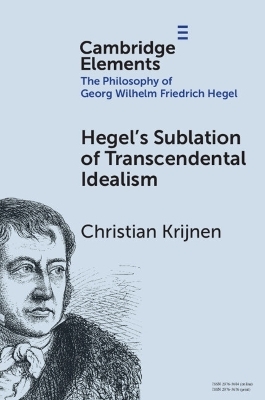
Hegel's Sublation of Transcendental Idealism
Seiten
2025
Cambridge University Press (Verlag)
978-1-009-55579-1 (ISBN)
Cambridge University Press (Verlag)
978-1-009-55579-1 (ISBN)
- Noch nicht erschienen (ca. Dezember 2025)
- Portofrei ab CHF 40
- Auch auf Rechnung
- Artikel merken
Speculative idealism is the end of transcendental idealism. Focusing on the problem of the beginning of philosophy, this thesis is substantiated in four chapters. They scrutinize Kant, Fichte, Neo-Kantianism, and contemporary transcendental philosophy, while bringing all dimensions of Hegel's Logic (Being, Essence, Concept) into the discussion.
Speculative idealism is the end of transcendental idealism. Focusing on the problem of the beginning of philosophy, this thesis is substantiated in four chapters. The chapter on Kant exposes the problem of the beginning and its solution. The chapter on contemporary transcendental philosophy shows that even in the most advanced versions of transcendental philosophy, the problem of the beginning remains. The chapter on neo-Kantianism, so important for contemporary transcendental philosophy, renders explicit that here too the problem of the beginning is a paradigmatic burden of transcendental idealism. The first three chapters proof concerning all dimensions of Hegel's Logic (Being, Essence, Concept) that transcendental philosophy perishes due to the methodical profile of its reflection and requires its sublation by speculative idealism. For this reason, as becomes clear from the final chapter, a return to the late Fichte does not overcome the problem of the beginning either.
Speculative idealism is the end of transcendental idealism. Focusing on the problem of the beginning of philosophy, this thesis is substantiated in four chapters. The chapter on Kant exposes the problem of the beginning and its solution. The chapter on contemporary transcendental philosophy shows that even in the most advanced versions of transcendental philosophy, the problem of the beginning remains. The chapter on neo-Kantianism, so important for contemporary transcendental philosophy, renders explicit that here too the problem of the beginning is a paradigmatic burden of transcendental idealism. The first three chapters proof concerning all dimensions of Hegel's Logic (Being, Essence, Concept) that transcendental philosophy perishes due to the methodical profile of its reflection and requires its sublation by speculative idealism. For this reason, as becomes clear from the final chapter, a return to the late Fichte does not overcome the problem of the beginning either.
1. Introduction; 2. Kant: The Fate of Reason; 3. Contemporary Transcendental Philosophy: Absolutized; 4. External Reflection; 5. Neo-Kantianism: Heterology versus Dialectics; 6. Back to Late Fichte: A Solution for the Problem of the Beginning?; 7. Conclusion; 8. References.
| Erscheint lt. Verlag | 31.12.2025 |
|---|---|
| Reihe/Serie | Elements in the Philosophy of Georg Wilhelm Friedrich Hegel |
| Zusatzinfo | Worked examples or Exercises |
| Verlagsort | Cambridge |
| Sprache | englisch |
| Gewicht | 250 g |
| Themenwelt | Geisteswissenschaften ► Philosophie ► Philosophie Altertum / Antike |
| Geisteswissenschaften ► Philosophie ► Philosophie der Neuzeit | |
| Sozialwissenschaften | |
| ISBN-10 | 1-009-55579-0 / 1009555790 |
| ISBN-13 | 978-1-009-55579-1 / 9781009555791 |
| Zustand | Neuware |
| Informationen gemäß Produktsicherheitsverordnung (GPSR) | |
| Haben Sie eine Frage zum Produkt? |
Mehr entdecken
aus dem Bereich



aus dem Bereich
Anleitung zu einer Lektüre Mark Aurels
Buch | Hardcover (2025)
FinanzBuch Verlag
CHF 27,95


