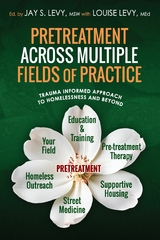
Pretreatment Across Multiple Fields of Practice (eBook)
228 Seiten
Loving Healing Press (Verlag)
978-1-61599-859-3 (ISBN)
'Jay and Louise Levy and their co-authors have distilled years of diverse experience serving people with complex psychological and physical needs into a much-needed roadmap for providers. This book clearly outlines working principles that guide practitioners in the art of building authentic and effective working partnerships with people experiencing homelessness and other traumas, while minimizing re-traumatization and creating psychological safety. Carefully chosen case studies beautifully illustrate how these principles can be put into practice in a variety of settings--from street outreach to shelters to special education classrooms--and are attentive to the impact of racism and other forms of oppression.'
-- Kiko Malin, MPH, MSW, Public Health Director, Amherst, Massachusetts
'As a representative of the Street Medicine Institute, and more importantly, the global street medicine movement, Jay's work is a beacon not just to light the path we are on, but to guide us towards a better place.'
-- Jim Withers, MD, Medical Director and Founder of Pittsburgh Mercy's Operation Safety Net, Medical Director and Founder of the Street Medicine Institute
'As Levy, Conolly, and others argue in this important book, the concept of Pre-treatment Therapy is of major applicability way beyond the field of homelessness: its ideas and concepts should be core reading for psychologists and psychiatrists and indeed anybody hoping to work with people affected by chronic experiences of trauma in a psychologically informed way.'
-- Dr Peter Cockersell, DPsych, Psychoanalytic Psychotherapist, Chief Executive of Community Housing and Therapy
From Loving Healing Press
"e;Jay and Louise Levy and their co-authors have distilled years of diverse experience serving people with complex psychological and physical needs into a much-needed roadmap for providers. This book clearly outlines working principles that guide practitioners in the art of building authentic and effective working partnerships with people experiencing homelessness and other traumas, while minimizing re-traumatization and creating psychological safety. Carefully chosen case studies beautifully illustrate how these principles can be put into practice in a variety of settings--from street outreach to shelters to special education classrooms--and are attentive to the impact of racism and other forms of oppression."e; -- Kiko Malin, MPH, MSW, Public Health Director, Amherst, Massachusetts "e;As a representative of the Street Medicine Institute, and more importantly, the global street medicine movement, Jay's work is a beacon not just to light the path we are on, but to guide us towards a better place."e; -- Jim Withers, MD, Medical Director and Founder of Pittsburgh Mercy's Operation Safety Net, Medical Director and Founder of the Street Medicine Institute "e;As Levy, Conolly, and others argue in this important book, the concept of Pre-treatment Therapy is of major applicability way beyond the field of homelessness: its ideas and concepts should be core reading for psychologists and psychiatrists and indeed anybody hoping to work with people affected by chronic experiences of trauma in a psychologically informed way."e; -- Dr Peter Cockersell, DPsych, Psychoanalytic Psychotherapist, Chief Executive of Community Housing and Therapy From Loving Healing Press
| 1 | Introducing Pretreatment: Outreach Counseling for People with Significant Trauma & Loss |
If we could look into each other’s hearts and understand the unique challenges each of us faces, I think we would treat each other much more gently, with more love, patience, tolerance, and care.
Marvin J. Ashton (1992)
Far too many people are desperately in need and yet are afraid to hope. The most vulnerable among us are often not actively seeking help and may even be pre-contemplative3 of their own complex-multiple needs. This is an understandable and protective stance to a significant history of trauma and loss that is often compounded by negative experiences with human service workers and systems of care (toxic help4). Some have experienced so many unkept promises or perceived personal failures in addition to the loss of critical supportive relationships that they reside in a perpetual state of learned helplessness.
Since the late 1980s, I found this to be common among people who had experienced long-term homelessness. On a basic level we were failing to reach out to those who were most in need. There was a clear calling for a more effective and impactful outreach counseling practice that could not only facilitate access to affordable housing, but also recovery options to address the vestiges of significant trauma and loss.
I first pioneered “Pretreatment” as an approach to help people without homes who presented with complex trauma issues in an article published by the Families in Society journal, entitled “Homeless Outreach: On the Road to Pretreatment Alternatives” (Levy, 2000). This was the outgrowth of my witnessing too many people being ignored by a treatment-biased culture. People who were continually refused services because they were not raising their hands and actively requesting help for healthcare inclusive of mental health and/or addiction issues. In response to this dilemma, a Pretreatment philosophy was developed from an outreach perspective.
Over the past several years, applications of Pretreatment have spread, aiding a variety of programs and staff to reach those who were often deemed “too high risk,” “non-compliant,” “beyond service capabilities,” “ineligible,” or “not ready” to partake in services. The fields of practice have ranged from outreach, street medicine, and housing support to clinical services that address trauma, as well as education to better serve those with complex multiple needs.
What is it about Pretreatment that allows for such great flexibility across multiple fields of practice? The answer is rooted in its four basic tenets of care (Levy, 2013):
•The initial task is to literally and figuratively get where the person is at.
•Our interventions are informed by how our words and actions resonate in the person’s world.
•We foster a trusting relationship that upholds client autonomy as the foundation of our work, while utilizing common language construction as our main tool for facilitating productive dialogue.
•We instill a sense of hope and possibility for positive change.
I think that one can see from the outset how these basic tenets have universal appeal for human services, as most if not all human services can be relationship-driven. In fact, a Pretreatment model is primarily based on the research that has demonstrated the importance of person-centered and goal-focused work.
What is Pretreatment?
The term “Pretreatment” (Levy, 2000, pp. 360-368; Levy, 2010, pp. 13-16) initially appeared as “Pretreatment Variables” through research that predicted successful outcomes for addiction and recovery treatment approaches (Joe et al., 1998, p. 1177; Miller & Rollnick 1991, pp. 5-29; Salloum et al., 1998, p.35). Psychologist and researcher Bruce Wampold (2001) took this a step further by conducting a meta-analysis of pretreatment variables on the success of different counseling methods for addressing mental illness. He concluded that therapeutic models mattered less as a predictor for success than an array of general factors such as the client’s hope and expectation for change, belief in the effectiveness of the therapy, and a positive working alliance between the client and therapist.
The main conclusions from research on both mental illness and addictions support the value of client-centered approaches (Rogers, 1957; Levy, 1998; Wampold, 2001), the importance of motivation and problem recognition, as well as the belief in the therapeutic model or approach by both counselor and client. Other studies on assisting people with severe mental illness uphold the effectiveness of psychosocial rehabilitation principles (Anthony et al., 1990), which instill hope and motivation by being goal-focused, rather than problem-centered. An integral part of the work is for counselor and client to jointly identify barriers to achieving one’s objectives and thereby develop strategies to overcome these obstacles. This is a goal-centered approach that helps people to recognize certain concerns over time based on their aspirations, rather than being dependent upon a person presenting with initial problems and/or declaring themselves in need of help.
Most people who experience the detrimental effects of homelessness and trauma are struggling just to survive and meet their immediate needs of health and safety. The research literature on people who experience homelessness (Babidge, Buhrich, & Butler, 2001; Burt et al. 1999, p. xix; Hwang, 2000; Johnson & Haigh (Eds), 2012; McMillan et al. 2015; O’Connell, 2005) confirms the high risk of premature death and increased rates of chronic health issues such as arthritis, diabetes, and cancer, as well as significant rates of psychological trauma and traumatic brain injury (TBI).
The conclusions from this type of research, coupled with the persistence of a treatment-biased culture that does not adequately provide access for people without homes who have significant healthcare concerns, indicate the need for a Pretreatment approach. It is relationship-driven work based on five guiding principles of care (Levy, 2000) as follows:
•Relationship Formation—Promote trust and respect client autonomy via Stages of Engagement resulting in a client-centered relationship that is goal-driven.
•Common Language Construction—Listen, understand and utilize a person’s words, ideas and values in an effort to develop effective communication.
•Ecological Considerations—Support the process of Transition and Adaptation to new ideas, people, environments, housing, and recovery, etc.
•Facilitate Change—Utilize Stages of Change Model and Motivational Interviewing techniques to facilitate positive change.
•Promote Safety—Apply Crisis Intervention and Harm Reduction Strategies to reduce risk, increase safety, promote stability, and embrace the opportunity for positive change.
Pretreatment (Levy, 2010) is defined as:
…an approach that enhances safety while promoting transition to housing (e.g., housing first options), and/or treatment and recovery alternatives through client-centered supportive interventions that develop goals and motivation to create positive change.
An outreach counseling process based on a Pretreatment philosophy affords us the opportunity to become both interpreters and bridge builders (Levy, 2013). Potential resources and services are therefore reinterpreted and reframed so the client can more fully consider these options and their potential impacts. This is the first major step toward building a bridge to needed resources and services that include housing, education, vocational training, treatment, and recovery options. It is a bridge consisting of a safe and trusting relationship between worker and client, as well as a common language that fosters communication. This aligns with our striving to understand people’s values and stories in a manner that dignifies the meaning or purpose of their narratives. Our mission is to reach out and engage vulnerable people in an open dialogue that leads to improved access to healthcare and a stable place to live promoting meaningful connections with others and a better quality of life.
A fuller conception of outreach counseling is derived from a Pretreatment approach that includes its ten guidelines (See Table 1-1 on p. 7) and the stages of Engagement (Levy, 2011; Levy, 2013) as represented here (See Table 1-2 on p. 8), based upon my integration of Eric Erikson’s (1968) Psychosocial Developmental stages and Germain & Gitterman’s (1980) Ecological phases. This includes developmental-stage-sensitive strategies and interventions to help guide the worker throughout the outreach counseling process.
Pretreatment and its related texts and training have been utilized by human services organizations throughout Massachusetts, New York, Texas, and California, among other states, via Street Medicine and Health Care for the Homeless practitioners, shelter case managers, After Incarceration service providers, Experts by Lived Experience (Peer Network), Homeless Outreach teams, and Housing First staff. It is part of several recommended reading lists and course syllabi at universities throughout the States.
Pretreatment has been adapted to provide guidance to homelessness services by UK charities (e.g., The Connection St. Martins in the Fields Homeless Day Centre and Outreach Team, Trafalgar Square, London) and Pre-treatment Therapy at the CLCH NHS Trust Westminster Homeless...
| Erscheint lt. Verlag | 1.11.2024 |
|---|---|
| Sprache | englisch |
| Themenwelt | Sozialwissenschaften ► Pädagogik ► Sozialpädagogik |
| Schlagworte | city planning • Counseling • Homeless • Political Science • Psychology • psychotherapy • Public Policy • Social Science • Social Work • Trauma • Urban Development |
| ISBN-10 | 1-61599-859-4 / 1615998594 |
| ISBN-13 | 978-1-61599-859-3 / 9781615998593 |
| Informationen gemäß Produktsicherheitsverordnung (GPSR) | |
| Haben Sie eine Frage zum Produkt? |
 EPUB (Ohne DRM)
Digital Rights Management: ohne DRM
Dieses eBook enthält kein DRM oder Kopierschutz. Eine Weitergabe an Dritte ist jedoch rechtlich nicht zulässig, weil Sie beim Kauf nur die Rechte an der persönlichen Nutzung erwerben.
Dateiformat: EPUB (Electronic Publication)
EPUB ist ein offener Standard für eBooks und eignet sich besonders zur Darstellung von Belletristik und Sachbüchern. Der Fließtext wird dynamisch an die Display- und Schriftgröße angepasst. Auch für mobile Lesegeräte ist EPUB daher gut geeignet.
Systemvoraussetzungen:
PC/Mac: Mit einem PC oder Mac können Sie dieses eBook lesen. Sie benötigen dafür die kostenlose Software Adobe Digital Editions.
eReader: Dieses eBook kann mit (fast) allen eBook-Readern gelesen werden. Mit dem amazon-Kindle ist es aber nicht kompatibel.
Smartphone/Tablet: Egal ob Apple oder Android, dieses eBook können Sie lesen. Sie benötigen dafür eine kostenlose App.
Geräteliste und zusätzliche Hinweise
Buying eBooks from abroad
For tax law reasons we can sell eBooks just within Germany and Switzerland. Regrettably we cannot fulfill eBook-orders from other countries.
aus dem Bereich