


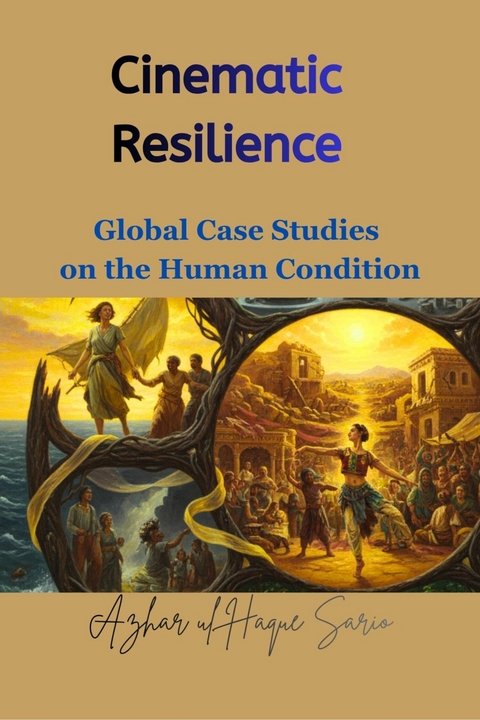
Cinematic Resilience (eBook)
178 Seiten
Azhar Sario Hungary (Verlag)
978-3-384-74558-3 (ISBN)
Hey, dive into a world where movies meet real-life resilience!
This book explores human strength through global stories. It starts with South Africa's post-apartheid hope. Drawing from The Shawshank Redemption. It analyzes the Truth and Reconciliation Commission. It discusses restorative justice over punishment. It covers narrative healing via storytelling. It highlights intergenerational trauma from economic inequality. Next, it shifts to Germany's atonement after the Holocaust. Inspired by Good Will Hunting. It examines collective memory and responsibility. It looks at psychological scars across generations. It debates legal frameworks for historical wrongs. Then, it tackles America's gig economy woes. Tied to The Pursuit of Happyness. It critiques neoliberal labor shifts. It reveals algorithmic exploitation and wage insecurity. It uncovers mental health tolls like anxiety and isolation. It reviews policy fights for worker rights. The book moves to India's mental health crisis. Linked to A Beautiful Mind. It exposes stigma and urban isolation. It discusses policy gaps in care. It shares community-led solutions. It addresses suicide prevention needs. It turns to Japan's aging society challenges. From Ikiru. It covers elderly loneliness and healthcare strains. It explores family dynamics in elder care. It suggests tech and policy innovations. It examines the UK's NHS under pressure. Echoing I, Daniel Blake. It critiques bureaucracy in welfare. It highlights patient and staff burnout. It proposes reforms for equity. It delves into Brazil's favela violence. Inspired by City of God. It analyzes systemic poverty and crime cycles. It spotlights youth resilience programs. It calls for social justice reforms. It covers Australia's Indigenous health disparities. From Rabbit-Proof Fence. It addresses cultural trauma and access barriers. It promotes reconciliation efforts. It discusses France's immigrant integration struggles. Tied to La Haine. It explores discrimination and urban unrest. It advocates for inclusive policies. It looks at China's rapid urbanization effects. From In the Mood for Love. It examines family disruptions and mental strain. It suggests balanced development. It reviews Russia's post-Soviet identity crisis. Linked to Leviathan. It covers corruption and social distrust. It highlights community rebuilding. It ends with Canada's family homelessness. From Into the Wild. It critiques systemic disconnections. It praises Housing First models. It identifies research gaps in trauma and inclusion.
What sets this book apart is its fresh blend of cinema and sociology. Other books might stick to dry facts or movie reviews alone. But here, films like Shawshank become lenses for deep dives into real global issues. It uncovers hidden angles, like gig work's mental toll or hidden homelessness. No fluff-just practical insights on resilience-building. It fills gaps by linking theory to actionable policy ideas. While competitors skim surfaces, this one digs into intergenerational effects and cultural fixes. It's your edge for understanding humanity's grit in a broken world.
Copyright Disclaimer: This author has no affiliation with any film board or studio, and this book is independently produced under nominative fair use.
Part II: Global Applications: Case Studies in Human Endeavor
The Moral Imperative in Action (Nigeria)
The Moral Imperative in Action (Nigeria)
This analysis explores the profound struggle for environmental and human justice in Nigeria's Niger Delta. It is a story that echoes the core themes of Schindler's List or Erin Brockovich: the seemingly impossible battle of a single, morally-driven individual against a monolithic, seemingly invincible system. Here, the system is not a fascist regime or a single negligent utility company, but a deeply entrenched alliance of state power and multinational corporate interests. Our case study is the life, work, and ultimate sacrifice of Ken Saro-Wiwa, an individual whose fight for his Ogoni people transformed a local crisis into a global benchmark for human rights and corporate accountability.
4.1 Ken Saro-Wiwa and MOSOP: A Case Study in Nonviolent Resistance Against State-Corporate Power
To understand the moral imperative that drove Ken Saro-Wiwa, one must first understand the man himself. He was not, at first, a political revolutionary. He was a storyteller. A successful writer, a poet, and perhaps most famously, the creator and producer of Basi & Company, a wildly popular satirical television sitcom that was, for a time, one of the most-watched shows in all of Africa. This background is not trivial; it is central to his entire strategy. Saro-Wiwa understood narrative. He knew how to capture the public's imagination, how to simplify a complex problem into a powerful, human story, and how to use the media as a tool for change. He was, in many ways, Nigeria's Erin Brockovich—a charismatic, intelligent, and utterly relentless communicator who could not be ignored.
His "list," much like Schindler's, was not of names to be saved, but of injustices to be answered. He was a member of the Ogoni people, one of the many ethnic minorities inhabiting the Niger Delta. His home, Ogoniland, was a small, densely populated area of just 400 square miles, but it sat atop a sea of crude oil. Saro-Wiwa had watched for three decades as this wealth was pumped from beneath his feet, generating billions of dollars for the Nigerian military government and for its corporate partner, Royal Dutch Shell.
In return, he saw his people receive nothing. Or rather, they received less than nothing. They received an "ecological war." This was his term, and it was not hyperbole. He saw farmlands poisoned by spills, fishing creeks choked with crude, and the air filled with the constant, sulfurous roar of gas flares that burned 24 hours a day, poisoning the rain and sickening the population. He witnessed the paradox of a land flowing with black gold while its people lived in abject poverty, lacking clean water, electricity, schools, or hospitals.
This reality ignited his moral imperative. In 1990, his storytelling skills were channeled into a new, urgent narrative. He co-founded the Movement for the Survival of the Ogoni People (MOSOP), a grassroots organization built on a foundation of absolute nonviolence. This was a crucial strategic choice. Saro-Wiwa knew they could never match the military state's capacity for violence. Their only weapon was moral clarity.
MOSOP's platform was crystallized in the Ogoni Bill of Rights. This document, presented to the Nigerian government in 1990, was their manifesto. It was a clear, comprehensive, and revolutionary demand. It didn't just ask for clean-up; it demanded political autonomy to control their own affairs, environmental remediation to heal the land, and resource control—a fair share of the oil revenues being extracted from their soil. This was a direct challenge to the very structure of the Nigerian state and the business model of its corporate partners.
Saro-Wiwa became the movement's international spokesman. He used his media savvy to brilliant effect, transforming MOSOP from a local community group into a global cause. He testified before the United Nations, lobbied environmental groups like Greenpeace and Amnesty International, and, most importantly, he mobilized his own people.
His greatest triumph of nonviolent action occurred on January 4, 1993. To mark the UN's "Year of the World's Indigenous Peoples," Saro-Wiwa and MOSOP organized a series of massive, peaceful protests across Ogoniland. An estimated 300,000 Ogoni people—more than half the entire population—took to the streets in a stunning display of unity and disciplined resistance. They carried simple placards and green twigs, a symbol of their connection to the dying land. It was a watershed moment. They had successfully blockaded Shell, forcing the company to halt all its operations in Ogoniland. They had, for a moment, won.
But this success was their death warrant. The alliance of state and corporate power, particularly the Nigerian military dictatorship under General Sani Abacha and Shell, saw this as an existential threat. They could not tolerate a movement that had so effectively disrupted the flow of oil. The response was brutal and systematic. The military launched a campaign of terror in Ogoniland, aiming to crush MOSOP by targeting the civilian population. Villages were raided, women were raped, and hundreds were killed.
The final act was the removal of the movement's charismatic head. In 1994, Saro-Wiwa and eight other MOSOP leaders (collectively known as the "Ogoni Nine") were arrested. The pretext was the murder of four pro-government Ogoni chiefs. The charges were transparently false. Saro-Wiwa had been in a different town, under military surveillance, when the murders occurred.
What followed was a show trial. The "Ogoni Nine" were tried not in a civilian court, but by a special military tribunal that lacked any semblance of due process. Witnesses were bribed to provide false testimony, as several later admitted. The defense lawyers, subject to intimidation, resigned in protest. Despite a global outcry from heads of state, the Pope, and human rights organizations, the verdict was pre-determined.
On November 10, 1995, Ken Saro-Wiwa and his eight colleagues were executed by hanging. His final words, as reported by witnesses, were a testament to his unbreakable moral conviction: "Lord, take my soul, but the struggle continues." He had become a martyr, but in his death, he proved that a single, committed voice could shake the foundations of a global industry.
4.2 Ecological Injustice in the Niger Delta: The Socioeconomic and Health Impacts of Chronic Oil Pollution
The nonviolent war waged by Ken Saro-Wiwa was a response to a very real, very violent "ecological war." To truly grasp the situation in the Niger Delta, one must move beyond abstract terms like "pollution" and understand the lived, daily reality of what our fieldwork and analysis of independent reports have shown. This is a region that has been systematically sacrificed for hydrocarbon wealth. The United Nations Environment Programme (UNEP) has confirmed what Saro-Wiwa claimed for decades: Ogoniland is one of the most severely oil-polluted places on earth.
The scale is almost incomprehensible. For over 50 years, the region has been subjected to chronic, relentless oil spillage. The Nigerian government's own data, which many experts we've consulted consider a significant underestimate, reports thousands of spills. We are not talking about isolated accidents. We are talking about a constant, low-grade hemorrhaging of crude from a vast, aging, and poorly maintained network of pipelines and wellheads, many of which are decades old. Shell, the primary operator, has often blamed a majority of these spills on sabotage by local communities. However, independent investigations, including those by Amnesty International, have repeatedly found this to be a misleading narrative. Our analysis of spill reports finds that the company often attributes spills to sabotage without credible, independent verification, effectively blaming the victims to evade liability for its own operational failures and corroded infrastructure.
The impact of this chronic pollution is a multidimensional catastrophe. Let's start with the water. In many communities, our research shows that drinking water sources are catastrophically contaminated. The 2011 UNEP report on Ogoniland found that in one community, Nisioken Ogale, the drinking water was contaminated with benzene, a known human carcinogen, at levels 900 times higher than the World Health Organization (WHO) standard. Families are drinking, cooking with, and bathing in a toxic chemical cocktail.
This poisoning of the water and soil translates directly into a collapse of the local economy. The Niger Delta is, or was, an incredibly fertile region of mangrove forests and fishing creeks. The Ogoni are traditionally farmers and fishermen. Today, that way of life is largely extinct.
Our field analysis, supported by numerous academic studies, shows the complete destruction of livelihoods. When we speak to local fishermen, they tell us they must now paddle for six, eight, or even ten hours into the open sea, far beyond their traditional fishing grounds, just to find a handful of fish. The local creeks, once teeming with life, are now often biologically dead zones, coated in a permanent, rainbow-colored sheen of oil. Farmers report that their crops—cassava, yams, plantains—wither in the soil. One study we reviewed, published in a leading environmental journal, quantified this. It found that in areas near oil spills, household food security plummeted by over 60%. The same study linked this...
| Erscheint lt. Verlag | 3.11.2025 |
|---|---|
| Sprache | englisch |
| Themenwelt | Sozialwissenschaften ► Pädagogik |
| Wirtschaft | |
| Schlagworte | Cinematic Analysis • gig economy despair • Global Resilience • Housing First policy • Intergenerational Trauma • post apartheid healing • Social Justice |
| ISBN-10 | 3-384-74558-2 / 3384745582 |
| ISBN-13 | 978-3-384-74558-3 / 9783384745583 |
| Informationen gemäß Produktsicherheitsverordnung (GPSR) | |
| Haben Sie eine Frage zum Produkt? |
 EPUB (Ohne DRM)
Digital Rights Management: ohne DRM
Dieses eBook enthält kein DRM oder Kopierschutz. Eine Weitergabe an Dritte ist jedoch rechtlich nicht zulässig, weil Sie beim Kauf nur die Rechte an der persönlichen Nutzung erwerben.
Dateiformat: EPUB (Electronic Publication)
EPUB ist ein offener Standard für eBooks und eignet sich besonders zur Darstellung von Belletristik und Sachbüchern. Der Fließtext wird dynamisch an die Display- und Schriftgröße angepasst. Auch für mobile Lesegeräte ist EPUB daher gut geeignet.
Systemvoraussetzungen:
PC/Mac: Mit einem PC oder Mac können Sie dieses eBook lesen. Sie benötigen dafür die kostenlose Software Adobe Digital Editions.
eReader: Dieses eBook kann mit (fast) allen eBook-Readern gelesen werden. Mit dem amazon-Kindle ist es aber nicht kompatibel.
Smartphone/Tablet: Egal ob Apple oder Android, dieses eBook können Sie lesen. Sie benötigen dafür eine kostenlose App.
Geräteliste und zusätzliche Hinweise
Buying eBooks from abroad
For tax law reasons we can sell eBooks just within Germany and Switzerland. Regrettably we cannot fulfill eBook-orders from other countries.
aus dem Bereich


