


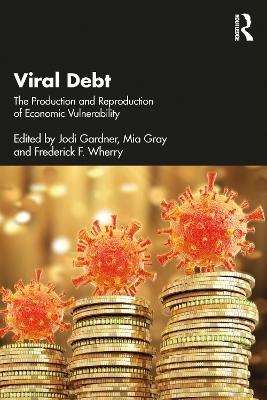
Viral Debt
Routledge (Verlag)
978-1-032-75883-1 (ISBN)
- Noch nicht erschienen (ca. April 2026)
- Versandkostenfrei
- Auch auf Rechnung
- Artikel merken
Debt is not merely a contractual condition, it is also an inherently unequal relationship between creditor and debtor that can exploit pre-existing vulnerabilities while creating new ones. With a roster of leading social science and socio-legal scholars, this book shows how debt – like a contagion – works systematically across economic and social structures and geographies, demonstrating the ways in which policy has exacerbated the problem of debt through policy choices.
This volume offers urgent answers by drawing on quantitative data about household indebtedness, credit and debt policies, and local court actions, together with qualitative research.
Jodi Gardner is a Professor and Brian Coote Chair in Private Law at the University of Auckland. Her research focuses on the relationship between the private law and social policy. Jodi was formerly a Fellow at St John’s College, University of Cambridge. Mia Gray is a Professor of Economic Geography at Cambridge University. She has published extensively on contemporary austerity, debt, and regional economies. She is also one of the editors of the Cambridge Journal of Regions, Economy and Society. Frederick F. Wherry is the Class of 1917 Professor of Sociology at Princeton University and founder of the Debt Collection Lab. He is the author, editor, or co-editor of nine books, including Credit Where It’s Due and Money Talks. His forthcoming book is What We Owe: How Debt Came for All of Us and How We Get Free.
1. Viral Debt: Origins, Pathways, and Consequences, Frederick F. Wherry, Mia Gray and Jodi Gardner; Part I: What Makes Households Vulnerable to Viral Debt; 2. How Welfare and Credit Regimes Shape Economic Policies During Times of Crisis: The Case of Covid-19, Marie-Lou Laprise and Andreas Wiedemann; 3. Viral Debts and the Economic Storytelling about Crisis, Johnna Montgomerie; 4. Unpacking Neoliberalism, Financialisation and Housing Class Inequality: Debt Virality, Policy Anomalies, and the Case of Mortgage Prisoners, Matthew Sparkes; Part II: Experience of Viral Spread; 5. How Eviction Protections Created New Debt Problems, Peter Hepburn, Jacob Haas, Emily Lemmerman, and Matthew Desmond; 6. The ABC of Growing Debt and Inequality: Austerity, Brexit and Covid-19, Karen Rowlingson; 7. How Did COVID-19 Feed into Later Life Financial Vulnerability in the UK?, Hillary Cooper; Part III: Responding to the Debt Viral Aftermath; 8. Personal Debt, State Debt and the Tax System, Andy Lymer; 9. Ripple Effect of Debt and Health, John Ford, Anita Patel, and Anna Starling; 10. Medicine or Poison? Fintech, Racial Inequities, and Bad Debt, Mae Watson Grote and Frederick F. Wherry; 11. Sunset Clauses, False Dawns: Crises and Possibilities for Debt Cancellation Through Law, Joseph Spooner
| Erscheint lt. Verlag | 6.4.2026 |
|---|---|
| Zusatzinfo | 5 Tables, black and white; 20 Line drawings, black and white |
| Verlagsort | London |
| Sprache | englisch |
| Maße | 156 x 234 mm |
| Gewicht | 453 g |
| Themenwelt | Sozialwissenschaften ► Ethnologie |
| Sozialwissenschaften ► Soziologie ► Allgemeines / Lexika | |
| Sozialwissenschaften ► Soziologie ► Makrosoziologie | |
| ISBN-10 | 1-032-75883-X / 103275883X |
| ISBN-13 | 978-1-032-75883-1 / 9781032758831 |
| Zustand | Neuware |
| Informationen gemäß Produktsicherheitsverordnung (GPSR) | |
| Haben Sie eine Frage zum Produkt? |
aus dem Bereich


