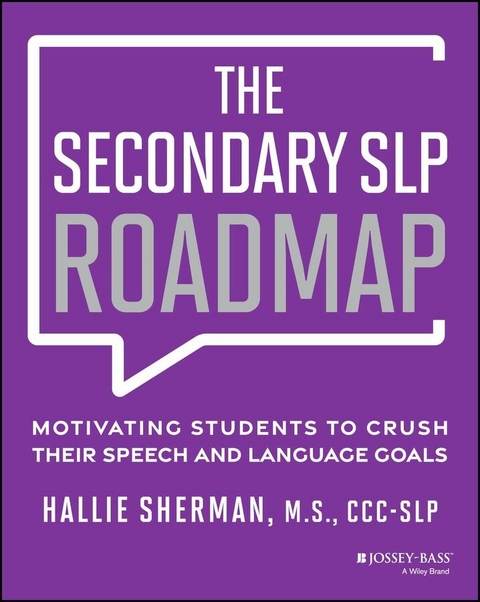
Secondary SLP Roadmap (eBook)
Essential guide for Grade 4-12 SLPs to reduce prep work and help students crush their goals
The Secondary SLP Roadmap: Motivating Students to Crush their Speech and Language Goals is a unique resource for speech-language pathologists working with secondary students, who are often harder to motivate and more aware that learning is difficult for them. Based on author Hallie Sherman's 16 years of SLP experience and her extensive professional development training career, this book is filled with stories and practical ideas, tips, and tricks that you can use right away to help students learn more effectively while bringing prep work down to one hour each week.
Broken down into three phases to allow for modular learning, this book shows readers how to:
- Target a variety of goals without spreading resources too thin
- Work with mixed groups in a way that all students get the attention and assistance they need
- Teach skills differently than how they are already being addressed in the classroom
- Build rapport and a safe environment in which students feel comfortable taking risks
The Secondary SLP Roadmap provides readers with an essential framework to go from being uncertain and overwhelmed to having their speech students crushing their goals and making massive progress.
Hallie Sherman, M.S., CCC-SLP is a speech language pathologist and the owner of Speech Time Fun, a firm that helps SLPs working with students in grades four through twelve break through barriers to progress. She has over sixteen years' experience working with students in schools and hosts the Coffee Talk podcast. Visit https://speechtimefun.com to learn more about her work.
Essential guide for Grade 4-12 SLPs to reduce prep work and help students crush their goals The Secondary SLP Roadmap: Motivating Students to Crush their Speech and Language Goals is a unique resource for speech-language pathologists working with secondary students, who are often harder to motivate and more aware that learning is difficult for them. Based on author Hallie Sherman's 16 years of SLP experience and her extensive professional development training career, this book is filled with stories and practical ideas, tips, and tricks that you can use right away to help students learn more effectively while bringing prep work down to one hour each week. Broken down into three phases to allow for modular learning, this book shows readers how to: Target a variety of goals without spreading resources too thin Work with mixed groups in a way that all students get the attention and assistance they need Teach skills differently than how they are already being addressed in the classroom Build rapport and a safe environment in which students feel comfortable taking risks The Secondary SLP Roadmap provides readers with an essential framework to go from being uncertain and overwhelmed to having their speech students crushing their goals and making massive progress.
CHAPTER 1
Start Small, Win Big
I will never forget when I started working with upper grades. I did not do my school placement with this age, I did not learn how to work with this age group in graduate school, and I did not know anyone working with this age group I could ask questions. This was a time before social media, before iPhones, before Pinterest, and before Teachers Pay Teachers. I was terrified. It did not help that I did not want to work with this age group. I wanted to work with elementary students. But a job was a job and I was not going to pass an opportunity up. I did not want anyone suspecting I was not capable.
On top of not having experience or materials, I had an extremely large caseload. I stopped counting after 60 students. A large caseload, a large building with lots of personalities to adjust to, and lots of different goals to manage. Back‐to‐back sessions, large groups of five students, students all working on different goals, and trying to navigate a new setting. It was a huge adjustment. To add to the stress of all this, I was placed in a tiny room that was hot. There was zero circulation of air. No windows. Just heat pumping in and nowhere to go. I was even forced to keep the door closed for security reasons. Enough said.
Okay. Back to the caseload. I was given Individualized Education Plans (IEPs) with goals such as determining the main idea, making inferences, recalling sequences, and understanding vocabulary. I did not even realize those were things students in grades 4–12 would still be working on or need to be working on in speech therapy. Yes, when I did my school placement with elementary students, we had some sequencing and basic answering questions goals (i.e., who, what, where, when, why) but not as complex as these. I learned how to work on more basic skills, even using literacy‐based therapy, but I was never instructed how to work on these goals.
I remember seeing similar goals listed to be addressed by the classroom teacher and wondered why we were both working on them. I knew why reading specialists would be working on reading goals. But why me too? Should we both be working on that? What was my role with these goals and why was it a speech thing?
I did not have any resources to look at. I walked into an empty therapy room. I only had the materials I made and collected from my elementary placement. What should I be using to work on these goals? I also didn't have any colleagues to ask questions. I was the only SLP in the building. So, I did what I had to do; I went into the local teacher store that existed at the time. I found English language arts (ELA) workbooks from various publishers. The store employee could not help me find speech therapy materials, but they directed me to what they had for the above goals. I found ESL worksheets from free websites. I used what I had and went through the motions. I assumed this was what I was expected and supposed to be doing and using with my students. I didn't see other options. After a few weird comments from students, I learned to use whiteout to cover up the ESL label on the worksheets.
Worksheet after worksheet. We just practiced the various goals over and over again. I remember thinking, I guess this is what I am supposed to do and what I am supposed to use to work on these goals. I didn't have anyone telling me otherwise. It also didn't help that I was new, no one knew who I was, and I was having a difficult time getting teachers to let me know how my students were doing in the classroom or what they were working on. I didn't have access to the curriculum, textbooks, or what things they were trying in the classroom. At the time, many of the classroom teachers I was working with wouldn't even respond to an email I sent. I left notes in their mailboxes, and they did not respond.
It did work for a while. My students participated and did the work. Were they making progress toward their IEP goals? Were they becoming a more effective communicator or student? I am not sure. Were they having fun? Probably not. But they did the work, and I was getting the job done. I was addressing the goals as defined on their IEPs. But I did not feel adequate or effective, and major imposter syndrome was kicking in. Who was I to be working on these skills with these students? I did not feel properly trained or prepared. I was still a relatively new clinician, and working with this age group was foreign to me. I was not seeing quick wins, let alone any wins. I was not seeing progress at all, and I felt like I wasn't making an impact.
INTRODUCING MY MOST CHALLENGING STUDENT EVER
But then I had a student who I'll call K. Have you ever had that one student that you will never forget, but not for positive reasons? K. did not like my activities. He did not like me. He did not have a problem letting me and the other students know how he felt. He would torment me and the other students every time he entered my speech room. He complained about every activity. “This is boring.” “This is babyish.” “X is stupid for being here.” He made me brace for impact and take a deep breath every time he was about to show up. (And of course he was never absent! Those students never are!). Week after week went on like this. It got worse over time. My anxiety when he entered the room grew. I was not confident. I was nervous, and it probably showed. I spent hours planning for his group because I did not want to have another disaster session that left me wanting to run out of the room and cry in the bathroom (no time to run to the car!). I knew I couldn't go the entire year stressing and worrying about planning for this one student on my caseload. I had 60 other students to worry about. I realized I had to ask for help and that I wasn't the only one working with this student. I asked his teachers, reading specialist, and even his former speech‐language pathologist about him. “How is he doing in your class?” “How is his behavior?” “How are you getting him to participate?” “Why is he receiving speech services?”
By asking the right questions, I finally found the answers I needed. I realized why he was acting the way he was and why he was receiving speech in the first place. K. couldn't read. He was in the sixth grade and reading on a kindergarten level. No wonder he was acting the way he was in my room. I was giving him reading comprehension activities, worksheets with passages he couldn't read. He did not want his peers to know he couldn't read. He was using his behavior as an avoidance strategy and boy was it working. But how could I work on the reading comprehension goals he had without reading?
I realized I needed a different approach. Did I have to make him read? What did he truly need from me? I started to understand my role as the SLP and with language comprehension and how I could support him without even reading. I started using a strengths‐based approach and built his strengths to support his weaknesses. He was savvy socially, had strong listening comprehension skills, and had great background knowledge. I used materials that were appropriate for him. I did not force him to read. I used simplified language activities that he had background knowledge of. He was competitive and liked to win, so I incorporated games and competitions.
We played jeopardy games where I gave the students the option to read or to have me read to them. I found articles on his favorite sports but did not require him to read. I rewrote articles I found so that it was simplified and easier to understand. We solved mysteries where students worked together to figure out the mystery. I started using YouTube videos to work on comprehension skills.
I helped him achieve some quick wins and in so doing, built his confidence. He was willing to work for me and ended up becoming one of my star students. He learned my room was safe and he was capable there. I didn't provide him with activities that were so easy that he felt they were babyish or so challenging that he needed to avoid them. I changed the way I taught the skills so that he could grasp them and make tons of progress. I ended up discharging him from speech services on his IEP at the end of sixth grade.
By learning how to work with my most challenging student of my career thus far (and probably the most challenging throughout the years), I realized what was necessary to get quick wins for my students and how essential those wins were. We cannot just work on the end goal from the beginning and expect our students to be successful. We need to start where they are at and build up from there.
READY FOR QUICK WINS?
That is how I came up with the Quick Wins Concept. It is what I have used to guide me to knowing what to work on and how to work on it with my students. I didn’t have a roadmap or curriculum, so I needed to develop something to provide me with direction. I have realized the importance of getting quick wins for students. I have also seen the frustration when they are not making progress or not understanding what we are doing. I cannot predict every situation for you. But I can help you determine what is appropriate for your individual students on your caseload. Yes, there are exceptions to every rule. Of course. But SLPs are creative problem solvers and use their knowledge and expertise for those situations. There are many components that will be necessary in order to achieve quick wins that we will go into thoroughly throughout this section. My goal is that you see the benefit of getting...
| Erscheint lt. Verlag | 31.10.2025 |
|---|---|
| Sprache | englisch |
| Themenwelt | Sozialwissenschaften ► Pädagogik ► Sonder-, Heil- und Förderpädagogik |
| Schlagworte | slp goals • slp grades 4 12 • slp high school • slp in school • slp middle school • slp mixed groups • slp prep work • slp progress • slp resources • slp secondary students • slp skills • slp teaching • speech language pathologist |
| ISBN-13 | 9781394301737 / 9781394301737 |
| Informationen gemäß Produktsicherheitsverordnung (GPSR) | |
| Haben Sie eine Frage zum Produkt? |
 EPUB (Adobe DRM)
Kopierschutz: Adobe-DRM
Adobe-DRM ist ein Kopierschutz, der das eBook vor Mißbrauch schützen soll. Dabei wird das eBook bereits beim Download auf Ihre persönliche Adobe-ID autorisiert. Lesen können Sie das eBook dann nur auf den Geräten, welche ebenfalls auf Ihre Adobe-ID registriert sind.
Details zum Adobe-DRM
Dateiformat: EPUB (Electronic Publication)
EPUB ist ein offener Standard für eBooks und eignet sich besonders zur Darstellung von Belletristik und Sachbüchern. Der Fließtext wird dynamisch an die Display- und Schriftgröße angepasst. Auch für mobile Lesegeräte ist EPUB daher gut geeignet.
Systemvoraussetzungen:
PC/Mac: Mit einem PC oder Mac können Sie dieses eBook lesen. Sie benötigen eine
eReader: Dieses eBook kann mit (fast) allen eBook-Readern gelesen werden. Mit dem amazon-Kindle ist es aber nicht kompatibel.
Smartphone/Tablet: Egal ob Apple oder Android, dieses eBook können Sie lesen. Sie benötigen eine
Geräteliste und zusätzliche Hinweise
Buying eBooks from abroad
For tax law reasons we can sell eBooks just within Germany and Switzerland. Regrettably we cannot fulfill eBook-orders from other countries.
aus dem Bereich