


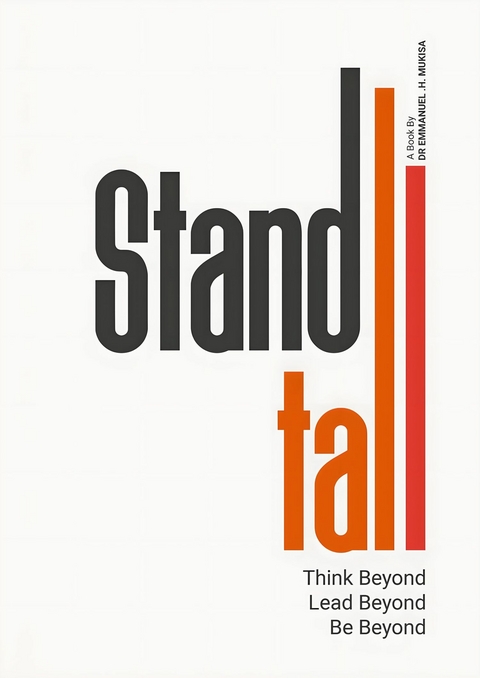
Stand Taller (eBook)
120 Seiten
Publishdrive (Verlag)
978-0-00-109349-2 (ISBN)
Dare to challenge the ordinary and redefine what's possible with Stand Taller. This groundbreaking book invites you to explore innovative thinking that sparks solutions in education, leadership, health, community, and more. From reimagining traditional schooling to embracing modern food movements, this is your guide to breaking barriers and shaping a brighter future.
Discover how unconventional ideas can drive personal growth, inspire creative leadership, and build stronger communities. Think differently, act boldly, and stand taller in a world that craves innovation.
Matching traditional schooling with Montessori, unschooling, and other educational approaches.
Matching traditional schooling to Montessori, unschooling, and other educational approaches means discussing how we can balance strengths from both conventional and alternative models of education. Traditional schooling has formed the backbone in most parts of the world for a long period through structured curriculums, standardized tests, and teacher-centered instruction. Although this model works for many students, it usually misses the boat in terms of engaging students with different learning styles or unique interests. By considering alternative approaches to education such as Montessori and unschooling, the education system will become all-inclusive, personal, and supportive of creativity, independence, and self-directed learning.
One of the most famous alternative methods of education is the Montessori approach. It focuses on student-led learning whereby students study subjects independently and at their own speed. Montessori students are free to choose any activity in a classroom they want and learn through hands-on experience. This approach nurtures creativity, critical thinking, and problem-solving skills that so many traditional classrooms lack. Mainstream education integrates such ways along with the Montessorian elements to let schools facilitate a nurturing dynamic atmosphere for students to take their learning ownership.
Unschooling goes with the same idea further. Unlike Montessori, unschooling rejects any structures in the form of curricula. A student cannot be confined within a specific classroom or at rigid school schedules anymore; learning is thus naturally about their interests in life itself. For instance, if a child is interested in animals, he would like to volunteer at the shelter or read about other species. In this respect, self-designed learning would also promote autonomy as well as curiosity among the students when it comes to their particular interests. If these concepts of unschooling could be inculcated into the more traditional method of schooling, then this would definitely leave room for the children to make their choices, yet guided at proper instances.
Progressive education models such as the Montessori and unschooling step far away from this completely. However, it is absolutely quite feasible to undertake these models together with the usual schooling and thus provide an exact blend of regularity and free learning for your children. For instance, project-based learning can be implemented amongst the practitioners wherein students work on a long-term assignment integrated with research and collaboration. This kind of learning can emulate self-initiated inquiry found in Montessori as well as un-schooling simultaneously as this meets curriculum standards and requirements set forth. In such a way, practitioners will have the opportunity to combine imagination with academics skill learning.
Another consideration of incorporating alternative methods of learning into traditional educational facilities is recognizing diversities among students. Though some children blossom in such an environment where guidelines are given and a routine provided, others may feel enclosed. By providing a mix between the traditional teaching of specific topics and more free-style learning options, the school can make way for these varied ways of learning. For instance, schools might propose a program very strict regarding mathematics and reading subjects while giving complete free time and projects that allowed creativity to flourish on all the remaining topics. Therein comes in some balancing sort of yin and yang-discipline that's strict with freedom in imagining and innovation.
Currently, most schools try to break out of this mold of traditional teaching and are beginning to incorporate more alternative schools. Other classrooms bring Montessori into the daily routine, giving choices to the children and really emphasizing individualized learning. Some even bring in unschooling in places, such as projects based on interests and time spent outdoors. This is a way of drawing them into learning in ways that have more meaning to the children. These hybrid approaches create an environment that enables the child to take up the responsibility for learning as well, and the teacher becomes more of a guide and not quite the authoritarian figure.
It is this very idea of love for learning that is at the essence of all these melanges of traditional schooling with alternative methods. While traditional schools prepare one for excelling in examinations and later on competing in the job market-a kind of perspective towards education that allows little creativity to set in-Montessori or unschooling allows the students to explore a wide range of subjects and develop a love of learning that shall stay for life. If we can integrate these methods into traditional schools, then we will find that students begin to appreciate education once more, and learning becomes both fun and intellectually stimulating.
One such example of how traditional schooling can be mixed with progressive approaches is the incorporation of technology within the classroom. Conventional education relies mostly on textbooks and lectures, but novelty in these technologies has opened an entirely new world that could be tapped to its full use by students in learning: online resources, virtual field trips-even peer collaborations from other continents can be done. All these constitute increased interactive involvement in learning, as facilitated through integrating technology, than what was afforded through mere traditional approaches in education, alternative too. It, therefore, bridges the gap between the structure that conventional schooling had and the freedom alternative methods gave to the students, unschooling included.
Other commonalities that make traditional schooling match Montessori and unschooling are in the emphasis on social and emotional learning. Traditional schools usually put academic performance ahead of personal development. Progressive models, however, recognize emotional intelligence, collaboration, and communication. Schools would, therefore, be able to support students in teamwork, creative expression, and reflection of feelings, taking a more holistic approach toward the education of students. This helps them develop emotional resilience, empathy, and social skills required to live life. The incorporation of alternative approaches now challenges this view of the "ideal" student.
Traditional schooling has often meant forcing students into a certain standard of behavior or achievement. While both Montessori and unschooling recognize that each child has his or her particular bent and may learn differently, embracing the diversity of the students' differences can give us a more inclusive educational system in which respect for individual strengths and talents can be accorded. For example, a person not being too good at mathematics might turn out to be excellent in creative arts or problem-solving tasks. It is when such kinds of intelligence are valued that an avenue is opened for all students to become outstanding in their own different ways. The gap between tradition and the somewhat alternative mode of education can also be bridged when parents and teachers remain open-minded and receptive to new teaching strategies so that the students get a sense of being valued and appreciated.
This process can be encouraged out of school by parents through provisions which allow children to practice and learn through direct involvement, for example. Or it could be teachers bringing progressive ideas into the classroom through offering freer choices to students, letting them assume greater ownership of their learning process. Though the integration of traditional and alternative forms is quite difficult, the potential thereby unleashed in the education sector would be enormous.
One of the biggest barriers toward that is resistant attitudes to change; most of the institutions have been running their education on the same old model for years. In recent times, though, it certainly has become a lot more obvious through various schools trying different forms of blending these techniques that indeed, a more flexible student-centered approach really does offer superior results. It allows students to be further engaged, motivated, and self-assured in their potentials. Such models prosper through a collaborative effort by teachers, administrators, and the community.
Those schools which represent both traditional and progressive approaches very often have strong support networks: parents, local organizations, sometimes businesses. It is when all these stakeholders start working in tandem that they are actually in a position to support conditions that help shape an education-friendly environment-conditions of creativity, independence, and readiness toward change, in short. The best from both worlds has been given to us by collaboration. Looking Ahead A meld of traditional school education, Montessori and unschooling, and some progressive methods has prospects and potentials galore for an evolved future.
With society continuing to evolve, so too must our approach to education. It is in melding the best of the traditional and alternative models that an education system can be envisioned which places a value on both academic achievement and personal growth. This approach will not only prepare the students for the oncoming challenges but will train them to act independently and in a creative manner, turning into problem-solving adults in an attempt to be effective toward human needs. This harmony was to be achieved instead by matching traditional schooling with the Progressive Education methods as replacement of one...
| Erscheint lt. Verlag | 31.10.2025 |
|---|---|
| Sprache | englisch |
| Themenwelt | Sozialwissenschaften ► Pädagogik |
| ISBN-10 | 0-00-109349-5 / 0001093495 |
| ISBN-13 | 978-0-00-109349-2 / 9780001093492 |
| Informationen gemäß Produktsicherheitsverordnung (GPSR) | |
| Haben Sie eine Frage zum Produkt? |
 EPUB (Adobe DRM)
Größe: 616 KB
Kopierschutz: Adobe-DRM
Adobe-DRM ist ein Kopierschutz, der das eBook vor Mißbrauch schützen soll. Dabei wird das eBook bereits beim Download auf Ihre persönliche Adobe-ID autorisiert. Lesen können Sie das eBook dann nur auf den Geräten, welche ebenfalls auf Ihre Adobe-ID registriert sind.
Details zum Adobe-DRM
Dateiformat: EPUB (Electronic Publication)
EPUB ist ein offener Standard für eBooks und eignet sich besonders zur Darstellung von Belletristik und Sachbüchern. Der Fließtext wird dynamisch an die Display- und Schriftgröße angepasst. Auch für mobile Lesegeräte ist EPUB daher gut geeignet.
Systemvoraussetzungen:
PC/Mac: Mit einem PC oder Mac können Sie dieses eBook lesen. Sie benötigen eine
eReader: Dieses eBook kann mit (fast) allen eBook-Readern gelesen werden. Mit dem amazon-Kindle ist es aber nicht kompatibel.
Smartphone/Tablet: Egal ob Apple oder Android, dieses eBook können Sie lesen. Sie benötigen eine
Geräteliste und zusätzliche Hinweise
Buying eBooks from abroad
For tax law reasons we can sell eBooks just within Germany and Switzerland. Regrettably we cannot fulfill eBook-orders from other countries.
aus dem Bereich


