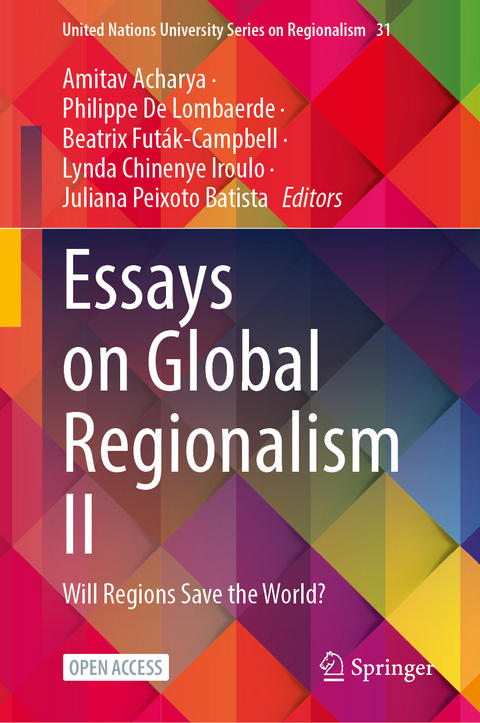
Essays on Global Regionalism II
Springer International Publishing (Verlag)
978-3-032-13645-9 (ISBN)
- Noch nicht erschienen - erscheint am 27.02.2026
- Versandkostenfrei
- Auch auf Rechnung
- Artikel merken
In this ambitious two-volume open access collection of essays, a diverse group of scholars from all over the world reflects on the past, present and future of the (comparative) regionalism research program. Volume II reflects on the continued relevance of regions in current world politics, on scenarios that can be visualized in terms of their future role, and on normative arguments that claim a role for regions as important governance levels. In consecutive sections, the chapter authors explore the role of regions in global governance, the role of interregional relations, and the (regional) role and impact of regional organizations. This collection of essays celebrates and highlights the research and scholarly undertakings of the United Nations University Institute on Comparative Regional Integration Studies (UNU-CRIS) on its 25th anniversary.
Amitav Acharya is the UNESCO Chair in Transnational Challenges and Governance and Distinguished Professor at the School of International Service, American University, Washington, DC. Previously he was a Professor at York University, Toronto and the University of Bristol. He is currently Honorary Professor at Rhodes University, and Guest Professor at Nankai University. He was the inaugural Boeing Company Chair in International Relations at the Schwarzman Scholars Program at Tsinghua University, Fellow of Harvard s Asia Center and John F. Kennedy School of Government, and Christensen Fellow at Oxford. His recent books include Re-imagining International Relations (Cambridge, 2022, with Barry Buzan), The Making of Global International Relations (Cambridge, 2019, with Barry Buzan), Constructing Global Order (Cambridge, 2018); and The End of American World Order (Polity, 2014, 2018).
Philippe De Lombaerde is Director of the United Nations University Institute on Comparative Regional Integration Studies (UNU-CRIS) and Lecturer at the Brussels School of Governance (VUB). Previously, he worked at Neoma Business School (Rouen), Universidad Nacional de Colombia (Bogotá), University of Antwerp, and National Institute of Development Administration (NIDA) (Bangkok). His recent edited books include: Indicator-Based Monitoring of Regional Economic Integration (Springer, 2017), The Political Economy of New Regionalisms in the Pacific Rim (Routledge, 2019), and the Handbook of Regional Cooperation and Integration (Edward Elgar, 2024).
Beatrix Futák-Campbell is Assistant Professor of International Relations (IR) at Leiden University College, based at the Faculty of Governance and Global Affairs, and a co-convenor of the Leiden University Centre for International Relations (LUCIR). She is a Marie Curie fellow at Aberystwyth University. Previously she worked at the University of Hamburg, University of Oxford, Vienna School of International Studies, University of Edinburgh and St Andrews, as well as at the United Nations Office on Drugs and Crime, the German Marshall Fund, and the British Civil Service. She has published Practising EU Foreign Policy: Russia and the Eastern Neighbours (Manchester University Press), and Globalizing Regionalism and International Relations (Bristol University Press).
Lynda Chinenye Iroulo is Assistant Professor of International Relations at Georgetown University in Qatar. Her upcoming book project is: Institution Building in a Multi-actor Postcolonial Region: How the African Union Navigates Diverse Demands. Before joining GU-Q, Lynda was a research fellow and is now an associate at the GIGA Institute of African Affairs, Hamburg. She was also part of the Global Governance unit at the Berlin Social Science Center (WZB), Berlin. She co-founded the African Policy Initiative (API).
Juliana Peixoto Batista is a Professor and researcher in the International Relations Area of the Latin American Faculty of Social Sciences (FLACSO), Argentina, where she also works as coordinator of the LATN Network and as a member of the WTO/FLACSO Chair. She teaches at the University of Buenos Aires (UBA) and the National University of San Martin (UNSAM).
Chapter 1. Introduction to Essays on Global Regionalism (Vol. II): Will Regions Save the World?.- Part I: Global Perspectives.- Chapter 2. Are you NUTS? A United Nations of Regions.- Chapter 3. United Nations Law and Global Regionalism.- Chapter 4. United Regions: Exploring the Impact of Regionalism in a Multipolar World.- Chapter 5. Can Regionalism Save the World? Geopolitical Challenges and Regionalism.- Chapter 6. Can Regions Stabilise the Global Geopolitical System? Balancing Local Initiatives and Global Challenges.- Chapter 7. Regionalism in the Global International Relations: Promoting an Ethical and Intercultura Global Agenda.- Chapter 8. Rethinking Regionalism as a Force for Global Cooperation, Not Fragmentation.- Chapter 9. The World Needs a Radical Regionalism.- Chapter 10. Will Regions Save the World? Regional Organisations and Conflict Resolution.- Chapter 11. Regionalism and Deglobalisation.- Chapter 12. Towards a Regional Glocalisation.- Chapter 13. Sub-National Regional Actorness: A Polycentric Pathway via Paris.- Chapter 14. Interrogating the Potential of ASEAN Regionalism as a Panacea for Global Challenges.- Chapter 15. The Place of Regionalism in Investor-State Dispute Settlement.- Chapter 16. Digital Regionalism: Exploring Fault Lines in Global Digital Governance.- Chapter 17. Constructing Transnational Governance from the Regional Level: The Role of Regional Institutions in the Areas of Health and Migration.- Part II: The Future of Interregionalism.- Chapter 18. Overlaps, Observers, and Organisational Cooperation: New Perspectives on Interregionalism.- Chapter 19. Interregional Fluidness of the Global South.- Chapter 20. Science and Technology in Interregional Association Strategies: The Construction of Geopolitical Circles of Trust in the New Multipolarity.- Chapter 21. Towards Global Cooperation via Megaregion Formation: Facing the Global Polycrisis.- Chapter 22. Opportunities and Challenges of Interregionalism: The Case of the European Union-Mercosur Negotiation.- Chapter 23. The Interregionalism Imperative: Europe's Myopic Response to Irregular Migration and Displacement Challenges and an Alternative Path Forward.- Chapter Part III: Regional Perspectives.- Chapter 24. Unravelling Stability: Regional Hegemony in West and Southern Africa Through Three Lenses.- Chapter 25. Regionalism and the Quest for Geopolitical Stability: An Analysis of the Role of ECOWAS.- Chapter 26. Regionalism and Endemic Instability: How to (Not) Understand the Illusion of Regionalism Dividends in Africa.- Chapter 27. Advancing Regional Resilience: Lessons from Article 16 of the Protocol on Free Movement of Persons in the IGAD Region and SOP Development in Uganda, Kenya, and Ethiopia.- Chapter 28. Global Spaces for Co-Existence, Governance, and Sustainability: Intersections of Climate Change, Herder-Farmer Conflicts, and Human Security from the Regional Context of ECOWAS.- Chapter 29. African Human Rights Architecture: A (Safe) Space for All Africans? Human Rights of LGBTIQ+ Persons and the Role of the African Union.- Chapter 30. Evaluating the Rising Tides of Regional Economic Integration in Africa: The Reality and Illusion of the African Continental Free Trade Area (AfCFTA).- Chapter 31. A Critical Appraisal of Regional Economic Integration in the Implementation of the African Continental Free Trade Area (AfCFTA).- Chapter 32. Regionalism: Lessons from Africa.- Chapter 33. Referee, Player, Or (Only) Trophy? Africa In Contemporary Global Geopolitics and Global Governance.- Chapter 34. The Role of Science Diplomacy in Consolidating the Global Resonance of EU External Action.- 35. Regionalism in South Asia: Trajectories, Achievements, and Potentials.- Chapter 36. Regionalism and Border Management: The Case of the India-Myanmar Free Movement Regime.- Chapter 37. China's Influence on the Conceptual Transformation
| Erscheint lt. Verlag | 27.2.2026 |
|---|---|
| Reihe/Serie | United Nations University Series on Regionalism |
| Zusatzinfo | X, 465 p. 7 illus., 6 illus. in color. |
| Verlagsort | Cham |
| Sprache | englisch |
| Maße | 155 x 235 mm |
| Themenwelt | Sozialwissenschaften ► Soziologie ► Spezielle Soziologien |
| Schlagworte | future of regionalism research • Global International Relations • global regionalism • North-South regionalism • open access • UNU-CRIS |
| ISBN-10 | 3-032-13645-8 / 3032136458 |
| ISBN-13 | 978-3-032-13645-9 / 9783032136459 |
| Zustand | Neuware |
| Informationen gemäß Produktsicherheitsverordnung (GPSR) | |
| Haben Sie eine Frage zum Produkt? |
aus dem Bereich