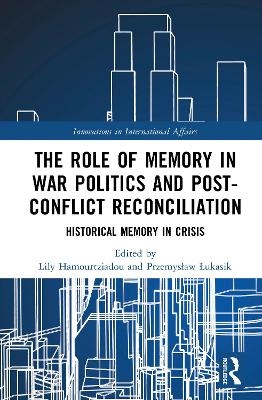
The Role of Memory in War Politics and Post-Conflict Reconciliation
Routledge (Verlag)
978-1-041-09339-8 (ISBN)
- Noch nicht erschienen (ca. April 2026)
- Versandkostenfrei
- Auch auf Rechnung
- Artikel merken
How do states use history to justify current policies? Why do certain events become national myths while others are erased? And how can memory be used to promote peace instead of conflict? Through case studies from the UK, Poland, Romania, Georgia, Ukraine, Austria, and the Czech Republic, the book explores how war memorials, education systems, and media shape public opinion and foreign policy. Part one looks at past conflicts and their commemoration, while part two focuses on the Russia–Ukraine war as a living example of memory in action. Special attention is given to young people’s perspectives and the role of cultural memory in their views on war and identity. Bridging history, politics, and culture, the book shows that memory is not static — it is a battleground. Whether manipulated by elites or reclaimed by citizens, how we remember the past deeply affects our present choices and future peace.
This book will be of great interest to students and scholars of political science, history, international relations, sociology, psychology, anthropology, and media studies.
Dr Lily Hamourtziadou, Senior Lecturer in International Relations, Birmingham City University, Birmingham, United Kingdom. She served as principal researcher and analyst of the NGO Iraq Body Count 2006-2025, twice nominated for the Nobel Peace Prize. She is a member of the West Midlands Military Education Committee, and a member of the Counter Terrorism Evidence-Based Review Group. She has worked for the United Nations High Commissioner for Refugees (UNHCR) as a Middle East reports writer, and she is the author of three books: Body Count. The War on Terror and Civilian Deaths in Iraq (2020), The Ethics of Remote Warfare (2024), and Human Costs of War (2024). Dr Przemyslaw Lukasik, Assistant Professor, Institute of Journalism and International Relations, National Education Commission University, Krakow, Poland. He has been a visiting fellow in the ‘Scholar in Residence’ program of the Goethe-Institute and the Institute for Advanced Study in Humanities in Essen, Germany. Editorial secretary (2011-2015) of the English-language historical scientific journal ‘Remembrance and Solidarity Studies In 20th Century European History’, published by the European Network Remembrance and Solidarity.
Introduction. The construction of a mnemonic order using history Chapter 1. War memorialised: How the UK remembers its wars and its dead. Chapter 2. Annus Horribilis: 1989 in the Balkans Ch 3. Vergangenheitsbewältigung as a Global Challenge for Historians. How Russia and others have dealt with their past Chapter 4. Weeping Dubček, shocked society. Use and misuse of historical memory during the Czechoslovak crisis of 1968 Chapter 5. Commemorating KL Gusen and its victims as a subject of international controversy Chapter 6. Romanian perspectives on the Russian-Ukrainian War (2022-2023) Chapter 7. The Russia-Ukraine War as a Crisis Situation: Poland and Georgia Chapter 8. Young Czechs, Poles, Austrians, and Ukrainians: Their Attitudes to the War in Ukraine
| Erscheint lt. Verlag | 30.4.2026 |
|---|---|
| Reihe/Serie | Innovations in International Affairs |
| Verlagsort | London |
| Sprache | englisch |
| Maße | 156 x 234 mm |
| Themenwelt | Geschichte ► Allgemeine Geschichte ► Neuzeit (bis 1918) |
| Geschichte ► Allgemeine Geschichte ► Zeitgeschichte | |
| Geisteswissenschaften ► Geschichte ► Regional- / Ländergeschichte | |
| Sozialwissenschaften ► Politik / Verwaltung | |
| ISBN-10 | 1-041-09339-X / 104109339X |
| ISBN-13 | 978-1-041-09339-8 / 9781041093398 |
| Zustand | Neuware |
| Informationen gemäß Produktsicherheitsverordnung (GPSR) | |
| Haben Sie eine Frage zum Produkt? |
aus dem Bereich