


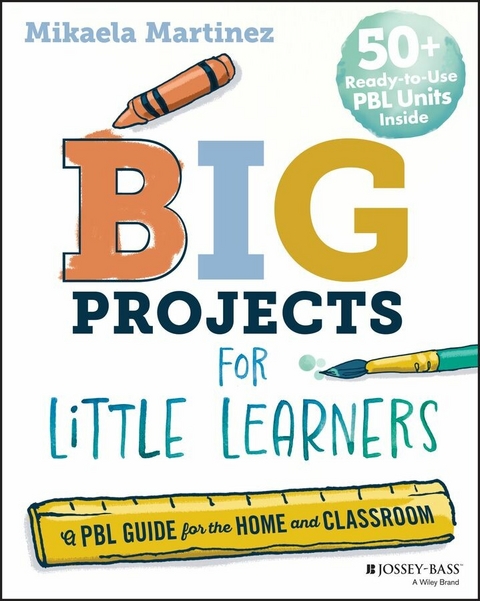
Big Projects for Little Learners (eBook)
385 Seiten
Jossey-Bass (Verlag)
9781394319039 (ISBN)
The complete guide to implement project-based learning in the home and classroom
Big Projects for Little Learners: A PBL Guide for the Home and Classroom is a comprehensive step-by-step guide that explores the transformative power of project-based learning (PBL), not just within the four walls of a classroom, but also in alternative learning spaces such as homeschooling or micro schools. The book is jam-packed full of real-world PBL examples and success stories, 52 complete project units you can immediately implement in your classroom setting, planning guides and resources, tips for implementation and facilitation, and guidance for assessing student learning throughout the unit and addressing common challenges and obstacles.
This book shows readers how to:
- Create a PBL unit to meet your state learning standards
- Design a driving question and connect it to the end product
- Make your home or classroom learning dynamic and engaging
- Develop ready-to-use resources to walk educators through the process
- Connect learning to the community and real-life scenarios
Big Projects for Little Learners: A PBL Guide for the Home and Classroom is a must-have resource for parents and educators seeking strategies to create a more engaging, student-centered, and future-ready educational experience.
Mikaela Martinez is a certified teacher and licensed educator with more than 10 years' teaching experience. She has specialized certifications and additional training from world-leaders in Project-Based Learning. She is also the founder of Project Based Primary, which serves homeschoolers and educators.
The complete guide to implement project-based learning in the home and classroom Big Projects for Little Learners: A PBL Guide for the Home and Classroom is a comprehensive step-by-step guide that explores the transformative power of project-based learning (PBL), not just within the four walls of a classroom, but also in alternative learning spaces such as homeschooling or micro schools. The book is jam-packed full of real-world PBL examples and success stories, 52 complete project units you can immediately implement in your classroom setting, planning guides and resources, tips for implementation and facilitation, and guidance for assessing student learning throughout the unit and addressing common challenges and obstacles. This book shows readers how to: Create a PBL unit to meet your state learning standards Design a driving question and connect it to the end product Make your home or classroom learning dynamic and engaging Develop ready-to-use resources to walk educators through the process Connect learning to the community and real-life scenarios Big Projects for Little Learners: A PBL Guide for the Home and Classroom is a must-have resource for parents and educators seeking strategies to create a more engaging, student-centered, and future-ready educational experience.
02
Math Centered PBL Units
Math is all around us: in the way we count our rock collection, sort our toys, and build towers out of blocks. But for young children, math isn't just about numbers on a page; it's about exploring, discovering, and making sense of the world. Project-Based Learning (PBL) brings math to life by weaving it into hands-on, meaningful experiences that feel like play. Instead of math being abstract, children engage in real-world problem-solving, using math in ways that feel natural and exciting.
The following units are designed to help preschool and kindergarten learners build foundational math skills—like counting, sorting, measuring, money, and recognizing patterns—through creative, student-driven projects. Whether they're setting up a store, building bridges, or exploring patterns in nature, these developmentally appropriate project units make math interactive, engaging, and fun!
Jr. Chefs
| Driving Question: How can we create a cookbook that celebrates food, culture, and creativity? | Public Product: The culmination of the project will be the production of a classroom cookbook that showcases all the students’ recipes. This cookbook will be shared with families and school community, providing a tangible product that celebrates the students' hard work and creativity. |
| Unit Overview: This project connects students with their personal and cultural backgrounds through food. It allows them to explore what different foods mean to themselves and their families. Students will investigate various cultural foods by interviewing family members and researching family recipes. They will explore the ingredients, cooking methods, and the significance of each dish, prompting questions such as, “What makes a recipe special?” and “How do different cultures use food to celebrate?” Students will have the opportunity to choose the recipes they want to include in the cookbook, allowing them to connect with their family's heritage or their personal favorites. They will design their own recipe cards, cookbook pages, and prepare their dish for others to enjoy. |
| Launch Event: Bring in a variety of spices, seasonings, and cultural ingredients with distinct tastes and smells. Have students taste test and smell the different ingredients and discuss if any seem familiar to them, if they can name any of them, or if they know what kinds of food they may find them in. |
| Module 1: What does food mean to our family? |
Activities:
|
| Module 2: What makes up a recipe? |
Activities:
|
| Module 3: How can we make a cookbook? |
Activities:
|
Exhibition Event:
|
Adapting for smaller learning environments: For homeschooling, co-ops, and micro school settings with fewer students, individual students can research a variety of meals and create a mini cookbook that includes a food from the following categories: a breakfast dish, lunch dish, dinner dish, desert, holiday meal, and their favorite meal. They can prepare one or more of these foods for a family meal where they can share their learning and cookbook/recipe cards and can also collect donations of food to contribute to a community outreach facility.
I Know My Numbers!
| Driving Question: How can we create a tool for our classroom that will help us learn and remember our numbers? | Public Product: Students will create a classroom number line that can be used throughout the year to reference during math. Number lines will show digits, number name, quantity, ten frame representation, and pictures of student hands showing the number value. |
| Unit Overview: Throughout this unit, students will be introduced to and become masters of the numbers 1 through 10. Students will explore numbers and their value, learn about their digit representation and number name, and how to represent the number quantity in multiple different ways. They will be creating a class number line that they will be able to reference throughout the school year that will aid in their mathematical thinking and learning. |
| Launch Event: Prior to beginning this unit, remove all representations of numbers from the classroom. This could include premade number lines, 100 charts, calendars, posters, etc. When students arrive in the classroom, ask them if they notice if anything is missing. Once they noticed that everything that has to do with numbers is gone, explain to them they will need to be the ones that become the number masters and create the materials that they will need in their classroom for them to know their numbers. |
| Module 1: How do we count? |
Activities:
|
| Erscheint lt. Verlag | 27.10.2025 |
|---|---|
| Sprache | englisch |
| Themenwelt | Sozialwissenschaften ► Pädagogik |
| Schlagworte | ela pbl • math pbl • PBL assessment • pbl benefits • pbl classroom • pbl education • pbl examples • pbl facilitation • pbl homeschool • pbl implementation • pbl microschool • pbl obstacles • PBL planning • pbl project units • pbl resource • project based learning • Project-based learning • science pbl • social studies pbl |
| ISBN-13 | 9781394319039 / 9781394319039 |
| Informationen gemäß Produktsicherheitsverordnung (GPSR) | |
| Haben Sie eine Frage zum Produkt? |
 EPUB (Adobe DRM)
Kopierschutz: Adobe-DRM
Adobe-DRM ist ein Kopierschutz, der das eBook vor Mißbrauch schützen soll. Dabei wird das eBook bereits beim Download auf Ihre persönliche Adobe-ID autorisiert. Lesen können Sie das eBook dann nur auf den Geräten, welche ebenfalls auf Ihre Adobe-ID registriert sind.
Details zum Adobe-DRM
Dateiformat: EPUB (Electronic Publication)
EPUB ist ein offener Standard für eBooks und eignet sich besonders zur Darstellung von Belletristik und Sachbüchern. Der Fließtext wird dynamisch an die Display- und Schriftgröße angepasst. Auch für mobile Lesegeräte ist EPUB daher gut geeignet.
Systemvoraussetzungen:
PC/Mac: Mit einem PC oder Mac können Sie dieses eBook lesen. Sie benötigen eine
eReader: Dieses eBook kann mit (fast) allen eBook-Readern gelesen werden. Mit dem amazon-Kindle ist es aber nicht kompatibel.
Smartphone/Tablet: Egal ob Apple oder Android, dieses eBook können Sie lesen. Sie benötigen eine
Geräteliste und zusätzliche Hinweise
Buying eBooks from abroad
For tax law reasons we can sell eBooks just within Germany and Switzerland. Regrettably we cannot fulfill eBook-orders from other countries.
aus dem Bereich


