


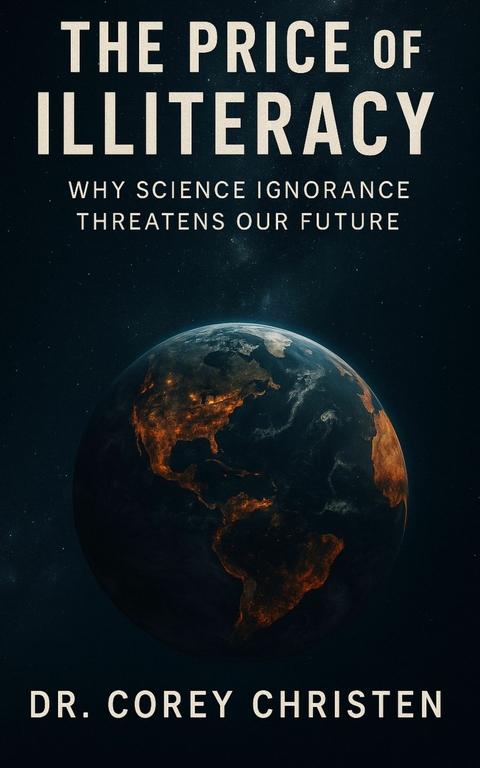
The Price of Illiteracy (eBook)
137 Seiten
Publishdrive (Verlag)
978-0-00-108690-6 (ISBN)
When we forget how science works, we forget how to wonder. The Price of Illiteracy is a call to see the world with fresh eyes and open minds. Dr. Corey Christen shows how curiosity, reason, and empathy can rebuild our shared understanding of truth. Science can teach us how the world works, but only we can decide what to do with that knowledge.
Chapter 1: The Illusion of Knowledge
We are a species surrounded by everyday miracles we barely notice. A beam of sunlight walks into a leaf and leaves as food and oxygen. A strand of DNA copies itself, and a child is born. Inside a computer, tiny silicon switches turn on and off so quickly that they can instantly generate something huge, like the image of an entire continent on your screen. We live inside a cathedral of phenomena, yet so often we know the hymns and not the meaning. Ask a room of adults about photosynthesis. Heads nod. The word is familiar, like a landmark passed on the highway. Ask what it does, how light, water, and air become sugar and oxygen, and the confidence drains away. The syllables remain; the substance evaporates. We have learned to prize the possession of vocabulary over the possession of understanding. In a civilization like ours, that illusion is more dangerous than honest ignorance.
I have seen this illusion up close in my own research on postsecondary students. Many arrived in college classrooms fluent in the language of science, able to recite terms like “mitosis,” “equilibrium,” or “evolution”, but when asked to explain what those terms meant or why they mattered, the clarity dissolved. In surveys and interviews, students often expressed confidence until pressed for detail, at which point their answers thinned into fragments of half-remembered definitions. They could recall the song but not the music. This gap between vocabulary and comprehension is not a matter of laziness; it reflects how we have too often taught science as a set of facts to be memorized rather than as a way of seeing and questioning the world. It was in tracing that gap, semester after semester, that I first encountered the idea of science literacy, not just knowing the words of science, but being able to use them to make sense of reality.
By “science literacy,” I mean the everyday capacity to ask testable questions; connect mechanisms to claims; follow and evaluate evidence (including uncertainty, scale, and limits); distinguish correlation from causation and expert consensus from opinion; and apply those judgments to real decisions in health, environment, technology, and civic life. It is not mere familiarity with terms; it is the practiced ability to reason with evidence in context.
One student told me in my research that lectures “moved quickly,” another that keeping pace with the intricacies of cellular functions was like chasing a train; close enough to touch, never to board. Literature backs their lived sense of overwhelm: technical terms, presented in torrents, strain cognitive load and make it hard to process novel ideas. When jargon outruns meaning, memory becomes mimicry. And then there is the canyon between high school and college, a leap many attempt with maps that no longer match the terrain. Again and again, students described the “huge jump”: the detail deeper, the pace faster, the guidance thinner, the self-regulation suddenly nonnegotiable. It is a pedagogical shift as much as a psychological one, and for many, it turns familiar words into moving targets. If you have spent years being rewarded for recall, a world that demands reasoning can feel like a trick.
The illusion of knowledge thrives in that canyon. If we confuse a label for an explanation, we become easy prey for confident claims unmoored from evidence. A person who doesn’t understand why vaccines work can be unspooled by a viral post insisting they don’t. Someone who hasn’t seen how a climate system breathes can mistake a cold week for the end of a century’s data. When our grasp is shallow, the next gust of misinformation is a storm.
Consider the flat Earth movement, which has gained surprising traction in the age of YouTube and social media. Despite centuries of evidence, from circumnavigation to satellite imagery, survey data show that certainty about a round Earth is not universal; for example, a 2018 YouGov poll found that only 66% of U.S. millennials said they were certain, that is, completely confident without doubt, that the Earth is round (YouGov, 2018). The remaining third fell into categories such as expressing only partial confidence, being unsure, or endorsing flat-Earth views (Dean, 2018). This belief persists not because of evidence but because of the illusion of fluency: words like “horizon” and “perspective” are invoked as if they are explanations, but they serve as labels that block deeper inquiry. A second example is the belief that vaccines contain microchips designed for tracking or control. This conspiracy theory surged during the COVID-19 pandemic, fueled by social media and distrust of institutions. A 2022 survey reported that 28% of Americans saw the microchip claim as at least “probably true” (Pertwee et al. 2022). The claim draws strength from scientific illiteracy: people may know the word “nanotechnology,” but without understanding scale or biology, they become vulnerable to the illusion that an impossible technology is plausible. Third, climate change denial illustrates how the illusion of knowledge shapes public policy. Many people believe that a single cold winter disproves global warming, mistaking weather for climate. Surveys show that nearly 30% of Americans attribute climate change primarily to “natural patterns” rather than human activity (Pew Research Center, 2021). This error is reinforced by selective vocabulary, hearing “natural cycles” without understanding the carbon budget or radiative forcing mechanisms. Once again, the illusion thrives where words substitute for comprehension. Finally, the persistence of creationist beliefs in a scientifically advanced society demonstrates how labels overtake explanation. In the United States, roughly 40% of adults still agree with the statement that “God created humans in their present form within the last 10,000 years” (Gallup, 2019). I do not see belief in God itself as the problem; faith can provide meaning, comfort, and moral guidance, but ignoring overwhelming evidence is different. To reject the fossil record, genetics, and evolutionary biology is not an act of faith but an act of denial. The danger lies not in believing in God, but in refusing to look honestly at the evidence that shows how the natural world works. Students may learn the word “evolution” in school, but without grappling with the fossil record, genetics, or natural selection, the word can remain an empty token. Without depth, cultural narratives easily reclaim authority. When explanations are replaced by labels, the effects don’t stay in textbooks; they organize daily choices, in clinics, on ballots, and at kitchen tables.
And this is not just a matter of abstract belief; it filters into daily life in ways both subtle and profound. Consider health decisions: skepticism toward evolutionary biology often overlaps with broader mistrust in medicine, seeding doubts about vaccines, antibiotics, or even the reality of viruses (Larson, 2020). A parent’s choice to delay or refuse childhood vaccines doesn’t happen in a vacuum; it ripples outward, lowering herd immunity and reviving diseases once thought controlled. In politics, the illusion of knowledge shapes how communities vote, what policies they support, and even which candidates they see as trustworthy. A leader who denies climate science or downplays pandemics can appear credible to citizens whose understanding of science is shallow. When weather is confused for climate, a snowstorm becomes evidence against global warming, shaping conversations at the dinner table and votes at the ballot box (McInerney & Dougherty, 2020). Education, too, becomes a battleground. School boards in multiple U.S. states have debated whether to present creationism or “intelligent design” alongside evolution, framing it as an equal “theory” rather than religious (da Rosa, 2024). For students, this blurring of categories normalizes the idea that evidence and opinion weigh the same. A high schooler who is taught that evolution is “just one perspective” may enter college without the conceptual foundation needed for biology, medicine, or environmental science. But moral belief and scientific fact are not rivals. One guides how we live with one another; the other describes the world we live within. Faith itself isn’t the enemy, only when scripture is treated as a modern science textbook do the two come into conflict.
Even everyday consumer choices are shaped by these gaps. Families spend billions annually on “alternative medicines” with no empirical basis, convinced by marketing language that mimics science but provides no evidence (Nahin et al., 2024). The label “natural” becomes shorthand for “safe,” despite countless natural substances, from arsenic to cyanide, that are lethally toxic. Without scientific literacy, words like “chemical” trigger fear, while “organic” triggers trust, regardless of context.
This is the texture of the illusion of knowledge in modern life: not just mistaken ideas but daily habits, community norms, and national decisions. It is the neighbor who forwards a chain email about microchips in medicine. It is the school where students memorize but never model a scientific process. It is the policymaker who shrugs off climate projections because “weather always changes.” These are not isolated quirks. They are symptoms of a civilization that mistakes vocabulary for vision, and the costs are cumulative.
There are methods for escaping the illusion. Slow the language enough to see the landscape. Make vocabulary a ladder, not a wall. Earn precision through plain speech, analogies, and time for ideas to settle. Trade recital for encounter. Let students measure, model, test, and build; theories stop being slogans when...
| Erscheint lt. Verlag | 27.10.2025 |
|---|---|
| Sprache | englisch |
| Themenwelt | Sozialwissenschaften ► Pädagogik |
| ISBN-10 | 0-00-108690-1 / 0001086901 |
| ISBN-13 | 978-0-00-108690-6 / 9780001086906 |
| Informationen gemäß Produktsicherheitsverordnung (GPSR) | |
| Haben Sie eine Frage zum Produkt? |
 EPUB (Adobe DRM)
Größe: 1,3 MB
Kopierschutz: Adobe-DRM
Adobe-DRM ist ein Kopierschutz, der das eBook vor Mißbrauch schützen soll. Dabei wird das eBook bereits beim Download auf Ihre persönliche Adobe-ID autorisiert. Lesen können Sie das eBook dann nur auf den Geräten, welche ebenfalls auf Ihre Adobe-ID registriert sind.
Details zum Adobe-DRM
Dateiformat: EPUB (Electronic Publication)
EPUB ist ein offener Standard für eBooks und eignet sich besonders zur Darstellung von Belletristik und Sachbüchern. Der Fließtext wird dynamisch an die Display- und Schriftgröße angepasst. Auch für mobile Lesegeräte ist EPUB daher gut geeignet.
Systemvoraussetzungen:
PC/Mac: Mit einem PC oder Mac können Sie dieses eBook lesen. Sie benötigen eine
eReader: Dieses eBook kann mit (fast) allen eBook-Readern gelesen werden. Mit dem amazon-Kindle ist es aber nicht kompatibel.
Smartphone/Tablet: Egal ob Apple oder Android, dieses eBook können Sie lesen. Sie benötigen eine
Geräteliste und zusätzliche Hinweise
Buying eBooks from abroad
For tax law reasons we can sell eBooks just within Germany and Switzerland. Regrettably we cannot fulfill eBook-orders from other countries.
aus dem Bereich


