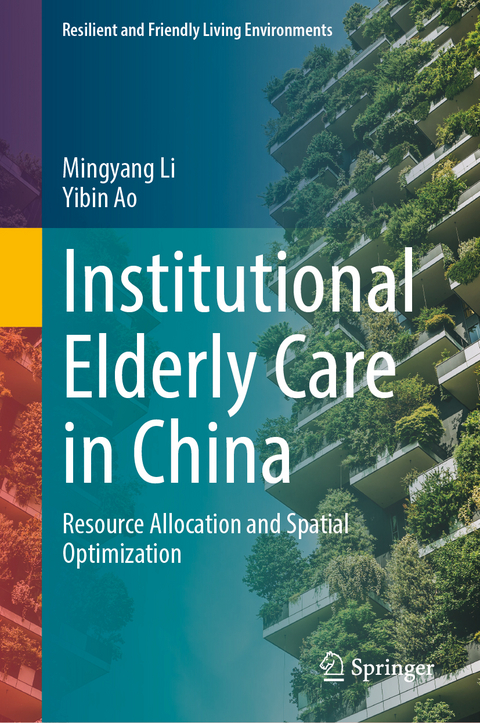
Institutional Elderly Care in China
Springer Verlag, Singapore
9789819550913 (ISBN)
- Titel nicht im Sortiment
- Artikel merken
The book covers key areas such as:
Resource allocation and optimization within elderly care institutions in China.
The urban-rural divide in access to services and facilities.
Age-friendly cities and senior welfare strategies.
An in-depth look at healthcare policy and its role in shaping long-term care systems.
The macro perspective on how social equity and resource efficiency are navigated in care provision across various regions.
This book is designed for scholars, policymakers, and practitioners in the fields of gerontology, social policy, urban planning, and public health. It is suitable for both graduate students and researchers seeking a deeper understanding of the evolving landscape of elderly care in China, especially in light of its rapidly aging population. The content is academic yet accessible, offering practical insights for real-world application. This book is an essential resource for those seeking to understand and improve elderly care systems in China and beyond, ensuring more equitable and efficient care for the aging population.
Mingyang Li, Ph.D. candidate, Chengdu University of Technology, is mainly engaged in the research of elderly friendly planning, healthy humanities and so on. Presided a number of scientific research projects, including the project of Sichuan Aging Health Development Center and the project of Sichuan Gerontology Society, participated in the research of National Key R&D Program of China, National Natural Science Foundation and other projects. Yibin Ao, Professor, Doctoral Supervisor, and Reserve Candidate for the 14th Batch of Sichuan Province's Academic and Technical Leadership Program. He has devoted his career to friendly and resilient environments. He has published more than 70 academic papers, presided over or participated in a number of national projects, and won the the Springer Nature 2024 China New Development Award.
Chapter 1. Research Progress on Elderly Care Resource Allocation and Spatial Optimization.- Chapter 2. Resource Allocation of Rural Institutional Elderly Care in China's New Era: Spatial-Temporal Differences and Adaptation Development.- Chapter 3. Dynamics of Resource Allocation in Chinese Elderly Care Institutions: A Comprehensive Study of Geographic Disparities and Influencing Mechanisms.- Chapter 4. Equity in Public Decision-Making: A Dynamic Comparative Study of Urban-Rural Elderly Care Institution Resource Allocation in China.- Chapter 5. Assessing the Gap: Resource Efficiency of Institutionalized Aging in Urban and Rural China.- Chapter 6. Exploring the equitable spatial planning on the accessibility of institutional elderly care in megacity: a study based on Chengdu, China.- Chapter 7. Analysis of Elderly Population and Institutional Care Resource Allocation in Chongqing.- Chapter 8. Spatial Characteristics and Challenges of Elderly Care Institution Distribution in Chongqing.- Chapter 9. Optimization Strategies for the Spatial Layout of Elderly Care Institutions in Chongqing.- Chapter 10. Theoretical Insights and Practical Implications on Elderly Care Resource Allocation and Spatial Optimization in China.
| Erscheint lt. Verlag | 14.2.2026 |
|---|---|
| Reihe/Serie | Resilient and Friendly Living Environments |
| Zusatzinfo | 62 Illustrations, color; 4 Illustrations, black and white |
| Verlagsort | Singapore |
| Sprache | englisch |
| Maße | 155 x 235 mm |
| Themenwelt | Sozialwissenschaften ► Soziologie ► Empirische Sozialforschung |
| Sozialwissenschaften ► Soziologie ► Spezielle Soziologien | |
| Schlagworte | age-friendly cities • Elderly care accessibility • healthcare policy • Long-Term Care • Macro perspective • Resource Efficiency • resource optimization • Senior welfare • Social Equity • Urban-rural divide |
| ISBN-13 | 9789819550913 / 9789819550913 |
| Zustand | Neuware |
| Informationen gemäß Produktsicherheitsverordnung (GPSR) | |
| Haben Sie eine Frage zum Produkt? |
aus dem Bereich