


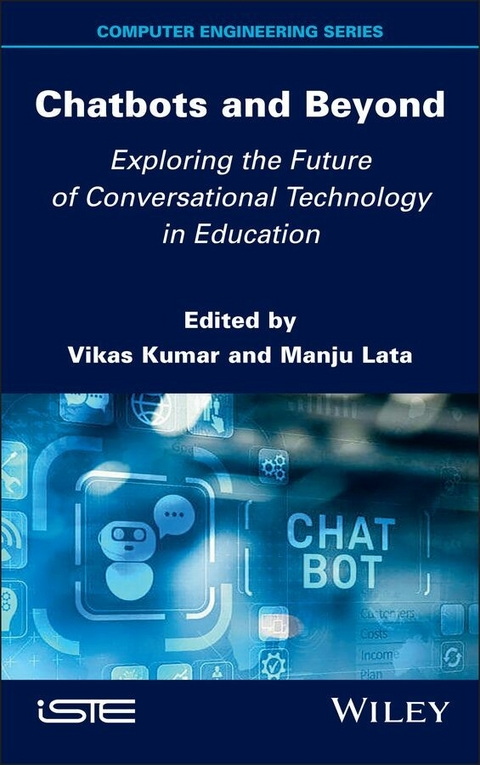
Chatbots and Beyond (eBook)
455 Seiten
Wiley-Iste (Verlag)
978-1-394-41127-6 (ISBN)
Chatbots and Beyond provides an innovative analysis of the transformative prospective of conversational technology in the field of education. It reveals the numerous advantages of integrating chatbots into an educational environment and identifies the obstacles in their perfect integration.
This book explores how these technologies can reform teaching and learning experiences, modify learning paths, and streamline administrative processes by using real-world examples and case studies. Rapid developments in artificial intelligence and its implementation in education have also raised many eyebrows. With millennial students practicing the application of AI on a large scale, it has become important to harness its power for student life cycle integration. With the educational landscape promptly developing, this book makes a strong case for embracing conversational technology as a cornerstone of future-focused educational methods, and serves as a complete guide for researchers, educators and administrators, proposing practical advice and techniques for utilizing chatbots to create a more productive, efficient and engaging learning environment.
Vikas Kumar works at the Central University of Haryana, India, and is Visiting Professor at the IIM Indore and University of Northern Iowa, USA.
Manju Lata works as Associate Professor at Chandigarh University, Mohali, India. Her areas of research include artificial intelligence, cloud computing, Big Data analytics and Internet of Things (IoT).
Chatbots and Beyond provides an innovative analysis of the transformative prospective of conversational technology in the field of education. It reveals the numerous advantages of integrating chatbots into an educational environment and identifies the obstacles in their perfect integration. This book explores how these technologies can reform teaching and learning experiences, modify learning paths, and streamline administrative processes by using real-world examples and case studies. Rapid developments in artificial intelligence and its implementation in education have also raised many eyebrows. With millennial students practicing the application of AI on a large scale, it has become important to harness its power for student life cycle integration. With the educational landscape promptly developing, this book makes a strong case for embracing conversational technology as a cornerstone of future-focused educational methods, and serves as a complete guide for researchers, educators and administrators, proposing practical advice and techniques for utilizing chatbots to create a more productive, efficient and engaging learning environment.
Preface
The rapid advancements in artificial intelligence (AI) and machine learning have profoundly changed a number of sectors, including education. The emergence of conversational technologies and chatbots is one of the most significant advances that has created a significant impact on the education. Once considered innovations, these tools are now essential parts of educational environments. With the ability to facilitate personalized learning, immediate user support and streamlined administrative tasks, chatbots are reshaping the way we approach education. To identify the futuristic models and applications, this book presents the exciting possibilities of conversational technologies in the education domain.
As we look to the future, it is clear that chatbots are creating new learning opportunities in addition to improving the educational experiences of both teachers and students. By eliminating obstacles that frequently restrict opportunities, AI integration can democratize access to high-quality education. From providing real-time feedback on projects to responding to student inquiries, this book examines a number of use cases where chatbots have already had an impact. As these technologies grow increasingly prevalent in classrooms, campuses and other settings, it also looks at the opportunities, difficulties and ethical issues that come up. Policymakers and educators can better prepare for the upcoming revolutionary shifts by comprehending these dynamics.
However, chatbots are only one example of the conversational technology being explored in education. Voice assistants, AI-powered tutors and conversational agent-powered immersive learning environments are just the start of a much bigger development that will completely change the way we interact with information. This book acts as a manual for both comprehending the current uses of these technologies and projecting their future advancements. This book provides insightful information about the fascinating opportunities that await the field of education, regardless of whether you are a technologist, educator or student interested in the intersection of AI and learning.
The book covers the existing learning theories, why they have failed and what new theories have emerged. It also covers what new initiatives have emerged and how they have contributed to the AI-based teaching-learning processes. The book covers the experiences and thoughts of leading researchers from across the world and offers perspectives from the point of view of different stakeholders.
Chapter 1 by Ikbal Maulana discusses the nurturing of an inquisitive mind, with chatbots encouraging curiosity, critical thinking and a love of learning despite the ease of access to information. While the chatbots and AI can provide quick answers, it is essential to cultivate a mindset that goes beyond accepting surface-level responses. Questioning, analyzing and diving deeper into subjects is very much required to develop a thorough understanding. The chapter highlights that technological cognitive enhancement offers opportunities to boost mental capabilities; however, it also poses a risk of cognitive erosion due to constant digital distractions that reduce attention span. They should stimulate critical thinking by challenging users to question assumptions and engage in thoughtful dialogue.
In Chapter 2, Tiara Nur Anisah and Andika Andika present the integration of AI in education and its evolutionary effects on teaching and learning. This chapter critically examines the multifaceted impact of AI on the education system, exploring both its potential and its challenges. Starting with a review of the historical evolution of AI in education, this chapter explores important uses of AI applications such as adaptive learning systems, automated assessments and intelligent tutor systems. This chapter presents a comprehensive discussion of these issues, providing insight into the ongoing debate regarding the role of AI in education. The chapter also includes case studies of AI implementation in various educational institutions, highlighting the best practices and lessons learned.
In Chapter 3, Paruthi et al. shed light on the role of AI in higher education in the context of Industrial Revolution 4.0 and Education 4.0. Authors have argued that generative AI tools will help students by providing tailored tuition, real-time feedback, career guidance and a personal touch. The studies have also highlighted the ethical concerns associated with the AI integration. By using the TCCM (theory, context, characteristics, methodology) framework, this chapter has reviewed the major literature, and analyzed the findings and associated theories in this area. The chapter describes the theories like sociotechnical systems theory and paradox theory to understand the impact of AI on higher education, along with merits and demerits. The chapter proposes a balanced approach between using AI and the education system, which should be followed to reap the benefits and emphasizes the importance of critical thinking and curriculum frameworks for responsibly using AI in education.
Fotiadis et al. have dedicated their chapter toward using chatbot technologies for digital entrepreneurship education. Chapter 4 presents the development and implementation of chatbot technology for improving self-learning in digital entrepreneurship. It outlines the innovative methodologies and tools to effectively integrate AI in the educational frameworks. The research highlights the need for incorporating real-world simulations, adaptive learning paths, support mechanisms for teachers and learners, and student centric customization for successful education systems. By adopting these suggested enhancements, both user experience and engagement could be improved, thereby maximizing the effectiveness of educational initiatives.
Chapter 5 of the book explores the role of chatbots as virtual tutors in learning management systems (LMS). The chapter highlights the design principles that make chatbot tutors effective, including the use of natural language processing (NLP) and adaptive learning algorithms. Differences between traditional human based tutoring and chatbot tutors have also been outlined to effectively understand the changes led by technology centric education. Finally, the chapter considers future trends, including the potential for chatbots to evolve with advancements in AI and their role in shaping the future of digital education.
Chapter 6 addresses the integration of chatbots in key principles of the flipped classroom model, including the pre-class preparation and in-class active learning. The chapter highlights the importance of pre-class preparation, enabling students to acquire foundational knowledge independently before engaging in active in-class activities. However, ensuring effective pre-class preparation can be challenging, as it requires students to stay motivated, access relevant resources and address doubts in real time. Thus, the role of chatbots as a transformative tool for pre-class learning in flipped classrooms becomes very important. As educational technology continues to evolve, chatbots will play a crucial role in transforming flipped classrooms into more dynamic, effective and student-centered environments, preparing the learners for a digital future that values both independence and collaboration.
The integration of the chatbots with LMSs in flipped classroom settings is presented by Dalal and Bhattacharya in Chapter 7. Authors have considered the elements that may affect the integration of chatbots in management education institutions in India. Most important factors include the existing infrastructure of the institutions and their preparedness to integrate new technologies, and the updated pedagogical frameworks by incorporation of AI chatbots in the educational process. These factors greatly influence the incorporation of AI into institutions’ LMS and flipped classroom models, leading to enhanced academic outcomes for students. This study employed the PLS-SEM tool to analyze the responses gathered from 162 educators across various business management institutions in India through an online questionnaire.
In Chapter 8, Faisol and Nurdiwaty investigate the relationships among perceived ease of use, technology integration quality, resource accessibility and academic performance, focusing on the mediating role of user engagement. Involving 120 university students, the research employed structural equation modeling-partial least squares (SEM-PLS) for data analysis. Findings reveal that perceived ease of use does not directly improve academic performance, indicating that ease of use alone is inadequate without active student engagement. Ultimately, user engagement mediates the relationship between technology integration quality and academic results, underscoring the need for educational institutions to prioritize student engagement alongside usability and technology quality to enhance educational outcomes, while integrating chatbots in education.
In Chapter 9, Paul and Rena examine the educational settings of the new era from the perspective of Fourth Industrial Revolution (4IR) technologies, including AI and data analytics. They have explored the AI-powered education and presented the effects of algorithms on the autonomy of instruction, teaching pedagogy and student experience at the faculty level. Ethical issues associated with the emerging technologies such as blockchain, virtual reality (VR) and augmented reality (AR) technologies have also been considered. This chapter scrutinizes successful universities to ascertain the different aspects, such as autonomy-based university...
| Erscheint lt. Verlag | 20.10.2025 |
|---|---|
| Reihe/Serie | ISTE Invoiced |
| Sprache | englisch |
| Themenwelt | Sozialwissenschaften ► Pädagogik |
| Schlagworte | Artificial Intelligence • Chatbots • Conversational Technology • Education • student life cycle integration |
| ISBN-10 | 1-394-41127-8 / 1394411278 |
| ISBN-13 | 978-1-394-41127-6 / 9781394411276 |
| Informationen gemäß Produktsicherheitsverordnung (GPSR) | |
| Haben Sie eine Frage zum Produkt? |
 EPUB (Adobe DRM)
Kopierschutz: Adobe-DRM
Adobe-DRM ist ein Kopierschutz, der das eBook vor Mißbrauch schützen soll. Dabei wird das eBook bereits beim Download auf Ihre persönliche Adobe-ID autorisiert. Lesen können Sie das eBook dann nur auf den Geräten, welche ebenfalls auf Ihre Adobe-ID registriert sind.
Details zum Adobe-DRM
Dateiformat: EPUB (Electronic Publication)
EPUB ist ein offener Standard für eBooks und eignet sich besonders zur Darstellung von Belletristik und Sachbüchern. Der Fließtext wird dynamisch an die Display- und Schriftgröße angepasst. Auch für mobile Lesegeräte ist EPUB daher gut geeignet.
Systemvoraussetzungen:
PC/Mac: Mit einem PC oder Mac können Sie dieses eBook lesen. Sie benötigen eine
eReader: Dieses eBook kann mit (fast) allen eBook-Readern gelesen werden. Mit dem amazon-Kindle ist es aber nicht kompatibel.
Smartphone/Tablet: Egal ob Apple oder Android, dieses eBook können Sie lesen. Sie benötigen eine
Geräteliste und zusätzliche Hinweise
Buying eBooks from abroad
For tax law reasons we can sell eBooks just within Germany and Switzerland. Regrettably we cannot fulfill eBook-orders from other countries.
aus dem Bereich


