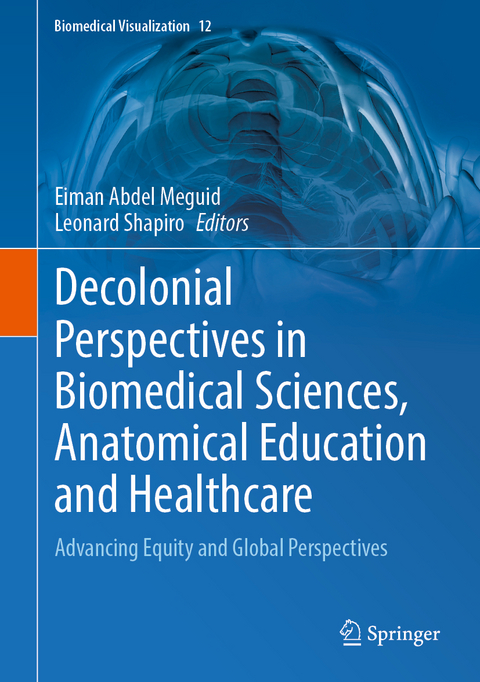
Decolonial Perspectives in Biomedical Sciences, Anatomical Education and Healthcare
Springer International Publishing (Verlag)
978-3-032-12304-6 (ISBN)
- Noch nicht erschienen - erscheint am 05.03.2026
- Versandkostenfrei
- Auch auf Rechnung
- Artikel merken
This edited volume draws on scholarly research and critical thinking about decolonization in the biomedical sciences, anatomical education and healthcare by authors from different areas within the biomedical arena, providing a multiplicity of perspectives.
The authors appeal to and address educators in anatomical and medical education, medical doctors, researchers, scientists and illustrators in the biomedical arena. They add to current and ongoing conversations about the need for addressing Eurocentric and colonial thinking which have prejudicially impacted anatomical education, imagery production, healthcare delivery, medical diagnoses, funding and research. This book provides details of the historical origins of entrenched colonial and Eurocentric thinking which negatively impact on our biomedical field at numerous levels, to the detriment of many recipients of medical education and healthcare. Chapters address how a Eurocentric and colonial worldview is expressed in the production of the many images of the human body in educational material, that has till very recently depicted only people with light skin tones, to the exclusion of people with darker skin tones.
The chapters in this book do not represent an attack on our current educational and healthcare systems, but rather call for a change in scholarly teaching and academic research. Guidelines are offered for implementing practical changes. These discussions appear at a time in which the Global South is increasingly participating in and contributing to biomedical discourse.
This book will appeal to educators of (bio) medicine in general and human anatomy in particular who are interested in the current thinking and discourse about increasing cultural inclusivity and visual equity in biomedical teaching and health care. We hope that these chapters stimulate thinking, promote discussion and contribute to the ongoing decolonial discourse within the biomedical arena.
Leonard Shapiro is an artist working in the health sciences and advancing art-based programs within the anatomical education curricula. He is honorary lecturer in the Primary Health Care Team, Department of Family, Community and Emergency Care, Faculty of Health Sciences, University of Cape Town, South Africa. Leonard has developed a novel, multi-sensory observation method, that specifically employs the sense of touch (haptics) coupled with the simultaneous act of drawing. It is called the Haptico-visual observation and drawing (HVOD) method. In anatomy education, the benefits of using the HVOD method include i) the enhanced observation of the three-dimensional form of anatomical parts, ii) the cognitive memorization of anatomical parts as a 3D 'mental picture', iii) improved spatial orientation within the volume of anatomical parts, and iv) an ability to draw. The HVOD method is taught to medical students, clinicians and anatomy educators in South Africa and abroad. Leonard also works with anatomy educators to develop tailored art-based exercises to assist medical students in improving their observation and three-dimensional spatial awareness.
Leonard has taught the HVOD method at the University of Cape Town (South Africa), Newcastle University (UK), The University of British Columbia (Canada), The Gordon Museum of Pathology (UK), University College Cork (Ireland), Weill Cornell Medical College (USA). Leonard contributes to the anatomy education discourse via publications and articles, and by presenting at anatomy conferences.
Leonard Shapiro, BSocSci, BA Fine Art (Hons).
Eiman Abdel Meguid is a medical graduate and a Reader of Anatomy at Queen s University Belfast (QUB), UK with expertise in human anatomy, embryology, and neuroanatomy. She is the Racial Equality Champion at her university. She is passionate about anatomical sciences education and is keen to actively support the education of her students. Eiman s areas of professional interest include anatomical variation, multimodal teaching strategies, implementing innovative technology and audience response system in teaching, flipped classrooms, blended and online learning. She is the Sole Academic Lead for the dental anatomy course, the MSc in Clinical Anatomy Programme Lead and a Co-lead for Musculoskeletal Unit 2 for the MB BCh BAO. She has multiple publications in high impact journals and she was an International Visiting Scholar/Guest Speaker at Weill Cornell Medicine, NY. She has previously acted as a member of the Career Development Committee and the Education Affairs Committee of the American Association of Clinical anatomy and is currently a member of the European Federation of Experimental Morphology (EFEM) Award Committee Award Committee and a member at the Anatomy Collective for Equality. She is a reviewer for the Clinical Anatomy, and the Anatomical Sciences Education Journals and a member of the Editorial Board of the BMC Medical Education. Through her membership of the Risk Management Group Committee at Royal College of Surgeons and previous role at the Research Ethics Committee at QUB, she gained lot of experience in reviewing and generating policies for educational and research-related activities. Having spent many years teaching students as a clinical anatomist, she is well placed to assist in producing resources that would assist the development of student education. The extensive experience she has gained, her international networking, and her interest in tailoring teaching and research have equipped her with the necessary skills.
Chapter 1. Decolonizing Healthcare Education: From Historical Exclusion to Equitable Practice.- Chapter 2. Decolonizing Anatomy: Examining and Unpicking the Relationship Between Coloniality, Sex, Gender, and the Body.- Chapter 3. Visualizing Racial Diversity in Anatomy Curricula Entrenches Race as a Biological Phenomenon.- Chapter 4. Constructing the Body: The Intersection of Standardizing Anatomy, Illustration, and Digitization.- Chapter 5. Visualizing Diversity: Addressing Bias in Anatomical Representation.- Chapter 6. Visualizing Equity: Addressing Racial and Cultural Representation in Anatomy Education and Biomedical Imagery.- Chapter 7. Embodied Data: Exploring the Impact of Biometric Visualization Techniques on Global Health Equity.- Chapter 8. Inclusivity within Living Anatomy Imagery.- Chapter 9. Diversifying and Decolonizing Oral Medicine s Clinical Images in Health Science Teaching: Rectifying Colonial and Racial Biases Through the Creation of an Interactive e-Resource.- Chapter 10. Decolonizing Chemokine and Chemokine Receptor Expression in Acute Allograft Rejection (AAR) An Overview.- Chapter 11. Visualising the Co-creation Process of Enhancing Inclusive and Diversified Biomedical Sciences, Anatomy Education and Healthcare Curricula.
| Erscheint lt. Verlag | 2.4.2026 |
|---|---|
| Reihe/Serie | Biomedical Visualization |
| Zusatzinfo | XIV, 269 p. 58 illus., 43 illus. in color. |
| Verlagsort | Cham |
| Sprache | englisch |
| Maße | 178 x 254 mm |
| Themenwelt | Medizin / Pharmazie ► Allgemeines / Lexika |
| Studium ► 1. Studienabschnitt (Vorklinik) ► Anatomie / Neuroanatomie | |
| Sozialwissenschaften ► Pädagogik | |
| Schlagworte | Anatomy Education • Biomedical Visualization Technique • Cultural representation • Digital Management • digitization • Diversity • Health Science Teaching • Inclusion • Inclusive Anatomy Education • oral medicine • racial bias • Standardizing Anatomy |
| ISBN-10 | 3-032-12304-6 / 3032123046 |
| ISBN-13 | 978-3-032-12304-6 / 9783032123046 |
| Zustand | Neuware |
| Informationen gemäß Produktsicherheitsverordnung (GPSR) | |
| Haben Sie eine Frage zum Produkt? |
aus dem Bereich