


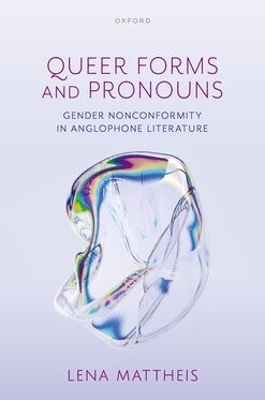
Queer Forms and Pronouns
Gender Nonconformity in Anglophone Literature
Seiten
2026
Oxford University Press (Verlag)
978-0-19-897411-6 (ISBN)
Oxford University Press (Verlag)
978-0-19-897411-6 (ISBN)
- Noch nicht erschienen (ca. März 2026)
- Versandkostenfrei
- Auch auf Rechnung
- Artikel merken
In Queer Forms and Pronouns, author Lena Mattheis explores gender nonconformity (GNC) pronouns in Anglophone literature and their impact on narrative form. The book features a dialogic chapter co-written with language revitalisation scholar and poet Kai Minosh Pyle, and each chapter is accompanied by a podcast episode.
Queer Forms and Pronouns is a journey into the world of gender nonconformity (GNC) pronouns in literature. Pronouns are frequently discussed in the contexts of language policies, grammar, and inclusion, but their role in queer, trans, and nonbinary storytelling is generally overlooked. Author Lena Mattheis here demonstrates that GNC pronoun use, referring to any pronoun use that marks a person or character as not conforming to gendered norms of their spatiotemporal and cultural context, has a profound impact on narrative form in Anglophone literature.
Pronouns such as singular they, neopronouns, mixed pronouns, and even 'it' pronouns find their place in literature not despite any imagined shortcomings, but because of their aesthetic quality, formal intrigue, and innovative potential. Mattheis demonstrates how the works of contemporary authors such as Lamya H, Rae Spoon, Andrea Lawlor, Becky Chambers, and Andrea Gibson illustrate the multitude of functions taken on by GNC pronouns. Grounding their reflections on contemporary Anglophone literature in long traditions of queer and trans writing, Mattheis reaches back centuries to examples of GNC pronoun use throughout literary history, touching upon precedents in texts by Margaret Cavendish, Aphra Behn, Virginia Woolf, and Octavia Butler, among others. Their discussions arund the surrounding potentials and shortcomings of GNC pronoun use focus on narrative agency, frequently returning to the real-world consequences that a pronoun--a small yet impactful word--can have, consequences that include government bans on inclusive language, censorship, and health impacts.
The book features a dialogic chapter, co-written with language revitalisation scholar and poet Kai Minosh Pyle, and each chapter is accompanied by a podcast episode to provide additional reflections and accessibility.
Queer Forms and Pronouns is a journey into the world of gender nonconformity (GNC) pronouns in literature. Pronouns are frequently discussed in the contexts of language policies, grammar, and inclusion, but their role in queer, trans, and nonbinary storytelling is generally overlooked. Author Lena Mattheis here demonstrates that GNC pronoun use, referring to any pronoun use that marks a person or character as not conforming to gendered norms of their spatiotemporal and cultural context, has a profound impact on narrative form in Anglophone literature.
Pronouns such as singular they, neopronouns, mixed pronouns, and even 'it' pronouns find their place in literature not despite any imagined shortcomings, but because of their aesthetic quality, formal intrigue, and innovative potential. Mattheis demonstrates how the works of contemporary authors such as Lamya H, Rae Spoon, Andrea Lawlor, Becky Chambers, and Andrea Gibson illustrate the multitude of functions taken on by GNC pronouns. Grounding their reflections on contemporary Anglophone literature in long traditions of queer and trans writing, Mattheis reaches back centuries to examples of GNC pronoun use throughout literary history, touching upon precedents in texts by Margaret Cavendish, Aphra Behn, Virginia Woolf, and Octavia Butler, among others. Their discussions arund the surrounding potentials and shortcomings of GNC pronoun use focus on narrative agency, frequently returning to the real-world consequences that a pronoun--a small yet impactful word--can have, consequences that include government bans on inclusive language, censorship, and health impacts.
The book features a dialogic chapter, co-written with language revitalisation scholar and poet Kai Minosh Pyle, and each chapter is accompanied by a podcast episode to provide additional reflections and accessibility.
Lena Mattheis (they/she) is a lecturer in contemporary literature at the University of Surrey and specialises in queer and trans literature, narrative studies, and literary geography. Since April 2021, Mattheis has been hosting the Queer Lit podcast and has recorded conversations with Sara Ahmed, Susan Stryker, Jack Halberstam, and many other inspiring scholars. In addition to another monograph, Translocality in Contemporary City Novels (awarded the Faculty of Humanities Award at the University of Duisburg-Essen), their work has been published in journals such as Narrative, Transnational Literature, Literary Geographies, and WSQ. Mattheis has previously worked at the University of Duisburg-Essen in Germany and at the University of Namibia.
| Erscheint lt. Verlag | 20.3.2026 |
|---|---|
| Zusatzinfo | 1 b/w illustration |
| Verlagsort | Oxford |
| Sprache | englisch |
| Maße | 156 x 234 mm |
| Themenwelt | Geisteswissenschaften ► Sprach- / Literaturwissenschaft ► Anglistik / Amerikanistik |
| Geisteswissenschaften ► Sprach- / Literaturwissenschaft ► Literaturwissenschaft | |
| Sozialwissenschaften ► Soziologie ► Gender Studies | |
| ISBN-10 | 0-19-897411-6 / 0198974116 |
| ISBN-13 | 978-0-19-897411-6 / 9780198974116 |
| Zustand | Neuware |
| Informationen gemäß Produktsicherheitsverordnung (GPSR) | |
| Haben Sie eine Frage zum Produkt? |
Mehr entdecken
aus dem Bereich



aus dem Bereich
Poetik eines sozialen Urteils
Buch | Hardcover (2023)
De Gruyter (Verlag)
CHF 83,90


