


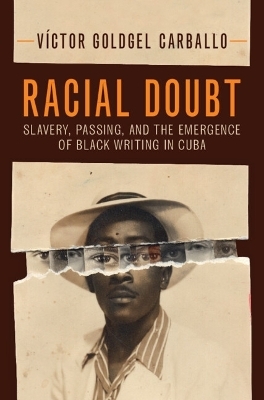
Racial Doubt
Slavery, Passing, and the Emergence of Black Writing in Cuba
Seiten
2026
Cambridge University Press (Verlag)
978-1-009-69288-5 (ISBN)
Cambridge University Press (Verlag)
978-1-009-69288-5 (ISBN)
- Noch nicht erschienen (ca. April 2026)
- Versandkostenfrei
- Auch auf Rechnung
- Artikel merken
This book challenges assumptions about race through the lens of nineteenth-century Cuba, addressing contemporary, transnational perspectives in Black and American studies. Through analyses of texts produced in the context of slavery, it invites students and scholars to comparatively consider race in the present tense.
With a focus on nineteenth-century Cuba, Víctor Goldgel Carballo conceptualizes the analytical category of racial doubt: the hesitation produced by divergent, contradictory, or ambiguous understandings of race. Racial doubt is the flip side of racialism, or of the assumption that social hierarchies are based on the existence of races, imagined as natural or prior to those hierarchies. Mapping key moments of a century that witnessed the peak of racial slavery, abolition, and the birth of the Black press, this book shows how captives, free people of color, and Afro-Cuban authors leveraged doubts to overcome racist sociopolitical structures. It interweaves analyses of literature, including poems by enslaved authors and a novel by a mixed-race journalist, with unpublished archival material, including testimonies of kidnapped Afrodescendants. Focusing on how people held multiple views of race simultaneously, it examines debates crucial to the history of the Americas, including color-blindness and shifting understandings of Blackness.
With a focus on nineteenth-century Cuba, Víctor Goldgel Carballo conceptualizes the analytical category of racial doubt: the hesitation produced by divergent, contradictory, or ambiguous understandings of race. Racial doubt is the flip side of racialism, or of the assumption that social hierarchies are based on the existence of races, imagined as natural or prior to those hierarchies. Mapping key moments of a century that witnessed the peak of racial slavery, abolition, and the birth of the Black press, this book shows how captives, free people of color, and Afro-Cuban authors leveraged doubts to overcome racist sociopolitical structures. It interweaves analyses of literature, including poems by enslaved authors and a novel by a mixed-race journalist, with unpublished archival material, including testimonies of kidnapped Afrodescendants. Focusing on how people held multiple views of race simultaneously, it examines debates crucial to the history of the Americas, including color-blindness and shifting understandings of Blackness.
Víctor Goldgel Carballo is a novelist and Professor of Spanish at the University of Wisconsin–Madison. He is the author of Cuando lo nuevo conquistó América, which won prizes for best book from the Latin American Studies Association and Casa de las Américas.
List of figures; Acknowledgments; Introduction: on doubt; Part I. The Enslaved: 1. Racist agnosia; 2. The farce of law; Part II. Free People of Color: 3. Two one-drop rules; 4. Fictions of racial coherence; Part III. Black Writing: 5. Back talk; 6. The beginning of Black writing; Conclusion; References; Index.
| Erscheint lt. Verlag | 30.4.2026 |
|---|---|
| Reihe/Serie | Afro-Latin America |
| Zusatzinfo | Worked examples or Exercises |
| Verlagsort | Cambridge |
| Sprache | englisch |
| Gewicht | 250 g |
| Themenwelt | Geisteswissenschaften ► Geschichte ► Regional- / Ländergeschichte |
| Sozialwissenschaften ► Ethnologie | |
| Sozialwissenschaften ► Soziologie | |
| ISBN-10 | 1-009-69288-7 / 1009692887 |
| ISBN-13 | 978-1-009-69288-5 / 9781009692885 |
| Zustand | Neuware |
| Informationen gemäß Produktsicherheitsverordnung (GPSR) | |
| Haben Sie eine Frage zum Produkt? |
Mehr entdecken
aus dem Bereich


aus dem Bereich
die Geschichte meiner Urgroßmutter
Buch | Hardcover (2025)
C.H.Beck (Verlag)
CHF 32,15


