


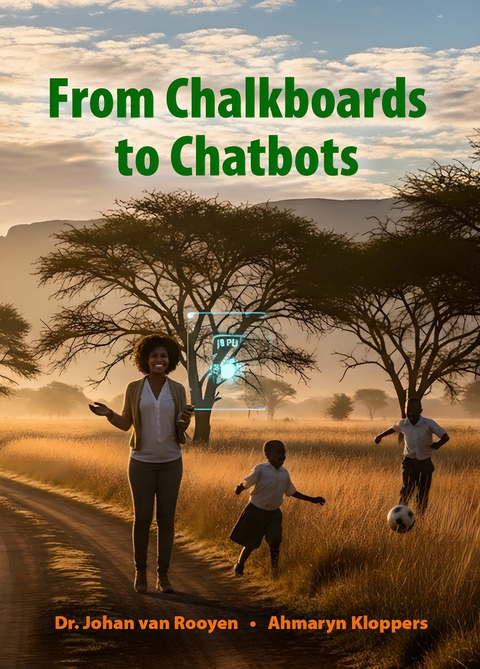
From Chalkboards to Chatbots (eBook)
90 Seiten
Publishdrive (Verlag)
978-0-00-107463-7 (ISBN)
From Chalkboards to Chatbots
Education is changing faster than ever, and teachers are at the heart of that transformation. From Chalkboards to Chatbots is a practical and inspiring guide for educators navigating the new world of Artificial Intelligence in the classroom.
Written by Dr. Johan van Rooyen and Ahmaryn Kloppers, this book bridges decades of classroom wisdom with the latest in AI innovation. It shows teachers everywhere, from rural schools to modern city classrooms, how to use AI tools to save time, spark creativity, and prepare students for a future where digital literacy is as essential as reading and math.
More than a technology manual, this book is about people. It highlights real-world success stories, practical strategies, and thoughtful reflections on how teachers can combine the power of AI with the irreplaceable human touch of empathy, creativity, and inspiration.
Whether you're new to AI or already experimenting with it in your teaching, From Chalkboards to Chatbots will empower you to:
Understand AI in simple, practical terms
Transform lesson planning and assessment
Support diverse learners with tailored resources
Inspire critical thinking and digital citizenship
Lead your students into a future of possibility
At its heart, this book reminds us that while technology evolves, great teaching remains timeless. AI is not here to replace teachers, it's here to amplify their impact.
Chapter 2
Discovering Your Most Reliable Teaching Partner
AI as Your Teaching Assistant
Redefining Educational Partnership
The integration of artificial intelligence into education represents a fundamental shift in how teaching and learning can occur. Rather than threatening the traditional role of educators, AI serves as an unprecedented force multiplier, amplifying teacher capabilities while preserving the essential human elements that make education meaningful.
Consider the ideal teaching assistant: one who never experiences fatigue, maintains consistent enthusiasm regardless of repetitive questions, possesses comprehensive knowledge across all subjects, communicates fluently in multiple languages, creates instructional materials rapidly, and remains available continuously. This assistant doesn’t replace human judgment but provides the foundational support that enables teachers to focus on what they do best, building relationships, inspiring curiosity, and adapting instruction to individual student needs.
This partnership model transforms the traditional limitations of classroom instruction. Where teachers once faced constraints of time, resources, and access to information, AI removes these barriers while preserving the irreplaceable human elements that define effective education.
The Synergy of Human and Artificial Intelligence
The most powerful educational applications of AI emerge from recognizing the complementary strengths of human teachers and artificial intelligence systems. This partnership creates capabilities that neither could achieve independently.
Human Contributions to the Partnership Teachers bring emotional intelligence that enables them to recognize when students are struggling, celebrate genuine breakthroughs, and provide the encouragement that sustains motivation through challenging learning periods. They understand the cultural context that shapes student perspectives and can adapt instruction accordingly. Their professional experience guides decisions about when to challenge students and when to provide additional support.
Teachers also contribute creativity in connecting curriculum content to students’ lived experiences, making abstract concepts concrete through familiar examples and local contexts. They build the trust relationships that encourage risk-taking in learning and provide the ethical framework that helps students navigate complex ideas and situations.
AI Contributions to the Partnership AI systems provide processing speed that enables instant access to vast information repositories and rapid generation of instructional materials. They offer consistency in quality and approach, ensuring that all students receive accurate information and well-structured learning experiences. Their capacity for patience means they can provide multiple explanations and approaches without fatigue or frustration.
AI excels at pattern recognition, identifying successful teaching strategies from extensive datasets and personalizing content based on individual learning preferences. It can simultaneously create materials for multiple learning styles and ability levels, ensuring that differentiated instruction becomes practical rather than overwhelming for teachers.
The Collaborative Result When human creativity and contextual knowledge combine with AI’s speed and comprehensive access to information, the result is educational experiences that are both deeply personal and broadly informed. Students benefit from instruction that is tailored to their needs while being grounded in global knowledge and best practices.
Real-World Transformations
The practical impact of AI-teacher partnerships manifests differently across diverse educational contexts, but the fundamental pattern remains consistent: AI handles routine tasks and information processing while teachers focus on relationship building and instructional leadership.
Rural Education Enhancement In Guatemala, Ana’s experience illustrates how AI can address the resource constraints common in rural education. Previously, her weekend lesson planning consumed entire days, limiting both her personal time and the variety of instructional approaches she could develop. AI transformation enabled her to generate comprehensive lesson outlines quickly, freeing time for the more important work of adapting materials to her students’ cultural context and individual needs.
This shift represents more than time savings; it demonstrates how AI can level the playing field between well-resourced and under-resourced schools. Ana now has access to the same quality of instructional ideas as teachers in urban districts, while retaining the autonomy to adapt these resources for her specific community.
Subject Matter Confidence David’s experience in Nigeria addresses one of the most common challenges teachers face: maintaining expertise across multiple subject areas. Rather than avoiding difficult student questions or providing inadequate answers, AI enables teachers to embrace curiosity and model lifelong learning. When students pose challenging questions, David transforms these moments into collaborative learning experiences where he and his students explore answers together.
This approach builds student confidence in questioning and investigation while maintaining teacher credibility. Students see their teacher as a learning facilitator rather than an omniscient authority, creating a more dynamic and engaging classroom environment.
Multilingual Education Support Fatima’s success in Morocco demonstrates AI’s potential for breaking down language barriers that historically limited educational opportunities. Creating materials in multiple languages was previously time-intensive and often impossible for individual teachers. AI translation and content generation enables seamless multilingual instruction, allowing students to build understanding in their native language while developing skills in additional languages.
This capability is particularly significant in regions with linguistic diversity, where traditional educational approaches often forced students to choose between their cultural identity and academic success.
Accessible AI Tools for Educators
The democratization of AI technology means that powerful educational tools are now available regardless of institutional resources or technical expertise. Understanding these tools and their applications enables teachers to make informed decisions about AI integration.
Conversational AI Platforms
ChatGPT represents the most widely accessible entry point for educators exploring AI integration. Its free tier provides substantial capabilities for lesson planning, content creation, and instructional support. The platform excels at generating educational materials quickly, explaining complex concepts in accessible language, and providing multiple approaches to the same learning objective.
Teachers can use ChatGPT for immediate lesson planning support, requesting comprehensive activity suggestions for specific topics and grade levels. The system’s ability to adjust explanations for different age groups and learning styles makes it particularly valuable for differentiated instruction. Its multilingual capabilities enable teachers to create materials in students’ native languages or to bridge between languages during instruction.
Google Gemini offers similar conversational capabilities with enhanced integration into Google’s educational ecosystem. Its strength in processing current information makes it particularly valuable for incorporating contemporary examples and recent developments into curriculum content. The platform’s presentation and document creation capabilities streamline the production of professional-quality instructional materials.
Specialized Applications
Translation and Communication Tools Google Translate has evolved beyond simple text conversion to become a comprehensive multilingual communication platform. Its camera translation feature enables real-time interpretation of printed materials, while conversation mode facilitates direct communication between teachers and non-English speaking families. These capabilities are essential for inclusive educational environments where linguistic diversity is common.
Design and Visual Content Creation Canva’s AI-enhanced design tools enable teachers to create professional-quality visual materials without graphic design expertise. The platform’s educational templates and AI image generation capabilities transform basic worksheets into engaging visual learning tools. This visual enhancement is particularly important for supporting different learning styles and maintaining student attention in increasingly digital learning environments.
Implementation Strategies for Different Technology Contexts
Smartphone-Only Access Many educators worldwide have access only to smartphones, yet this single device provides entry to virtually all AI educational tools. Voice interaction capabilities enable hands-free lesson planning during commutes or preparation periods. Offline preparation strategies, such as downloading AI-generated materials during periods of connectivity, maximize the utility of limited internet access.
Teachers with smartphone-only access can use voice commands to generate lesson ideas during non-instructional time, then adapt and implement these suggestions when working with students. The portability of smartphones also enables real-time translation and information access during instruction, supporting spontaneous learning...
| Erscheint lt. Verlag | 13.10.2025 |
|---|---|
| Sprache | englisch |
| Themenwelt | Sozialwissenschaften ► Pädagogik |
| ISBN-10 | 0-00-107463-6 / 0001074636 |
| ISBN-13 | 978-0-00-107463-7 / 9780001074637 |
| Informationen gemäß Produktsicherheitsverordnung (GPSR) | |
| Haben Sie eine Frage zum Produkt? |
 EPUB (Adobe DRM)
Größe: 15,8 MB
Kopierschutz: Adobe-DRM
Adobe-DRM ist ein Kopierschutz, der das eBook vor Mißbrauch schützen soll. Dabei wird das eBook bereits beim Download auf Ihre persönliche Adobe-ID autorisiert. Lesen können Sie das eBook dann nur auf den Geräten, welche ebenfalls auf Ihre Adobe-ID registriert sind.
Details zum Adobe-DRM
Dateiformat: EPUB (Electronic Publication)
EPUB ist ein offener Standard für eBooks und eignet sich besonders zur Darstellung von Belletristik und Sachbüchern. Der Fließtext wird dynamisch an die Display- und Schriftgröße angepasst. Auch für mobile Lesegeräte ist EPUB daher gut geeignet.
Systemvoraussetzungen:
PC/Mac: Mit einem PC oder Mac können Sie dieses eBook lesen. Sie benötigen eine
eReader: Dieses eBook kann mit (fast) allen eBook-Readern gelesen werden. Mit dem amazon-Kindle ist es aber nicht kompatibel.
Smartphone/Tablet: Egal ob Apple oder Android, dieses eBook können Sie lesen. Sie benötigen eine
Geräteliste und zusätzliche Hinweise
Buying eBooks from abroad
For tax law reasons we can sell eBooks just within Germany and Switzerland. Regrettably we cannot fulfill eBook-orders from other countries.
aus dem Bereich


