


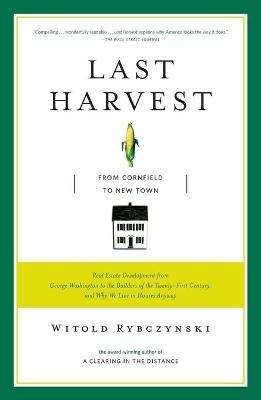
Last Harvest
From Cornfield to New Town: Real Estate Development from George Washington to the Builders of the Twenty-First Century, and Why We Live in Houses Anyway
Seiten
2008
Scribner (Verlag)
978-0-7432-3597-6 (ISBN)
Scribner (Verlag)
978-0-7432-3597-6 (ISBN)
- Titel ist leider vergriffen;
keine Neuauflage - Artikel merken
The bestselling author of "Home" and "A Clearing in the Distance" tells the compelling story of the transformation of a Pennsylvania cornfield into a neotraditional housing development--taking the reader on a revelatory inside tour of real estate in America.
When Witold Rybczynski first heard about New Daleville, it was only a developer's idea, attached to ninety acres of cornfield an hour and a half west of Philadelphia. Over the course of five years, Rybczynski met and talked to everyone involved in the building of this residential subdivision -- from the developers to the township leaders, whose approval they needed, to the home builders and engineers and, ultimately, the first families who moved in. Always eloquent and illuminating, the award-winning author of Now I Sit Me Down looks at this neotraditional project, with its houses built close together to encourage a sense of intimacy and community, and explains the trends in American domestic architecture -- from where we place our kitchens and fences to why our bathrooms get larger every year.
Last Harvest was voted one of the ten best books of 2008 by the editors of Planetizen, and as Publishers Weekly said, Rybczynski provides historical and cultural perspectives in a style reminiscent of Malcolm Gladwell, debunking the myth of urban sprawl and explaining American homeowners' preference for single-family dwellings.
When Witold Rybczynski first heard about New Daleville, it was only a developer's idea, attached to ninety acres of cornfield an hour and a half west of Philadelphia. Over the course of five years, Rybczynski met and talked to everyone involved in the building of this residential subdivision -- from the developers to the township leaders, whose approval they needed, to the home builders and engineers and, ultimately, the first families who moved in. Always eloquent and illuminating, the award-winning author of Now I Sit Me Down looks at this neotraditional project, with its houses built close together to encourage a sense of intimacy and community, and explains the trends in American domestic architecture -- from where we place our kitchens and fences to why our bathrooms get larger every year.
Last Harvest was voted one of the ten best books of 2008 by the editors of Planetizen, and as Publishers Weekly said, Rybczynski provides historical and cultural perspectives in a style reminiscent of Malcolm Gladwell, debunking the myth of urban sprawl and explaining American homeowners' preference for single-family dwellings.
Witold Rybczynski has written about architecture and urbanism for The New York Times, Time, The Atlantic, and The New Yorker. He is the author of the critically acclaimed book Home and the award-winning A Clearing in the Distance, as well as The Biography of a Building, The Mysteries of the Mall, and Now I Sit Me Down. The recipient of the National Building Museum's 2007 Vincent Scully Prize, he lives with his wife in Philadelphia, where he is emeritus professor of architecture at the University of Pennsylvania.
| Erscheint lt. Verlag | 1.7.2008 |
|---|---|
| Verlagsort | New York |
| Sprache | englisch |
| Themenwelt | Sozialwissenschaften ► Politik / Verwaltung |
| ISBN-10 | 0-7432-3597-5 / 0743235975 |
| ISBN-13 | 978-0-7432-3597-6 / 9780743235976 |
| Zustand | Neuware |
| Informationen gemäß Produktsicherheitsverordnung (GPSR) | |
| Haben Sie eine Frage zum Produkt? |
Mehr entdecken
aus dem Bereich



aus dem Bereich
Grundzüge eines neoliberalen Raumregimes
Buch | Softcover (2025)
Matthes & Seitz Berlin (Verlag)
CHF 20,95
Grundlagen, Entwicklungen, Positionen
Buch | Hardcover (2023)
wbg Academic (Verlag)
CHF 55,95


