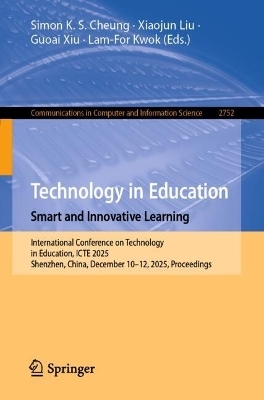
Technology in Education. Smart and Innovative Learning
Springer Verlag, Singapore
978-981-95-4498-1 (ISBN)
The 34 full papers included in this book were carefully reviewed and selected from 89 submissions. hey were organized in the following topical sections: Keynotes; Intelligent Applications in Education; Smart Learning Environments; Psychological and Pedagogical Issues; Technology in Vocational and Professional Education and Training; and Digital Technology, Innovation and Education.
Keynotes
.- Framing AI in Education 5.0: A Strategic Framework for Human-Centered Learning Ecosystems.
.- Empowering Non-Technical Teachers as Designers of Virtual Experiential Learning: Insights from the EduVenture-VR Journey.
.- Enhancing Learning through a Web-based OER: Application of Metamorphic Testing to John the Ripper.
.- Embodied Intelligence in Education: Current Status and Trends.
Intelligent Applications in Education
.- Research on the Construction of the Agent-OPDE Instructional Model for Project-Based Deep Reading in Primary School Chinese Language Education.
.- Simulated Realities: An AI Role-Play Analysis of Administrative Tensions in the Implementation of Agile-Blended Learning.
.- The application of generative artificial intelligence (GAI) in tourism higher education: the interactive effects of feedback types and task types on university students’ intention to use.
.- Exploring an AI-Enhanced Education Ecosystem Model: The Interplay and Synergy of Technology, Environment, and Scenario.
.- Scaffolding Computer Programming Learning for Novice Learners using LLM as a Conversational Resource.
.- Building Bridges to Student Growth: An LLM-Powered Feedback Generation System for Holistic Development.
Smart Learning Environments
.- The Construction of U-OCAET Classroom Model for Primary School Calligraphy Appreciation Empowered by “Platform + AI Agent”.
.- Augmented Reality Smart Glasses for Generic Learning Activities: An Exploratory Investigation.
.- Enhancing Fire Safety Training through Immersive Technologies: Evaluating the Impact of the "Three R" Virtual Building Project in Hong Kong.
.- Enhancing Student Engagement and Satisfaction in Tourism Education Through Virtual Reality: An Application of the Technology Acceptance Model.
.- Application Pathways of Virtual Simulation Technology in Vocational Education.
.- Design and Validation of a Game-Based Assessment Tool for Primary Students’ Digital Literacy.
Psychological and Pedagogical Issues
.- Construction of an Interdisciplinary Thematic Learning Activity Design Framework for Computational Thinking Cultivation.
.- Enhancing College Students’ Adaptive Generative Learning Outcomes: A Multi-Agent System Approach Based on the “C-H-R” Collaboration Mechanism.
.- The Research on the Construction of Primary School Mathematics Human-Machine Collaborative Precise Review Class Mode.
.- Research on the Enhancement of University Professors’ TPACK Competence Across Three Instructional Dimensions.
.- Always Online: University Students’ Perceptions of Screen Time, Mental Well-being, and Academic Focus.
.- Study on the Influencing Factors of College Students’ Critical Thinking in the Smart Classroom Environment.
Technology in Vocational and Professional Education and Training
.- A Lightweight Method for Process Evaluation in Educational Cyber Range Experiments.
.- Analysis of Student Satisfaction in Hybrid Teaching of Python Course in Higher Vocational Colleges and Universities - Taking the New Business Major as an Example.
.- Coupling–Coordination Analysis of Integrated Vocational–Technical Talent Cultivation Driven by Digital Transformation.
.-Digital Tech Use and Employment Satisfaction among Vocational College Students: Chain Mediation via Experience and Engagement.
.- The Influence and Trend of Technological Change on Vocational and Technical Education.
.- From Higher Diploma to Master: A Smart-Tech Vertical Curriculum Framework in Cyber Technology Education.
Digital technology, Innovation and Education
.- Digital Learning Literacy and Educational Technology Adoption among University Students in the Artificial Intelligence Era.
.- Balancing Innovation and Integrity: The Role of GenAI in Higher Education at a Taiwanese University.
.- Effects of Personalized Generative AI on Student Creativity: Evidence from Creative Performance, Self-Efficacy, and Attention Allocation.
.- Human-Al Collaboration in the STEM Classroom: A Systematic Literature Review of GenAI as a Complement in Higher Education.
.- A Review of Large Language Model Evaluation Metrics in Education.
.- Advancing Robotics Education: Trends, Innovations, and Practices.
| Erscheinungsdatum | 29.11.2025 |
|---|---|
| Reihe/Serie | Communications in Computer and Information Science |
| Zusatzinfo | 75 Illustrations, color; 16 Illustrations, black and white |
| Verlagsort | Singapore |
| Sprache | englisch |
| Maße | 155 x 235 mm |
| Themenwelt | Schulbuch / Wörterbuch ► Unterrichtsvorbereitung ► Unterrichts-Handreichungen |
| Mathematik / Informatik ► Informatik | |
| Sozialwissenschaften ► Pädagogik | |
| Sozialwissenschaften ► Soziologie ► Empirische Sozialforschung | |
| Schlagworte | Blended Learning • Computer supported collaborative learning • educational administration • Game-based Learning • institutional strategies, policies and practices • Intelligent applications for education • knowledge management • learning analysis and assessment • Learning platforms and content management systems • Massive Open Online Courses • Mobile Learning • social media for learning • technology-enabled learning • Virtual reality and augmented reality |
| ISBN-10 | 981-95-4498-X / 981954498X |
| ISBN-13 | 978-981-95-4498-1 / 9789819544981 |
| Zustand | Neuware |
| Informationen gemäß Produktsicherheitsverordnung (GPSR) | |
| Haben Sie eine Frage zum Produkt? |
aus dem Bereich