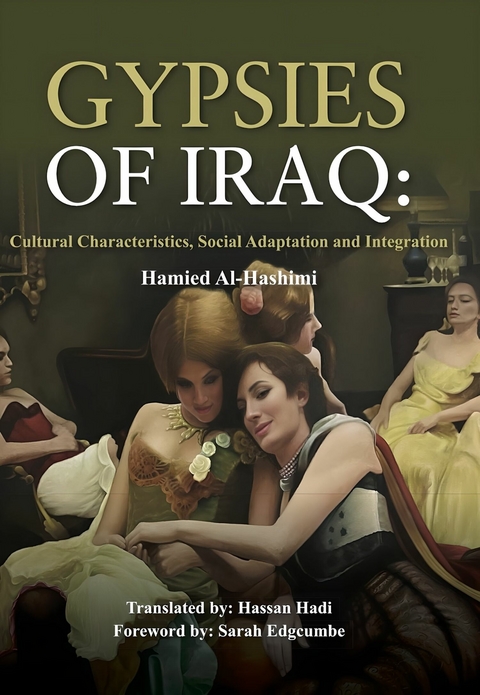
Gypsies of Iraq (eBook)
550 Seiten
Dolman Scott Publishers (Verlag)
978-1-915351-43-2 (ISBN)
Following the 2003 fall of Saddam Hussein's regime in Iraq, Gypsy communities-particularly in areas like Kamaliya (Baghdad) and Fawwar (Qadisiya)-were targeted by religious militias. Their homes were attacked, electricity was cut off, and the only local school in Fawwar was destroyed. This violence highlighted the strained and often hostile relationship between Gypsies and their neighbours. The study in question explores the Gypsies as a sub-culture within Iraqi society, examining their social adaptation using a socio-anthropological approach grounded in George Homans's theory of social exchange, which focuses on the balance of costs and benefits in social interactions.
Using a case study method, with households as units of analysis, the research applies comparative, historical, and statistical techniques. It concentrates on Gypsies in Kamaliya and Fawwar, chosen for their representative and active roles among other Gypsy communities across Iraq, including villages in Mosul, Kerkuk, Diala, Baghdad, Babil, Nasiriya, and Basra.
The study uses interviews, observation, oral testimonies, and documentary data. It has both theoretical and fieldwork components. The theoretical section introduces the research background and the hypothesis that the Iraqi term for Gypsies, Kawliya, may trace back to an Indian king named Kawil.
The fieldwork comprises six chapters. The first analysis of family structures noted large household sizes and weak kinship ties. The second addresses religion, revealing that all studied Gypsies identify as Muslim-a sign of surface-level social integration. The third focuses on economic roles, especially women's involvement in music, dance, sex work, and bar-related trades. The fourth examines social control, with state law (police) as the dominant force. The fifth chapter studies cultural communication, finding it stronger in Kamaliya due to proximity to Baghdad. The sixth explores forms of adaptation: superficial (dress, religion, language) versus deeper integration through interracial marriage, friendship, and neighbourhood ties.
Finally, the study discusses post-2003 challenges faced by Gypsies under the dominance of militias. It offers recommendations including gathering Gypsies into better-serviced settlements and guiding them toward accessible occupations like agriculture, while ensuring their security and enabling communication under healthy oversight.
Following the 2003 fall of Saddam Hussein's regime in Iraq, Gypsy communities-particularly in areas like Kamaliya (Baghdad) and Fawwar (Qadisiya)-were targeted by religious militias. Their homes were attacked, electricity was cut off, and the only local school in Fawwar was destroyed. This violence highlighted the strained and often hostile relationship between Gypsies and their neighbours. The study in question explores the Gypsies as a sub-culture within Iraqi society, examining their social adaptation using a socio-anthropological approach grounded in George Homans's theory of social exchange, which focuses on the balance of costs and benefits in social interactions.Using a case study method, with households as units of analysis, the research applies comparative, historical, and statistical techniques. It concentrates on Gypsies in Kamaliya and Fawwar, chosen for their representative and active roles among other Gypsy communities across Iraq, including villages in Mosul, Kerkuk, Diala, Baghdad, Babil, Nasiriya, and Basra.The study uses interviews, observation, oral testimonies, and documentary data. It has both theoretical and fieldwork components. The theoretical section introduces the research background and the hypothesis that the Iraqi term for Gypsies, Kawliya, may trace back to an Indian king named Kawil.The fieldwork comprises six chapters. The first analysis of family structures noted large household sizes and weak kinship ties. The second addresses religion, revealing that all studied Gypsies identify as Muslim a sign of surface-level social integration. The third focuses on economic roles, especially women s involvement in music, dance, sex work, and bar-related trades. The fourth examines social control, with state law (police) as the dominant force. The fifth chapter studies cultural communication, finding it stronger in Kamaliya due to proximity to Baghdad. The sixth explores forms of adaptation: superficial (dress, religion, language) versus deeper integration through interracial marriage, friendship, and neighbourhood ties.Finally, the study discusses post-2003 challenges faced by Gypsies under the dominance of militias. It offers recommendations including gathering Gypsies into better-serviced settlements and guiding them toward accessible occupations like agriculture, while ensuring their security and enabling communication under healthy oversight.
Foreword
By
Sarah Edgcumbe
Dr Hamied al Hashimi’s sociological publications on issues such as minority identities and integration have been pored over by university students all over Iraq. Crucially, Dr al Hashimi’s scholarship transcends established discourse concerning recognised minorities, to include socially ostracised, poorly understood, marginalised groups such as Iraqi Gypsies. As such, it is wonderful that with this English language translation, diligently and carefully produced by Mr Hassan Hadi, Dr al Hashimi’s work on Iraqi Gypsies has now been made accessible to those who are not fortunate enough to understand Arabic. Beyond this English language publication representing increased accessibility of Iraqi sociological scholarship, it also constitutes a valuable contribution to the field of Romani Studies of Middle Eastern origin, as well as Romani Studies more broadly.
Romani studies is a stubbornly Eurocentric discipline, and as a result, very little published scholarship exists which focuses on Dom (Middle Eastern Roma) and Gypsies in the Middle East - particularly in Iraq. This book, originally published in Arabic in 2012, is the first comprehensive work of its kind to provide valuable insight into kinship networks, marriage dynamics, and economic practices among Iraqi Gypsies. Additionally, this book is notable because it represents an important milestone in Romani Studies literature, reflecting at once the geo-political environment, context, and time in which it was written. As such, it sheds light on a key stage in the trajectory and development of the field of Romani Studies. Though this book focuses on Iraqi Gypsies as the subject, it simultaneously enables the reader to glimpse the social and power dynamics in which both non-Gypsy researcher, and Gypsy subject are embedded. A vantage point from which to begin to understand the lived experience of Gypsies in Iraq, this book provides a foundation upon which to caution against homogenisation of Iraqi Gypsies and to promote ongoing ethnology-oriented research with one of Iraq’s most maligned, and vulnerable minorities.
The position Dr al Hashimi adopts throughout this book sets him apart from the majority of his non-Gypsy Iraqi peers. Iraqi Gypsies have endured discrimination, marginalisation, and stigmatisation for decades, if not more. Iraqi state institutions and Iraqi society have consistently problematised Iraqi Gypsies (at least those who are not beloved singers and musicians) as irredeemably troublesome, culturally indecent, morally polluting non-citizens, who refuse to assimilate. As such, at various stages throughout Iraq’s history, Iraqi Gypsies have been subjected to exclusion, exploitation, persecution, and discrimination. It is here that Dr al Hashimi diverges from many of his peers in recognising that far from being outsiders, or an exoticized, objectified ‘Other’, Gypsies are a deeply rooted component of the Iraqi social fabric, having been present in the country for centuries. Whereas Iraqi state institutions have historically deliberately excluded Gypsies from the benefits of full citizenship, consigning them to a marginal life characterised by precarity and poverty, Dr al Hashimi advocates for greater respect, understanding, and importantly, support, to overcome the entrenched socio-economic barriers to social cohesion which permeate Iraqi Gypsies’ lives.
Just as this book contributes to an improved understanding of the lives and experiences of Iraqi Gypsies, so too does it present salient considerations concerning the ethics of conducting research and publishing work concerning marginalised minorities. Iraqi Gypsies, who have little recourse to any means through which to make their voices heard, are perpetually framed by socio-political discourse as dishonest and conniving. Such is the degree of derision reserved for Iraqi Gypsies, if they were to be provided with a platform from which to elevate their voices and concerns, they would likely be perceived by the Iraqi state and its public as untrustworthy and assumed to be distorting the truth in some way. Conducting research with Iraqi Gypsies is therefore socio-politically sensitive, but also laden with power imbalance. As non-Gypsy researchers, we analyse data and produce research as objectively as possible, but social science is inherently subjective and moments in time are innately transient. We cannot divorce ourselves from such subjectivity or transiency, as our entire world view is the cumulative sum of our life experiences, as is also the case for Gypsies. Researchers and scholars who are not Gypsy themselves, therefore bear a great deal of responsibility, and must be cautious of reinforcing or reproducing racist or prejudicial narratives through deployment of uncritical assumptions. Merely including Gypsies within our research as interviewees, or subjects of observation is insufficient if we do not ask the right questions, spend sufficient time with communities to contextualise their answers, or unveil the myriad ways in which power is deployed against them.
Violence is situated within power imbalance, as is evidenced by the complete exclusion of Iraqi Gypsies from political representation, their social ostracization, and the structural violence which saturates their everyday lives. Violence shapes their everyday interactions with non-Gypsies, influences (non)use of public space and services, permeates social networks, restricts opportunity, and limits Gypsy life through consignment to segregated, deplorable living conditions; poor access to health care; and obstruction of access to education and employment. The power differentials which incubate and (re)produce such forms of violence are evident in the relationship between Gypsies and the state, Gypsy and non-Gypsy public, and between (as well as within) Gypsy communities themselves. Similarly, the relationship between researcher and researched also presents a key locus for power analysis in terms of methodology used, questions employed, time committed to participants, participant selection, geographic area in which research is conducted, the process of analysis, and the acting of writing. Research participants have the power to withhold or manipulate information provided, but ultimately, the selection of information, the frame of analysis, and decisions concerning the degree of amplification or erasure of Gypsy voices is presided over by the researcher, who holds most of the power. Relatedly, we had the power to decide whether to interrogate, or ignore, the socio-political structures which both Gypsies and non-Gypsies inhabit, often with dramatically divergent experiences.
Popular discourse concerning Gypsies in Iraq conflates all Gypsies with sex work, or begging. Aside from this being a sweeping (false) generalisation, such discourse consistently fails to consider the structural violence, living conditions, and obstacles to other means of income generation which necessitate reliance on sex work and/ or begging in the first place. Similarly, reproduction of anti-Gypsy stereotypes which posit that Gypsies have no interest in education, fail to interrogate the barriers which prevent Gypsy children from accessing schools. As a result, symptoms of anti-Gypsyism are used to justify the continuance of anti-Gypsy social policies, while the root causes remain overlooked. This constitutes a discreet, often unrecognised form of political violence.
Political violence has firmly embedded itself in narratives and discourse concerning Iraq. Vast bodies of literature focus on U.S-led coalition assaults upon Iraqi human rights, private mercenary armies and their misdeeds, and a seemingly revolving door of militias, insurgents, and terrorist groups. However, more subtle, but arguably no-less devastating forms of political violence have received very little attention. For example, structural violence entails the state-imposed infliction of hidden forms of avoidable harm. Such harm can be devastating, and in the case of Iraqi Gypsies, has caused a significant inter-generational impact, trapping extended families in a cycle of circular poverty. Meanwhile, popular labelling of Gypsies by non-Gypsies animates the consequences of such structural violence and disproportionate poverty. The limited economic opportunities available to Iraqi Gypsies, and the corresponding dire poverty they often experience, have become essentialised in the public psyche, resulting in the deployment of labels which convey dehumanisation, homogenisation, and exclusion. In this way, labels tell a story of anti-Gypsyism which is mutually reinforced by society and state.
Throughout this book, Dr Al Hashimi stresses that Iraqi Gypsies are not a homogenous group. As such, he demonstrates a commitment to his interlocutors beyond that which would be expected of him by the Iraqi academy, or Iraqi society more generally. His contextually progressive scholarship advocates for Gypsies to be perceived as both human and citizen, two framings rarely applied in Iraq. This book therefore represents a divergence from long-standing socio-political norms which Other Iraqi Gypsies on the basis of their identity, and which ethnicise their poverty as a cultural or biological defect, or compulsion. By highlighting the severe and multifaceted nature of the discrimination Iraqi Gypsies face, Dr al Hashimi illuminates the barriers Gypsies face to poverty alleviation and integration: two things consistently demanded of them by a state which dehumanises and securitises them. The labels and discourse commonly applied to Gypsies in Iraq are indicative of a social dismissiveness towards anti-Gypsyism which is underpinned by contempt, and which reinforces the border between the Iraqi nation on the one hand, and Gypsies on the other.
The...
| Erscheint lt. Verlag | 13.8.2025 |
|---|---|
| Sprache | englisch |
| Themenwelt | Schulbuch / Wörterbuch ► Unterrichtsvorbereitung |
| Sozialwissenschaften ► Pädagogik | |
| Schlagworte | ethnic studies middles east • minority studies Iraq |
| ISBN-10 | 1-915351-43-X / 191535143X |
| ISBN-13 | 978-1-915351-43-2 / 9781915351432 |
| Informationen gemäß Produktsicherheitsverordnung (GPSR) | |
| Haben Sie eine Frage zum Produkt? |
 EPUB (Ohne DRM)
Digital Rights Management: ohne DRM
Dieses eBook enthält kein DRM oder Kopierschutz. Eine Weitergabe an Dritte ist jedoch rechtlich nicht zulässig, weil Sie beim Kauf nur die Rechte an der persönlichen Nutzung erwerben.
Dateiformat: EPUB (Electronic Publication)
EPUB ist ein offener Standard für eBooks und eignet sich besonders zur Darstellung von Belletristik und Sachbüchern. Der Fließtext wird dynamisch an die Display- und Schriftgröße angepasst. Auch für mobile Lesegeräte ist EPUB daher gut geeignet.
Systemvoraussetzungen:
PC/Mac: Mit einem PC oder Mac können Sie dieses eBook lesen. Sie benötigen dafür die kostenlose Software Adobe Digital Editions.
eReader: Dieses eBook kann mit (fast) allen eBook-Readern gelesen werden. Mit dem amazon-Kindle ist es aber nicht kompatibel.
Smartphone/Tablet: Egal ob Apple oder Android, dieses eBook können Sie lesen. Sie benötigen dafür eine kostenlose App.
Geräteliste und zusätzliche Hinweise
Buying eBooks from abroad
For tax law reasons we can sell eBooks just within Germany and Switzerland. Regrettably we cannot fulfill eBook-orders from other countries.
aus dem Bereich