


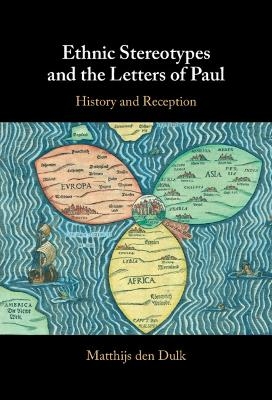
Ethnic Stereotypes and the Letters of Paul
History and Reception
Seiten
2026
Cambridge University Press (Verlag)
9781009718097 (ISBN)
Cambridge University Press (Verlag)
9781009718097 (ISBN)
- Noch nicht erschienen (ca. März 2027)
- Versandkostenfrei
- Auch auf Rechnung
- Artikel merken
Do Paul's letters draw on ethnic stereotypes? In this volume, Matthijs den Dulk offers a series of case studies that analyze different ways in which ethnic stereotypes were used or exerted influence on Pauline writings. This title is also available as Open Access on Cambridge Core.
Do Paul's letters draw on ethnic stereotypes? Did they influence how ethnic and racial outsiders were viewed in later eras? In this volume, Matthijs den Dulk offers a series of case studies that analyze different ways in which ethnic stereotypes were used or exerted influence on Pauline writings. Informed by recent empirical research on the impact of stereotypes, Den Dulk shows that paying attention to ancient stereotypes about Galatians, Corinthians, Scythians, Cretans and other groups sheds significant new light on the context, composition and content of Paul's letters. Den Dulk's exegetical argument integrates analyses of the history of interpretation, which demonstrate that Paul's letters were used to support modern conceptions of ethnic difference, including racist theories. This study thus raises important and timely questions about the content of Paul's letters as well as their influence on subsequent ideas about race and ethnicity. This title is also available as Open Access on Cambridge Core.
Do Paul's letters draw on ethnic stereotypes? Did they influence how ethnic and racial outsiders were viewed in later eras? In this volume, Matthijs den Dulk offers a series of case studies that analyze different ways in which ethnic stereotypes were used or exerted influence on Pauline writings. Informed by recent empirical research on the impact of stereotypes, Den Dulk shows that paying attention to ancient stereotypes about Galatians, Corinthians, Scythians, Cretans and other groups sheds significant new light on the context, composition and content of Paul's letters. Den Dulk's exegetical argument integrates analyses of the history of interpretation, which demonstrate that Paul's letters were used to support modern conceptions of ethnic difference, including racist theories. This study thus raises important and timely questions about the content of Paul's letters as well as their influence on subsequent ideas about race and ethnicity. This title is also available as Open Access on Cambridge Core.
Matthijs den Dulk is Associate Professor at Radboud University, a Research Fellow of the University of the Free State, and Academic Director of the Netherlands School for Advanced Studies in Theology and Religion. He has published widely on early Christian literature, including on ethnicity and race in Acts and Origen of Alexandria. His work in this area has been supported by a major grant from NWO and a Humboldt research fellowship.
1. Introduction; 2. Ethnic stereotypes: a cognitive approach; 3. Sinful gentiles; 4. Foolish Galatians; 5. Licentious Corinthians; 6. Barbaric Scythians; 7. Lying Cretans; 8. Conclusion.
| Erscheint lt. Verlag | 1.3.2027 |
|---|---|
| Zusatzinfo | Worked examples or Exercises |
| Verlagsort | Cambridge |
| Sprache | englisch |
| Gewicht | 500 g |
| Themenwelt | Religion / Theologie ► Christentum ► Bibelausgaben / Bibelkommentare |
| Religion / Theologie ► Christentum ► Kirchengeschichte | |
| Sozialwissenschaften ► Ethnologie | |
| Sozialwissenschaften ► Soziologie | |
| ISBN-13 | 9781009718097 / 9781009718097 |
| Zustand | Neuware |
| Informationen gemäß Produktsicherheitsverordnung (GPSR) | |
| Haben Sie eine Frage zum Produkt? |
Mehr entdecken
aus dem Bereich

aus dem Bereich
Buch | Softcover (2021)
De Gruyter (Verlag)
CHF 44,90


