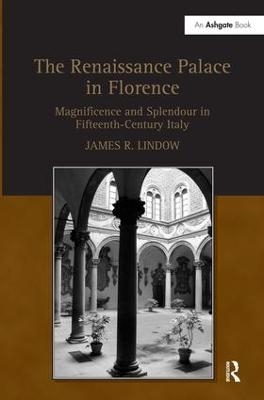
The Renaissance Palace in Florence
Routledge (Verlag)
978-0-7546-6092-7 (ISBN)
This book provides a reassessment of the theory of magnificence in light of the related social virtue of splendour. Author James Lindow highlights how magnificence, when applied to private palaces, extended beyond the exterior to include the interior as a series of splendid spaces where virtuous expenditure could and should be displayed. Examining the fifteenth-century Florentine palazzo from a new perspective, Lindow's groundbreaking study considers these buildings comprehensively as complete entities, from the exterior through to the interior. This book highlights the ways in which classical theory and Renaissance practice intersected in quattrocento Florence. Using unpublished inventories, private documents and surviving domestic objects, The Renaissance Palace in Florence offers a more nuanced understanding of the early modern urban palace.
James R. Lindow was the first Renaissance PhD from the Royal College of Art / Victoria & Albert Museum, and completed his MA in the History of Art and Architecture at the University of East Anglia. He has convened conferences and published articles on diverse aspects of the Renaissance, lectures widely in the UK and overseas, and is currently a fine art underwriter in the city of London.
Contents: Preface; Introduction; Debated concepts: magnificence and splendour; The classical and medieval precedents for magnificence; The magnificence debate in 15th-century Florence; The currency of the magnificence debates in 15th-century Florence. Magnificent architecture; The motivation to build: for God, for the city and for oneself; Exemplary magnificence: building anew in the antique style; The principle of decorum in the architectural treatises of Alberti and Filarete. Going beyond the palace façade; Connecting the interior and exterior; The accessibility of the palace and its spaces; Magnificent hospitality in the splendid interior. The splendid interior; Rooms and their functions; Furniture and display in the splendid interior; La camera bella: the room made beautiful through domestic display. Conclusion; Appendices; Gabriello di Messer Bartolomeo Panciatichi (1430); I Gismondo di Messer Agniolo della Stufa (1495); The 'camera bella' of Lorenzo di Giovanni Tornabuoni (1497) Bibliography; Index.
| Erscheint lt. Verlag | 14.6.2007 |
|---|---|
| Verlagsort | London |
| Sprache | englisch |
| Maße | 156 x 234 mm |
| Gewicht | 748 g |
| Themenwelt | Kunst / Musik / Theater ► Kunstgeschichte / Kunststile |
| Geschichte ► Allgemeine Geschichte ► Mittelalter | |
| Geisteswissenschaften ► Geschichte ► Regional- / Ländergeschichte | |
| Sozialwissenschaften ► Soziologie | |
| Technik ► Architektur | |
| ISBN-10 | 0-7546-6092-3 / 0754660923 |
| ISBN-13 | 978-0-7546-6092-7 / 9780754660927 |
| Zustand | Neuware |
| Informationen gemäß Produktsicherheitsverordnung (GPSR) | |
| Haben Sie eine Frage zum Produkt? |
aus dem Bereich