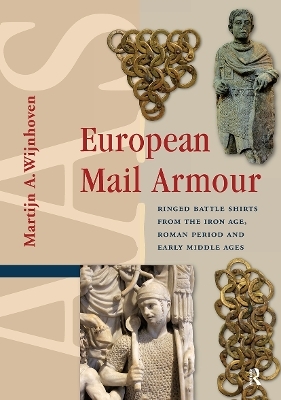
European Mail Armour
Routledge (Verlag)
978-1-041-17898-9 (ISBN)
Martijn A. Wijnhoven holds a PhD in archaeology from Vrije Universiteit Amsterdam. He specializes in ancient military studies and has published extensively on the analysis and reconstruction of ancient armour spanning from the Iron Age to the Middle Ages. His research combines methods from history, anthropology, and archaeology, rendering a holistic approach to material studies.
1 Introduction, 1.1 Previous research, 1.2 Research question and aims, 1.3 Chaîne opératoire, 1.4 A multi-dimensional approach to material studies, 1.5 Scope, 1.6 Mail or chain-mail?, 2 The Origins of Mail Armour, 2.1 Suggested precursors, 2.2 Contested origins, 2.3 Earliest evidence, 2.4 Tracing the earliest contexts, 2.5 Further dispersal, 2.6 When, where and by whom, 3 Distribution and Archaeological Contexts, 3.1 Battlefields and accidental loss, 3.2 Iron Age mail, 3.3 The Roman Republic, 3.4 The Roman Principate, 3.5 Hybrid feathered armour, 3.6 Hybrid armour beyond the roman empire, 3.7 Late Antiquity, 3.8 The Barbaricum and beyond, 3.9 Mail for men, women and children, 3.10 Social access to mail outside the Roman Empire, 3.11 Centuries of archaeological evidence, 4 The Iconography of Early Mail Armour, 4.1 the iconographic evidence, 4.2 the 3rd century bc to the end of the roman republic, 4.3 early empire until the end of the 1st century ad, 4.4 the 2nd century ad, 4.5 the 3rd to 5th century ad, 4.6 development of mail armour design in iconography, 5 The Naming of Mail Armour, 5.1 Classical literature on armour, 5.2 Lorica hamata, 5.3 Other designations, 5.4 Simply lorica, 6 Decoration in Mail Garments, 6.1 Gold on silver, 6.2 Copper alloy elements, 6.3 Decorative origin, 6.4 Development and distribution, 6.5 Decorative trimmings, 6.6 Inserted patterns, 6.7 Contrasting rivets, 6.8 Decoration of hybrid armour, 6.9 Decoration of 'miniature mail', 6.10 Decorative hems, 6.11 Colourful Roman army, 7 Padded Garments, 7.1 the advantages and disadvantages of flexible armour, 7.2 himation, thoracomachus, subarmalis and cimmerian tunic, 7.3 textile and leather remains, 7.4 medieval analogy, gladiators and pteruges, 7.5 concealed by metal armour, 8 The Craft of Making Mail Rings, 8.1 The mail maker's process, 8.2 The manufacture of metal wire, 8.3 The manufacture of solid rings, 8.4 Unravelling the use of butted rings, 8.5 Loose rings, 8.6 The mail making workshop, 9 Weaving Patterns, 9.1 Four-in-one pattern, 9.2 Six-in-one pattern from tiefenau, 9.3 Pinched loop-in-loop pattern from Bertoldsheim, 9.4 Four-in-one pattern in hybrid armour, 9.5 Favourable characteristics, 10 The Construction of Mail Garments, 10.1 Current knowledge based on late mail from Europe, 10.2 Presence of constructional techniques in early mail, 10.3 Construction of early mail by working in the flat, 10.4 Construction of textile clothing and mail, 10.5 Construction of the coat with shoulder guards, 10.6 Mail with shoulder guards and textile clothing, 10.7 The development of mail armour through the ages, 10.8 Construction in cultural context, 11 Ring Characteristics, 11.1 The relevance of the seemingly irrelevant, 11.2 Ring size, 11.3 Direction of the overlap and ring types, 11.4 Cross-section of riveted rings, 11.5 Rivet characteristics, 11.6 Shape of the overlap in riveted rings, 11.7 Cross-section of solid rings, 11.8 Ring characteristics typology, 12 Final Considerations, 12.1 Insights, 12.2 Prospects, 12.3 Methodological potential, Bibliography, Database, Appendix 1. Catalogue of mail armour, Appendix 2. Catalogue of hybrid armour, Appendix 3. Catalogue of isolated finds of fasteners and fixtures, Appendix 4. Finds excluded from the database.
| Erscheinungsdatum | 03.12.2025 |
|---|---|
| Reihe/Serie | Amsterdam Archaeological Studies |
| Verlagsort | London |
| Sprache | englisch |
| Maße | 210 x 297 mm |
| Gewicht | 960 g |
| Themenwelt | Geisteswissenschaften ► Archäologie |
| Geschichte ► Allgemeine Geschichte ► Altertum / Antike | |
| Sozialwissenschaften ► Politik / Verwaltung | |
| Sozialwissenschaften ► Soziologie ► Spezielle Soziologien | |
| ISBN-10 | 1-041-17898-0 / 1041178980 |
| ISBN-13 | 978-1-041-17898-9 / 9781041178989 |
| Zustand | Neuware |
| Informationen gemäß Produktsicherheitsverordnung (GPSR) | |
| Haben Sie eine Frage zum Produkt? |
aus dem Bereich