


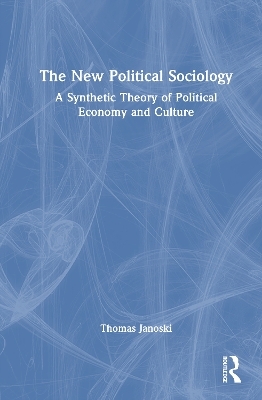
The New Political Sociology
Routledge (Verlag)
978-1-041-09617-7 (ISBN)
- Noch nicht erschienen (ca. Juli 2026)
- Versandkostenfrei
- Auch auf Rechnung
- Artikel merken
The New Political Sociology rethinks the ways societies are built and function in two parts. After delineating a theory of the bargaining process, the first part undertakes a reconstruction of the state, the inordinate influence of business, the weakened position of labor, the variable role of social movements, and the active role of the media. The second part delineates how exploitation and humiliation lead to social movements that reverse values and create new social forces, and the author uses empire in global theory to delineate how globalization affects politics within the now multi-nation-state. Both parts involve structures of power through class (business and labor) and status (race, gender, and religion), and each section discusses how new alternatives emerge for each bargaining group.
Connecting sociology and sociological theory to issues of social and democratic movements, this book shows how political economy and culture need each other as the opposite sides of the same coin. The New Political Sociology redirects theoretical approaches of researchers in political sociology and provides teachers with a classroom resource on theories and practices in political sociology, cultural sociology, social movements, and the media.
Thomas Janoski is Professor Emeritus of Sociology at the University of Kentucky after having served for 30 years. He has also taught at the University of California-Berkeley and Duke University. He was the lead editor of The Handbook of Political Sociology (2005) and The New Handbook of Political Sociology (2020). He has multiple books, including The Political Economy of Unemployment (1990), The Ironies of Citizenship (2010), Citizenship and Civil Society (1998), and Rethinking Symbolic Interactionism (2025). While following Max Weber on class, status, and power, he focuses on an optimistic approach, stressing citizen participation and collegiality.
1. Introduction: A Synthetic Approach to Political Sociology, Part I. Bargaining and Cultural Theory, 2. The Theory of Bargaining Alternatives in Political and Cultural Context, Part II. The Actors in Political Bargaining, 3. The State. Retheorizing the Arena of Bargaining over Alternatives, 4. Class-based Interest Groups and Social Movements, 5. Status-based Interest Groups and Social Movements in Bargaining, 6. Political Parties. Direct Bargainers but in Decline, 7. The Media as Full-Fledged Bargainers, Part III. Disruptive Politics, 8. Disruptions in National Politics. Exploitation, Humiliation and Ressentiment, 9. The External Disruptions Impacting Bargaining. Empire, War, and Globalization, 10. Conclusion: Synthesizing a Political Economy and Cultural Theory of Political Sociology, Epilogue
| Erscheint lt. Verlag | 13.7.2026 |
|---|---|
| Zusatzinfo | 19 Tables, black and white; 27 Line drawings, black and white; 27 Illustrations, black and white |
| Verlagsort | London |
| Sprache | englisch |
| Maße | 156 x 234 mm |
| Themenwelt | Sozialwissenschaften ► Soziologie ► Allgemeines / Lexika |
| Sozialwissenschaften ► Soziologie ► Makrosoziologie | |
| ISBN-10 | 1-041-09617-8 / 1041096178 |
| ISBN-13 | 978-1-041-09617-7 / 9781041096177 |
| Zustand | Neuware |
| Informationen gemäß Produktsicherheitsverordnung (GPSR) | |
| Haben Sie eine Frage zum Produkt? |
aus dem Bereich


