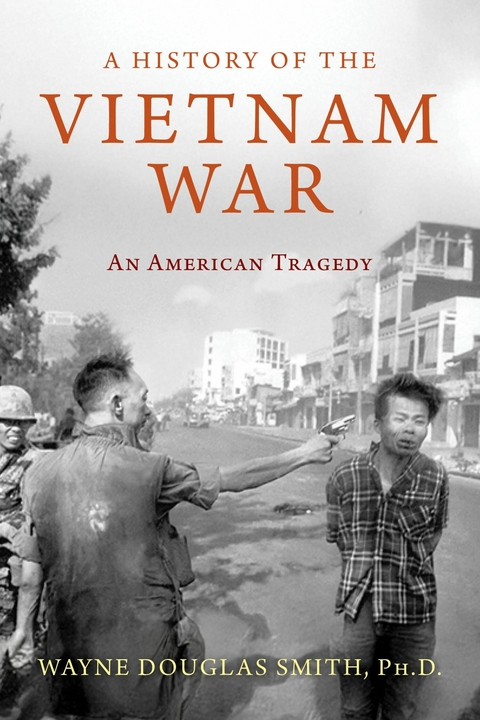
History of the Vietnam War: An American Tragedy (eBook)
145 Seiten
Bookbaby (Verlag)
979-8-3178-1575-2 (ISBN)
Wayne Douglas Smith graduated from the College of William and Mary, where he earned an Ed.S. in School Psychology. Later, he received a Ph.D. in neuropsychology from Bernelli International University, and he earned an M.D. from Blue Marble University Medical School. Wayne lives in Virginia Beach with his wife, Kale.
To wage the war in Vietnam, Johnson and Nixon turned the White House into a nest of criminal conspiracies. The war was the precondition for Johnson's not running for reelection and Nixon's ignominious resignation. The war was a good fit for their tyrannical tendencies, which were eventually rolled back because they overreached the limits of their power. The antiwar insurgency that brought America to its senses was so sweeping a challenge to authority as to reverberate for decades. A war that had been so popular at first, however undeclared and thinly grounded in law, was brought to an end with an impressive boost from popular action. There is a lesson here about the life of a democracy. Democracy is not a synonym for a periodic majority vote. A living democracy depends not just on the rules for choosing a leader, but it requires an ongoing process. It depends on what the populace does. It requires that minorities have a chance to become majorities by resorting to popular action, and it requires respect for the Constitution.
Chapter 2:
Vietnam’s History
The narrow region stretching a thousand miles from the Chinese southern border to the Gulf of Thailand was not united under a single ruler until the beginning of the 19th century. But the roots of a Vietnamese civilization stretched back much farther. The Vietnamese were influenced by Chinese culture. Their education and civil service systems followed strict Confucian lines, and court business was conducted in Chinese.
In 1858, France decided to invade Vietnam, and a year later forced the emperor to cede three provinces to them. Over the four decades that followed, French forces steadily extended their power until declaring in 1900 that pacification of Indochina was complete. France divided Vietnam into three parts: the French colony of Cochinchina in the south; Annam, the most mountainous part of the country; and Tonkin, the densely populated Red River Delta. These protectorates were ruled as part of the Indochinese Union by a French governor-general from his palace in Hanoi.
The French claimed they had begun to amass their Indochinese empire to bring cultural benefits to an unenlightened people. But their motives were less lofty. French Indochina was meant to provide a path for penetrating the Chinese market and creating a buffer against the British and the Dutch, who had already carved empires of their own from India, Burma, Malaya, and Indonesia. It also provided the prospect of fortunes to be made through exploitation of the land and its people. To that end, the French would transform much of the Vietnamese landscape.
The French Take Over
In southern Vietnam, the French carved out a complex network of canals that turned tens of thousands of acres of marshy wilderness into some of the most productive rice-growing country on earth. They developed modern ports at Haiphong and Danang, so that Vietnamese raw material could more efficiently be shipped abroad. They also built a railroad to move French products north from Saigon all the way to China.
One out of three of the 100,000 Vietnamese conscripted to lay its tracks died along the way, and thousands more were ravaged by malaria. They worked twelve hours a day, seven days a week, and those who tried to get away were beaten before forced back to work. In 1910, a government survey found that just three French officials in the whole country understood Vietnamese well enough to make policy decisions on their own. The French depended instead on a network of French-speaking Vietnamese willing to carry out their wishes, and all too eager to enrich themselves in the process.
For the peasants, who made up over 90 percent of Vietnam’s population, colonial rule provided few benefits. Subject to French monopolies on salt and alcohol, burdened by ever-climbing taxes, and dragooned to labor without pay on public works, the peasants were helpless as the lands they once owned slipped into the hands of a few collaborators. Resentment festered against the French.
The Early Fight
Early in the twentieth century, a group of mandarins led a guerrilla war aimed at restoring home rule in Vietnam. But after ten years, the French defeated them. Then, a second generation of Vietnamese land-gentry fostered nationalists movements of their own. They insisted that France live up to the ideals it professed to cherish., but the French considered all opposition suspect. Hundreds of nationalists were imprisoned and some were executed.
Then came the communists. They set out from the first to unite Vietnam’s factory workers with the peasant majority. Three communist parties competed with one another, until Ho Chi Minh brought their leaders together in Hong Kong in 1930 and united them under a single banner. Still, the French proved too strong for them, crushing peasant rebellions in Tonkin, Annam, and in Cochinchina in the 1930s. The French bombed villages suspected of harboring rebels, executed leaders, and shot unarmed civilians.
The Japanese Takeover
When France surrendered to Nazi Germany after just six weeks of fighting in June 1940, imperial Japan allied itself with Germany. Then, Japan moved against the British, Dutch, and French colonies throughout Asia. Within a year, Japanese soldiers would occupy all of Vietnam. Ho Chi Minh recognized that the Japanese were alien invaders, interested only in exploiting his country for its natural resources. Ho identified with the Allies, sure that they would defeat the Japanese and reward Vietnam after the war with independence.
In February 1941, Ho Chi Minh slipped across the Chinese border into Tonkin. For the first time in three decades, he was back home in Vietnam. He gathered the members of the central committee of the Indochinese Communist Party at Pac Bo in May, and he persuaded them to temporarily join a broad patriotic front called the Viet Minh. The communists would be in command, but nationalist of every kind would be welcome. Freedom from France and defeat of the Japanese would take priority. Objectives like land redistribution could wait.
To build a guerrilla army, Ho called upon Vo Nguyen Giap, an early convert to communism whose hatred of the French had only deepened when his wife had died after being tortured in a French prison. Giapin had developed a theory of revolutionary warfare based on his reading of the Chinese general Sun Tzu and of Lawrence of Arabia. In fighting the French and the Japanese, he said his armies would be “everywhere and nowhere.”
By early 1945, the Japanese naval fleet had been destroyed by the Americans. Fearing that Indochina might be next and that the French would turn against them, the Japanese staged a coup in Vietnam in March. They killed two thousand French soldiers and interned twelve thousand more. Then, they declared Vietnam independent and put a puppet emperor, Bao Dai, on the throne.
The Americans never invaded Indochina. They focused instead on preparing to assault the Japanese home islands. But American agents working in southern China sought allies behind enemy lines to gather intelligence. Ho Chi Minh eagerly joined forces with them, hoping that if the Viet Minh came to America’s aid, then America would support Vietnam’s bid for independence once the fighting ended. Ho began to call his followers the “Viet-American Army.”
In August 1945, Japan was ready to surrender. Ho immediately issued an appeal to the Vietnamese people to seize control of their country before Allied troops arrived in Indochina. The Viet Minh took over Hanoi, forced Bao Dai to abdicate, and established a tenuous hold on Saigon. The Vietnamese would remember this insurrection as the August Revolution.
The Return of the French
Ho Chi Minh’s hope that the United States would support Vietnamese independence was understandable. Before the war had ended, President Franklin Roosevelt had promised a postwar world that would respect the right of all peoples to choose the form of government under which they lived. “Indochina should not be given back to the French Empire,” he told his commanders. He said, “The French have been there for nearly a hundred years and have done nothing to improve the lot of the people.” But Roosevelt had died in April 1945, and his plans had died with him.
In the summer of 1945, the new president of France’s pro-visional government, General Charles de Gaulle, made it clear that restoration of the French empire was not negotiable. He said that if the the United States insisted on independence for his colonies, including Vietnam, France would look to the Russians for support. So the United States agreed make no objections to the restoration of French rule in Vietnam.
In September 1945, a 150,000-man Nationalist Chinese occupation army marched into Hanoi. On their way, they evicted the Viet Minh committees from power and replaced them with anticommunists allied with Chiang Kai-shek. Ho Chi Minh’s illusion of an easy path to independence had lasted just one week.
Things had gone badly in Cochinchina too. Saigon was in chaos, as the French tried to reclaim the southern region of Vietnam.
In early 1946, the Chinese Nationalist and the French reached an agreement. The French relinquished prewar trading rights in China, and the Chinese agreed to leave Vietnam. France was already engaged in retaking the South, and was now poised to retake the North as well. Ho Chi Minh visited Paris and was told that Vietnam would not be allowed to be independent nor reunited.
Ho realized that the Vietnamese people would have to fight to gain independence. He predicted that it would be a war between the French elephant and the Vietnamese tiger. Ho declared, “He lurks in the jungle by day and emerges by night. He will leap upon the back of the elephant, tearing huge chunks from his hide, and then he will leap back into the dark jungle. And slowly the elephant will bleed to death. That will be the war of Indochina.”
The tactics set forth by the Chinese communist revolutionary Mao Zedong were initially the guide for Ho Chi Minh and the leader of his guerrilla army, General Giap. They mined roads, blew up bridges, ambushed French patrols, and attacked their bases at night; then they disappeared into the darkness. Ho said, “The enemy advances, we retreat; the enemy halts, we harass; the enemy tires, we attack.”
As French casualties began to mount, they looked to the United States for help. But American Secretary of State John Marshall had little sympathy for the way the French were handling Vietnam. He said he thought France had an “outmoded colonial outlook” and needed to work more closely with the people. The year was 1946.
But then, events overtook the United...
| Erscheint lt. Verlag | 1.10.2025 |
|---|---|
| Sprache | englisch |
| Themenwelt | Sozialwissenschaften ► Politik / Verwaltung |
| ISBN-13 | 979-8-3178-1575-2 / 9798317815752 |
| Informationen gemäß Produktsicherheitsverordnung (GPSR) | |
| Haben Sie eine Frage zum Produkt? |
 EPUB (Ohne DRM)
Größe: 2,8 MB
Digital Rights Management: ohne DRM
Dieses eBook enthält kein DRM oder Kopierschutz. Eine Weitergabe an Dritte ist jedoch rechtlich nicht zulässig, weil Sie beim Kauf nur die Rechte an der persönlichen Nutzung erwerben.
Dateiformat: EPUB (Electronic Publication)
EPUB ist ein offener Standard für eBooks und eignet sich besonders zur Darstellung von Belletristik und Sachbüchern. Der Fließtext wird dynamisch an die Display- und Schriftgröße angepasst. Auch für mobile Lesegeräte ist EPUB daher gut geeignet.
Systemvoraussetzungen:
PC/Mac: Mit einem PC oder Mac können Sie dieses eBook lesen. Sie benötigen dafür die kostenlose Software Adobe Digital Editions.
eReader: Dieses eBook kann mit (fast) allen eBook-Readern gelesen werden. Mit dem amazon-Kindle ist es aber nicht kompatibel.
Smartphone/Tablet: Egal ob Apple oder Android, dieses eBook können Sie lesen. Sie benötigen dafür eine kostenlose App.
Geräteliste und zusätzliche Hinweise
Buying eBooks from abroad
For tax law reasons we can sell eBooks just within Germany and Switzerland. Regrettably we cannot fulfill eBook-orders from other countries.
aus dem Bereich