


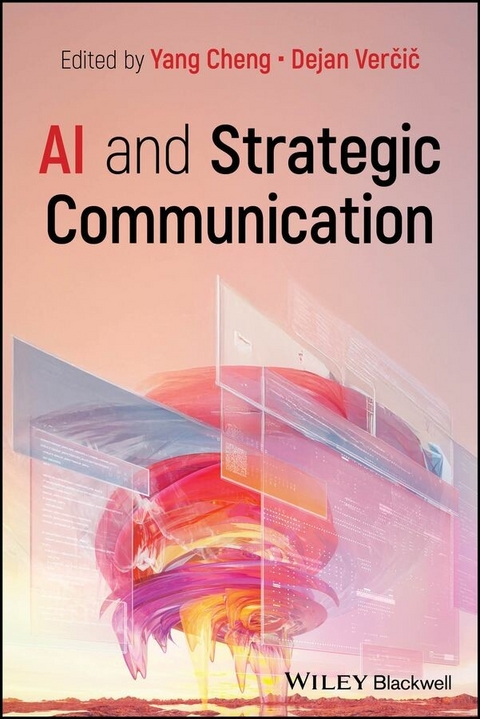
AI and Strategic Communication (eBook)
488 Seiten
Wiley-Blackwell (Verlag)
978-1-394-27541-0 (ISBN)
Provides an essential guide to AI's impact on PR practices, ethics, and societal implications
As AI technologies continue to evolve, communication professionals must understand their profound effects on media relations, activism, and digital engagement. AI and Strategic Communication: Navigating the Future offers a comprehensive exploration of AI's role in reshaping public relations, bringing together contributions from leading scholars and practitioners from 9 countries across 5 continents, with representation from Europe, North America, Oceania, and Asia, this comprehensive volume addresses the ethical implications, challenges, and opportunities AI presents for individuals, organizations, and society.
Covering topics such as AI-driven crisis communication, algorithmic bias, and human-robot interactions, the authors provide both theoretical frameworks and actionable strategies to help readers navigate the AI-driven landscape. The book is structured into three distinct sections, each addressing AI's impact at different levels of communication, including individual, professional and organizational, and society levels. The opening section explores personal experiences with AI, followed by an examination of AI's transformative role in public relations and strategic communication, including crisis management, employee communication, and AI-augmented content creation. The concluding section delves into the broader implications of AI on democracy, media ethics, and cultural biases.
Offering expert guidance for integrating AI tools responsibly while addressing privacy concerns and ethical dilemmas, AI and Strategic Communication:
- Presents cutting-edge research from experts in AI, PR, and media ethics
- Discusses emerging AI-driven technologies and their implications for PR professionals
- Discusses AI's impact on democracy, misinformation, and truth in public discourse
- Includes a forward-looking analysis of AI's evolving role in communication
- Offers recommendations for future research and professional adaptation
- Features research-backed insights, practical strategies, and real-world case studies
With a multidisciplinary approach to communication in the digital age, AI and Strategic Communication: Navigating the Future is essential reading for students, educators, and industry professionals looking to stay ahead in the evolving field of strategic communication. It is an ideal textbook for undergraduate and postgraduate courses on digital communication and social media, communication ethics and technology, advanced public relations, and strategic communication.
YANG CHENG is an Associate Professor at North Carolina State University One of Stanford University's top 2% most-cited scholars, she specializes in AI, crisis communication, and relationship management. Her work has earned numerous awards, and she has lectured at top institutions worldwide.
DEJAN VER?I? is Professor and Head of the Centre for Marketing and Public Relations at the University of Ljubljana. A Fulbright scholar and PhD graduate of the London School of Economics, he specializes in globalization, internal communication, and strategic PR.
Decoding Complexity: The Role of AI in Modern Public Relations
Marko Grobelnik
Department for Artificial Intelligence, Co‐founder of UNESCO International Research Center on AI (IRCAI), SI, Jozef Stefan Institute, Ljubljana, Slovenia
Setting the Stage: An Analogy
Google Maps and AI‐enhanced public relations are modern navigational systems for different terrains. In Google Maps, a user inputs a destination, and the system analyzes countless routes, traffic conditions, and obstacles to recommend the best path. Similarly, in AI‐driven public relations, the “destination” is a desired public perception or campaign objective. The AI acts as the navigator, analyzing audience sentiment, media trends, and communication channels, then suggesting strategies—be it press releases, social media posts, or influencer collaborations. Just as Google Maps adapts to real‐time traffic updates, AI in PR dynamically adjusts strategies based on live feedback, ensuring the journey from A to B is as effective and efficient as possible.
Introduction
In this paper, we present the relationship between two interdisciplinary fields—artificial intelligence (AI) and public relations (PR)—both of which intersect science, technology, and practice. While AI is a relatively young discipline, emerging in the early 1950s alongside the advent of modern computing, PR has roots that extend far deeper, arguably as old as organized human society itself. Despite their differences in age and focus, the two fields complement each other in various ways, with a significant point of intersection being their shared emphasis on managing social complexity.
AI provides advanced tools and methodologies to address complex tasks, many of which were traditionally within the exclusive domain of human cognition and labor. Throughout AI's short but dynamic history, researchers and engineers have continuously pushed the boundaries of task complexity. Although early ambitions aimed at achieving human‐level intelligence were largely unmet during AI's formative years, significant progress was realized after 2015 with the rapid advancements in “Generative AI” (GenAI, 2024), a transformative subfield of AI. The pivotal moment for public awareness occurred in November 2022, marked by the release of the groundbreaking chatbot system, “ChatGPT” (OpenAI, 2024). This system demonstrated unprecedented proficiency in text understanding and interaction, catalyzing a surge in the development of GenAI technologies across domains such as text, speech, image, and video processing. By 2025, the pace of GenAI innovation remains relentless, continuously advancing the complexity of tasks machines can perform.
The underlying reasons for this exponential progress post‐2020 are not entirely understood, but they likely reflect the convergence of three critical factors: (1) the unprecedented scale of computational power, (2) the availability of vast quantities of high‐quality data, and (3) algorithmic breakthroughs in machine learning, particularly in representation learning. Together, these factors have enabled AI systems to achieve and surpass human‐level performance in several domains, redefining the boundaries of what is computationally possible.
The development of PR has been deeply intertwined with advances in communication technologies such as the printing press, radio, television, and the internet. Each new medium introduced unique capabilities and necessitated the acquisition of new skills, offering practitioners enhanced tools to amplify their messages and achieve strategic objectives. However, these technologies served solely as aids, with the management and execution of PR strategies remaining firmly within human control.
The advent of AI marks a transformative shift in the field. For the first time in history, PR tasks can be partially or fully outsourced to machines. AI systems, equipped with advanced algorithms and infrastructure, can uncover previously unknown communication patterns, manage unprecedented levels of complexity, process vast quantities of information at high speed, and operate at significantly reduced costs. Moreover, AI‐driven systems can act autonomously, further extending the capabilities of PR by executing strategies and adapting dynamically to achieve desired outcomes. This evolution redefines the role of technology in PR, transforming it from a supporting tool to an active participant in shaping communication strategies.
In the following sections, we will present a detailed analysis of the intersection between AI and PR. We begin by examining how the definition of AI aligns with PR processes, offering a structured perspective on the integration of AI system components into PR workflows. This includes an analysis of the roles played by human intervention and AI automation, along with the ethical considerations that may arise from their interaction. Subsequently, we will explore currently relevant real‐world applications and use cases of AI technologies in PR, emphasizing current capabilities and practical implementations. Finally, we will project potential future scenarios, both realistic and speculative, to illustrate how AI may further shape the field of PR. These scenarios will address emerging opportunities, associated risks, and strategies to prevent manipulation and misuse, providing a likely perspective on the evolution of PR in light of AI advancements.
PR through the Lens of AI Definition
In this section, we will systematically decompose the typical processes occurring within the fields of AI and PR into a defined set of characteristic components. We will then present a structured analysis to illustrate the key points of operational interaction between these two fields.
Two important differences between both fields require attention. The first difference lies in the scope of their techniques and approaches. AI is a generic, domain‐agnostic technology, capable of application across diverse fields, whereas PR is domain specific, almost exclusively centered on social processes and communication between social entities. The second key distinction is in the observability and measurability of their respective processes. AI systems typically require nearly complete observability and measurability to function effectively, whereas PR tasks often deal with variables that are not easily observable or quantifiable.
It is important to note, however, that advancements in AI (particularly in GenAI) and the increasing availability of data have significantly enhanced the observability and measurability of social processes, leading to significantly greater overlap between the two fields.
AI System Definition
Defining a field as dynamic and expansive as AI, with its ongoing evolution, poses significant challenges. Nonetheless, recent developments in AI regulation at various levels—spanning international organizations, individual nations, and private companies—have necessitated a common, actionable definition to underpin legal frameworks and associated processes. The first politically agreed definition of an “AI System” was established by the OECD in 2019 and subsequently updated in 2023 (OECD, 2023). This definition achieved an initial consensus among over 40 countries (OECD member states) and was later adopted by key entities including the Council of Europe, the EU (to support the EU AI Act) (European Commission, 2024), the US National Institute of Standards and Technology (NIST), the G7, the G20, and numerous national governments. Notably, this effort focused on defining “AI System” as a tangible and actionable concept, rather than attempting to comprehensively define the broader field of AI.
The OECD definition of an “AI System” comprises three parts (Grobelnik et al., 2024): a concise two‐sentence narrative, a corresponding “Explanatory Memorandum” providing detailed context, and a graphical illustration to visually support and enhance understanding. The two‐sentence narrative outlines the essential components and properties of an “AI System,” emphasizing their integration within a feedback loop:
“An AI system is a machine‐based system that, for explicit or implicit objectives, infers, from the input it receives, how to generate outputs such as predictions, content, recommendations, or decisions that can influence physical or virtual environments. Different AI systems vary in their levels of autonomy and adaptiveness after deployment.”
The graphical depiction in Figure 1 illustrates a typical architecture of an “AI System,” comprising components aligned with the narrative definition provided above. These components are interconnected in various configurations to represent the standard flows of information throughout the system, encompassing multiple modes of use, such as pre‐deployment training or post‐deployment operation. The caption of Figure 1 provides detailed descriptions of the key elements and their specific roles within the overall architecture, offering better clarity on their interdependencies and functions.
Figure 1: The graphical depiction of an “AI System” illustrates its interaction with an observed and influenced “Environment.” On the left side of the image, the “AI System”...
| Erscheint lt. Verlag | 26.9.2025 |
|---|---|
| Sprache | englisch |
| Themenwelt | Sozialwissenschaften ► Kommunikation / Medien |
| Sozialwissenschaften ► Politik / Verwaltung | |
| Schlagworte | AI activism • AI corporate communication • AI crisis communication • AI democracy • AI governance • AI media ethics • AI media relations • AI PR strategies • AI public discourse • AI public relations • AI strategic communication • PR technology |
| ISBN-10 | 1-394-27541-2 / 1394275412 |
| ISBN-13 | 978-1-394-27541-0 / 9781394275410 |
| Informationen gemäß Produktsicherheitsverordnung (GPSR) | |
| Haben Sie eine Frage zum Produkt? |
 EPUB (Adobe DRM)
Kopierschutz: Adobe-DRM
Adobe-DRM ist ein Kopierschutz, der das eBook vor Mißbrauch schützen soll. Dabei wird das eBook bereits beim Download auf Ihre persönliche Adobe-ID autorisiert. Lesen können Sie das eBook dann nur auf den Geräten, welche ebenfalls auf Ihre Adobe-ID registriert sind.
Details zum Adobe-DRM
Dateiformat: EPUB (Electronic Publication)
EPUB ist ein offener Standard für eBooks und eignet sich besonders zur Darstellung von Belletristik und Sachbüchern. Der Fließtext wird dynamisch an die Display- und Schriftgröße angepasst. Auch für mobile Lesegeräte ist EPUB daher gut geeignet.
Systemvoraussetzungen:
PC/Mac: Mit einem PC oder Mac können Sie dieses eBook lesen. Sie benötigen eine
eReader: Dieses eBook kann mit (fast) allen eBook-Readern gelesen werden. Mit dem amazon-Kindle ist es aber nicht kompatibel.
Smartphone/Tablet: Egal ob Apple oder Android, dieses eBook können Sie lesen. Sie benötigen eine
Geräteliste und zusätzliche Hinweise
Buying eBooks from abroad
For tax law reasons we can sell eBooks just within Germany and Switzerland. Regrettably we cannot fulfill eBook-orders from other countries.
aus dem Bereich


